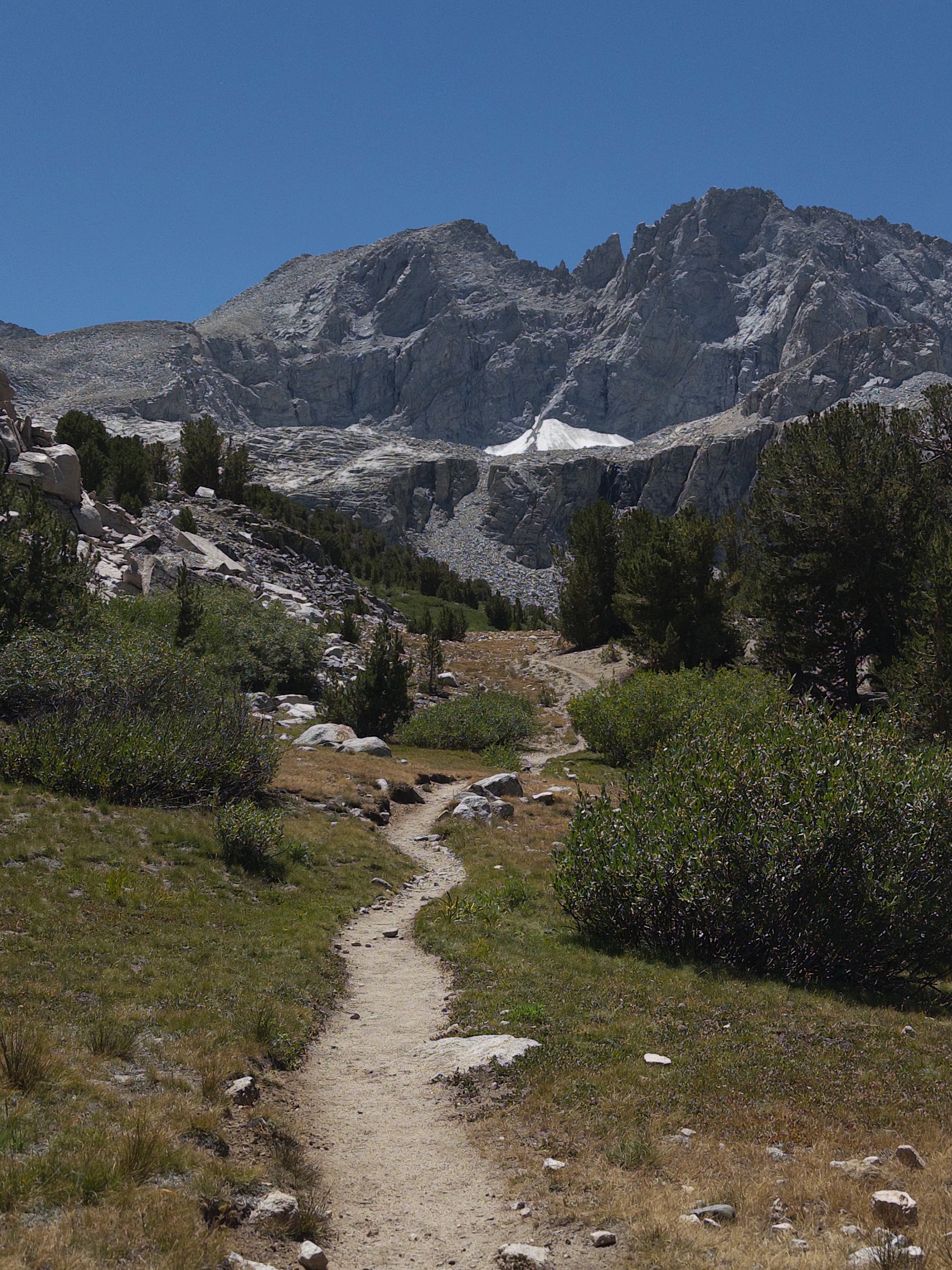
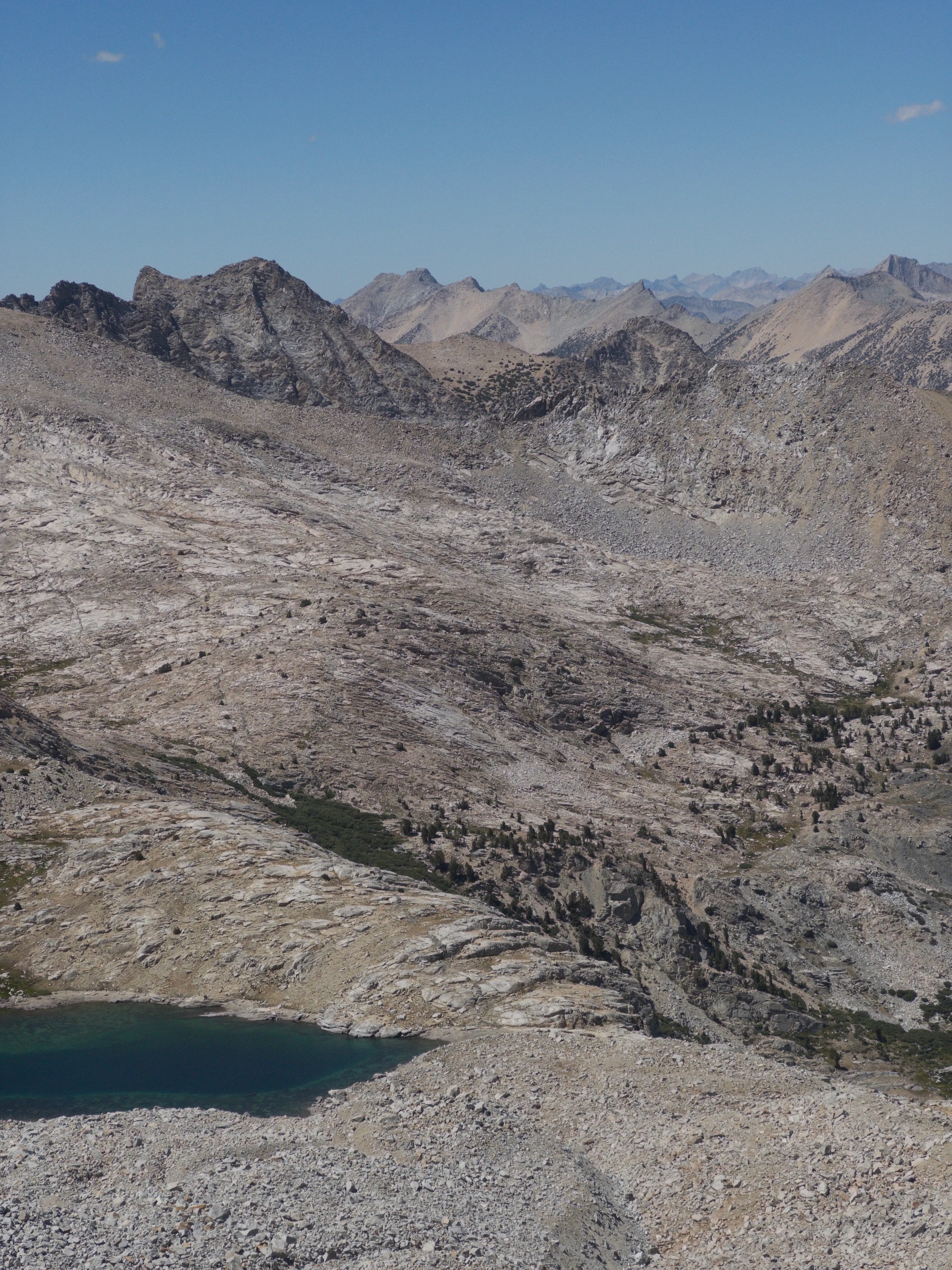
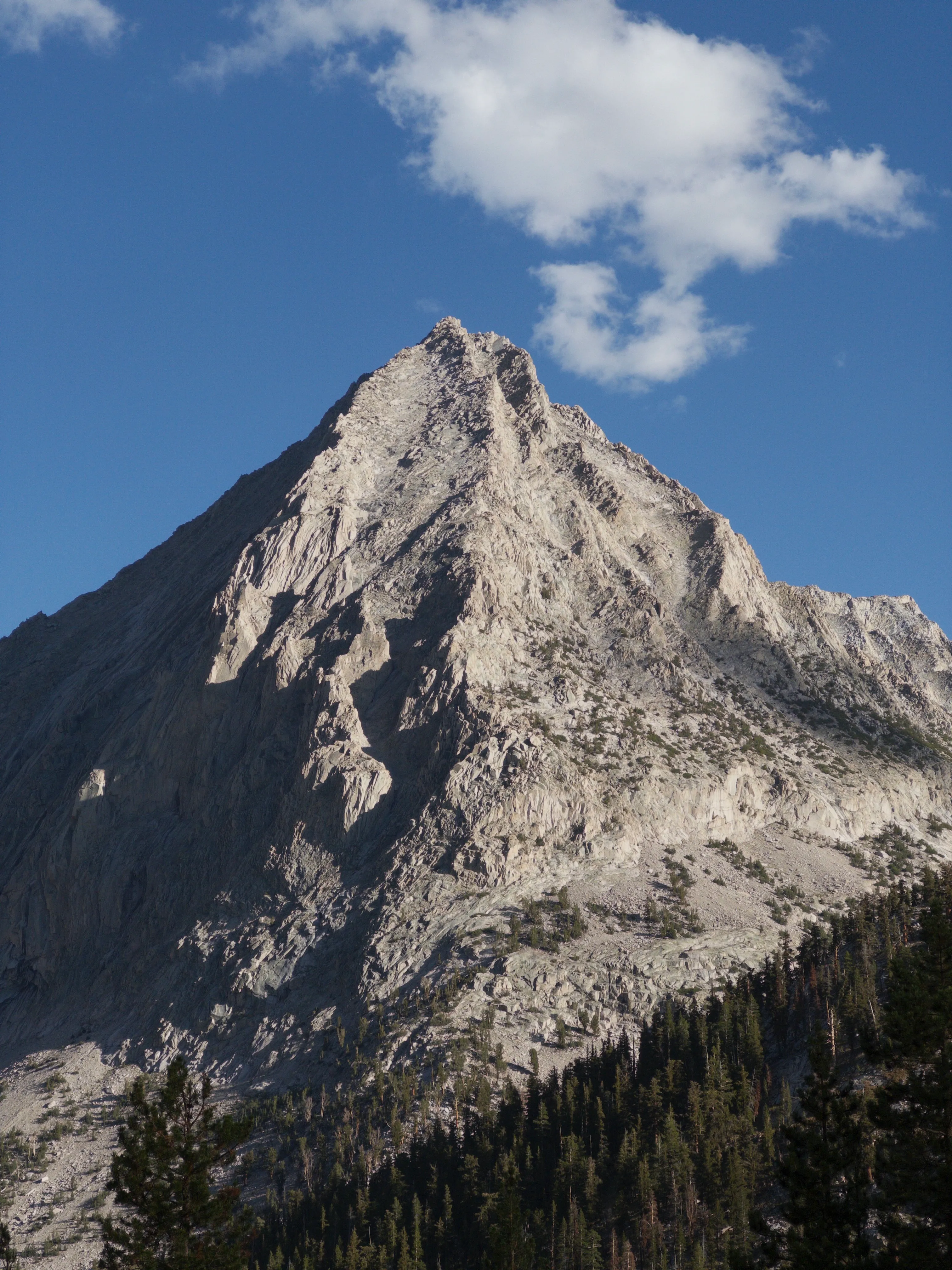
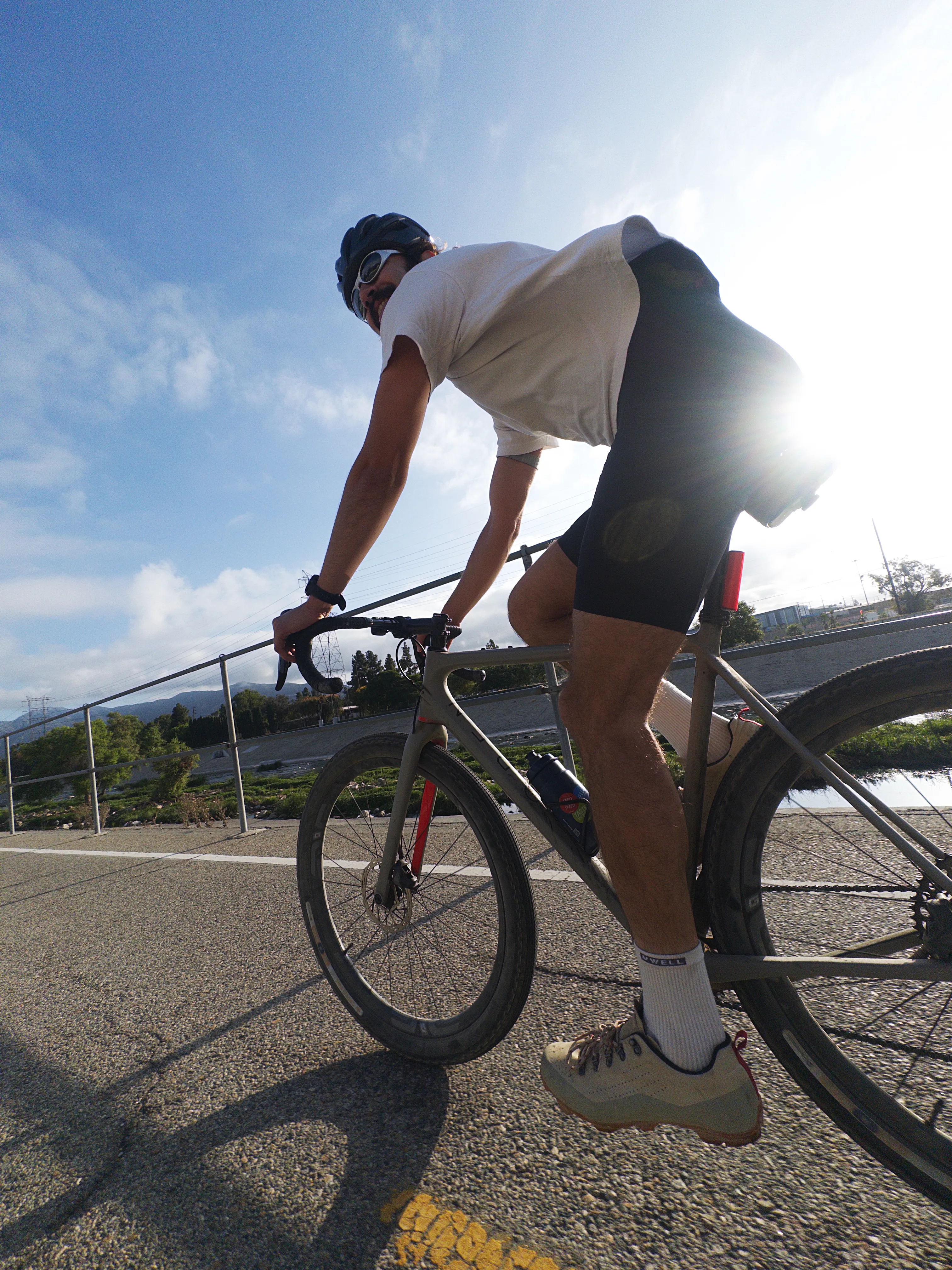
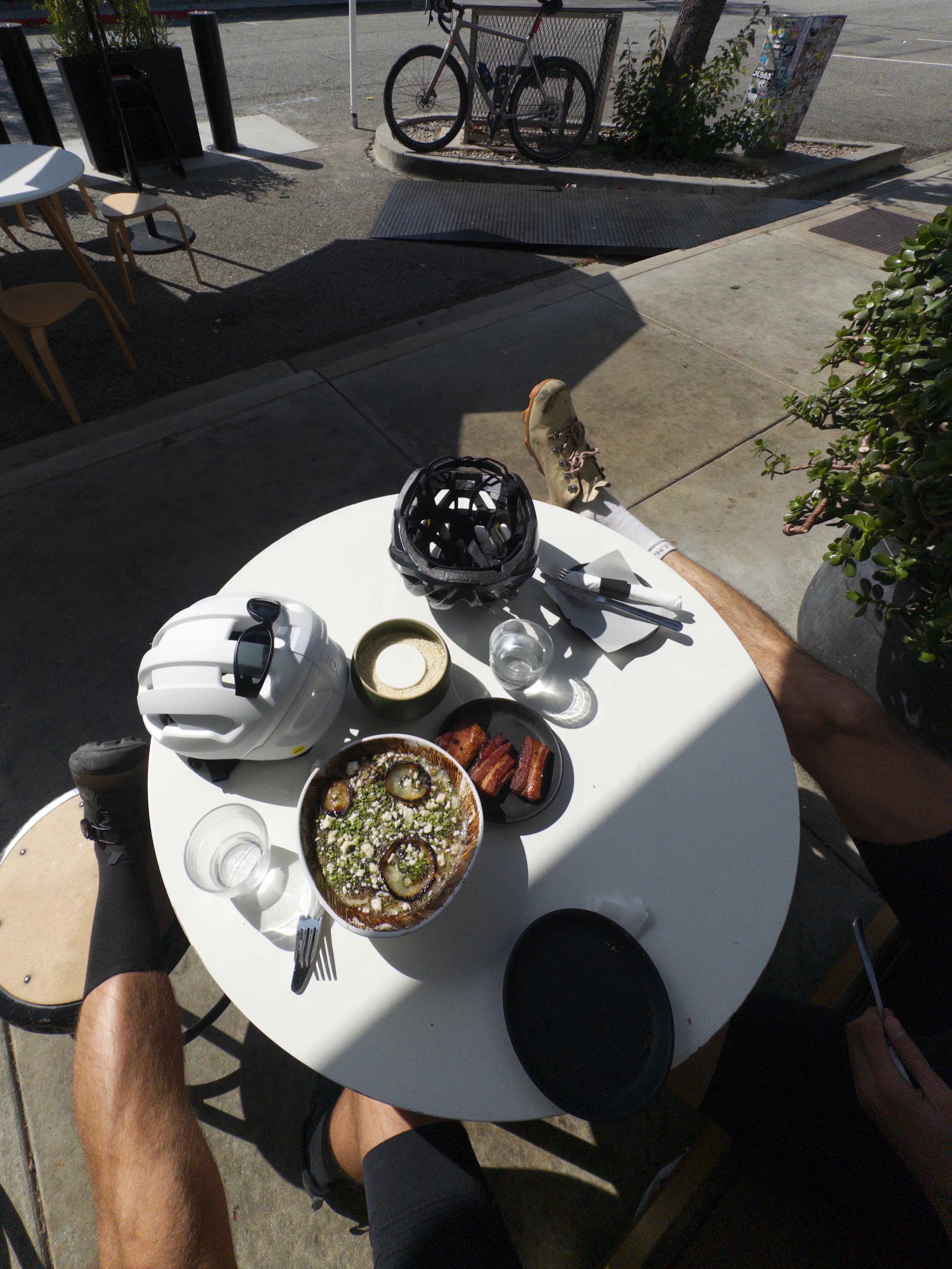
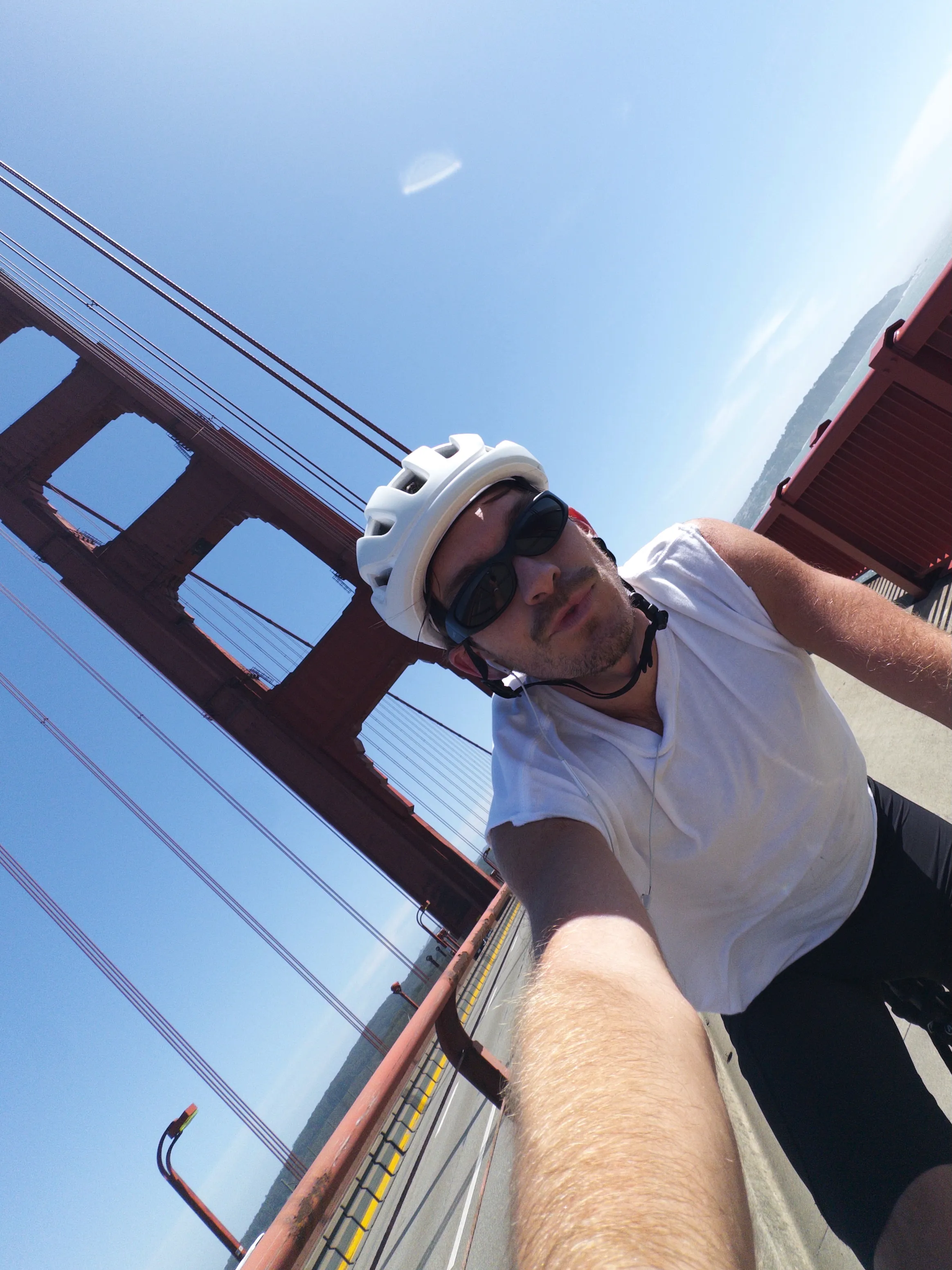
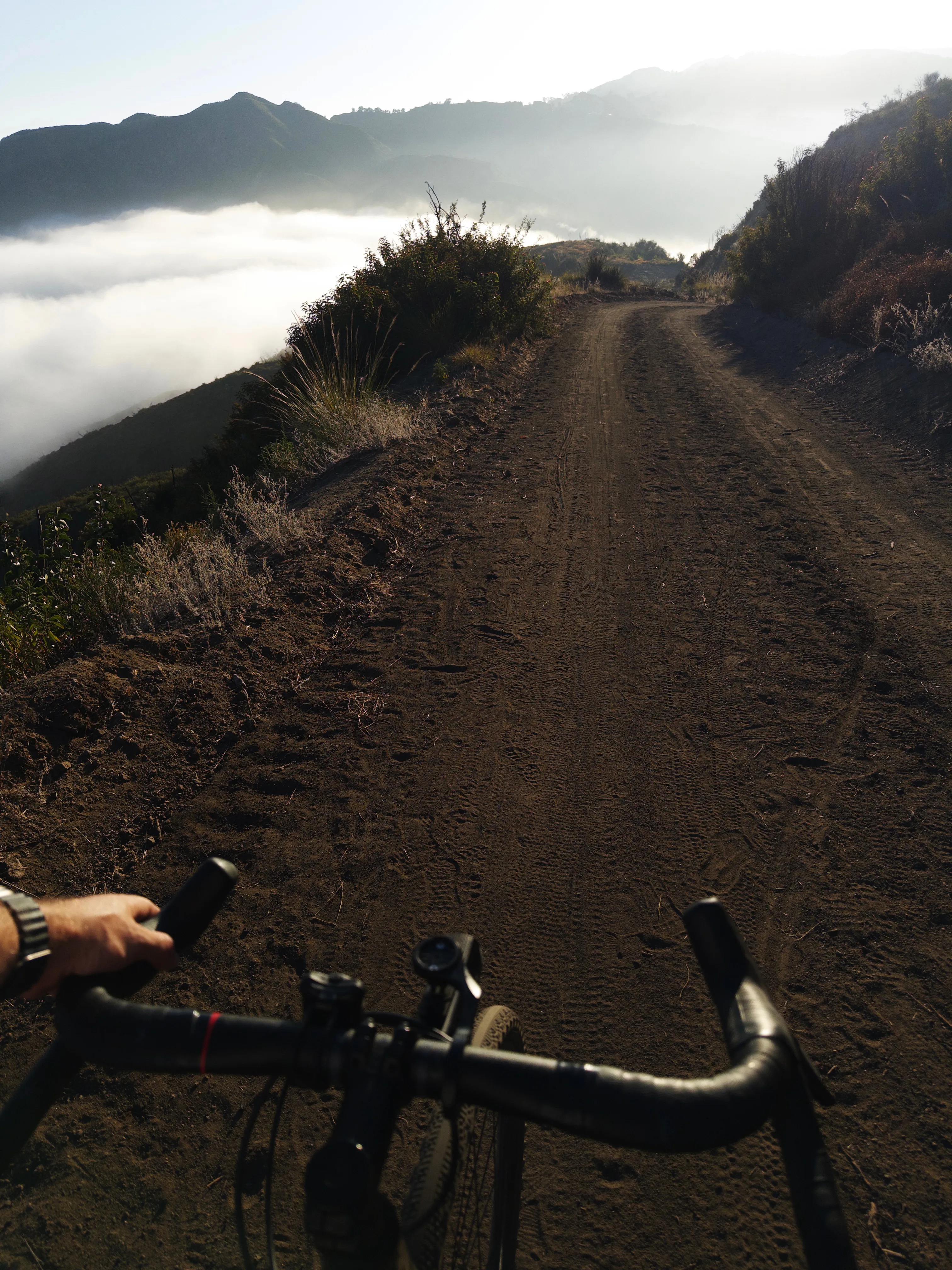
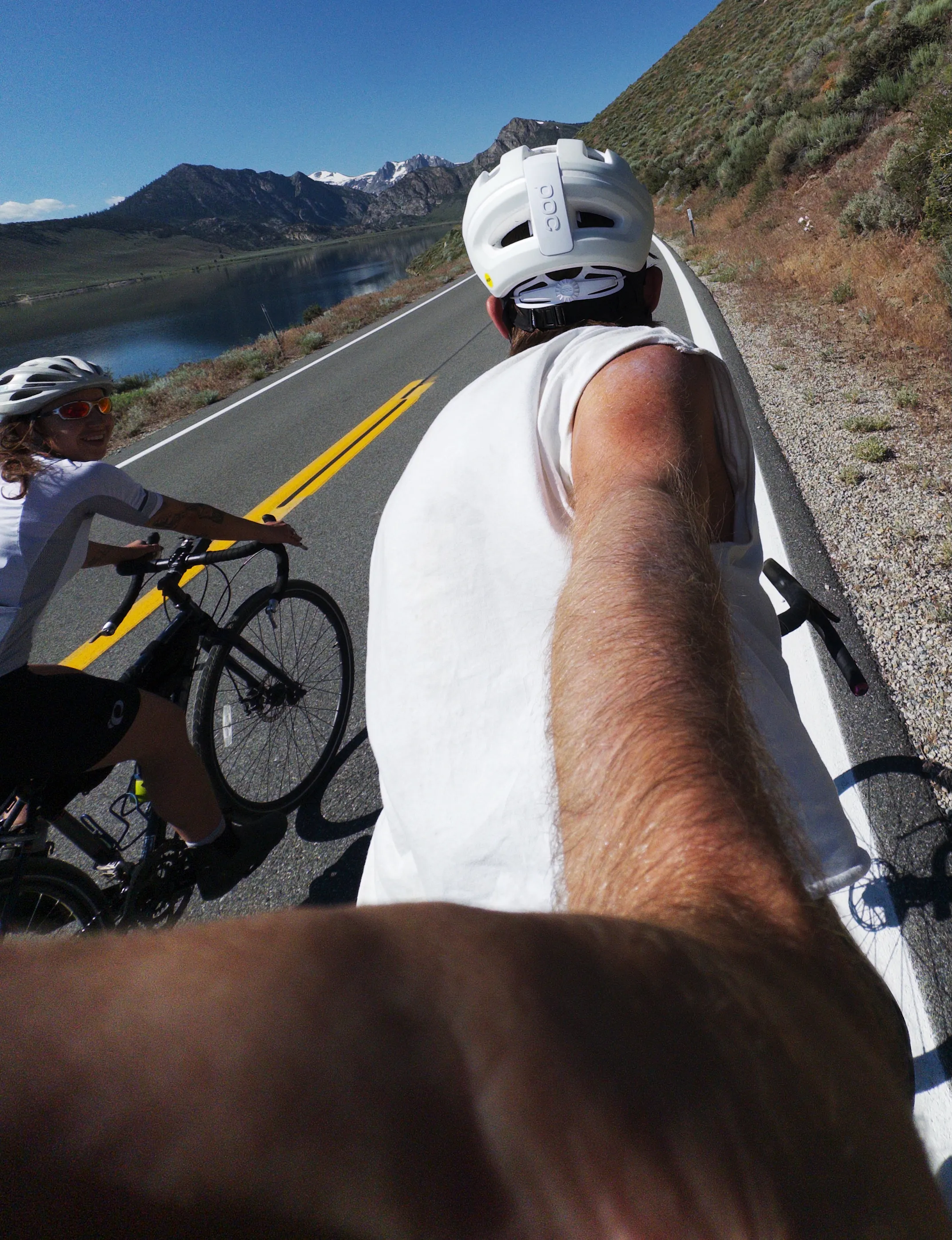
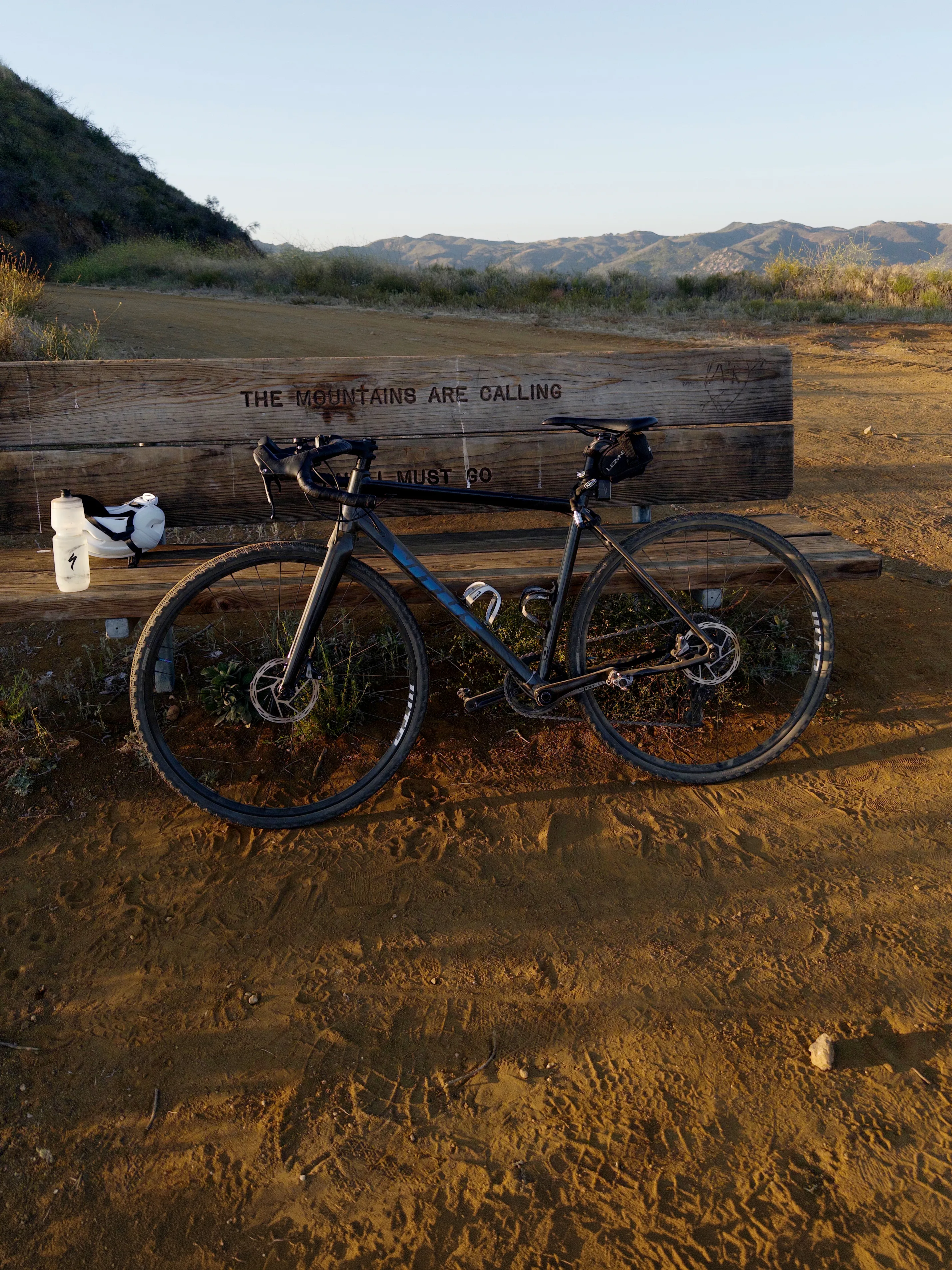
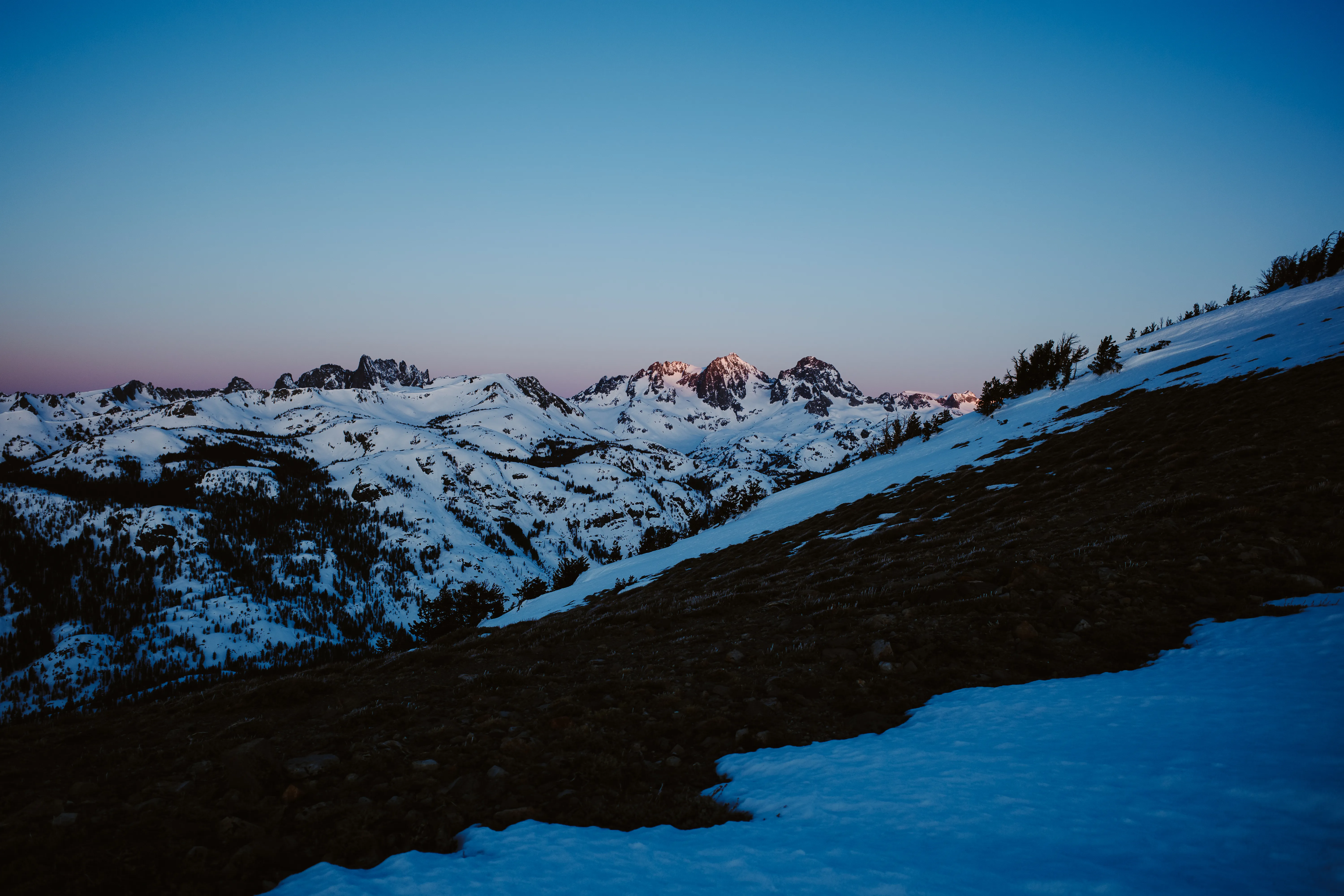
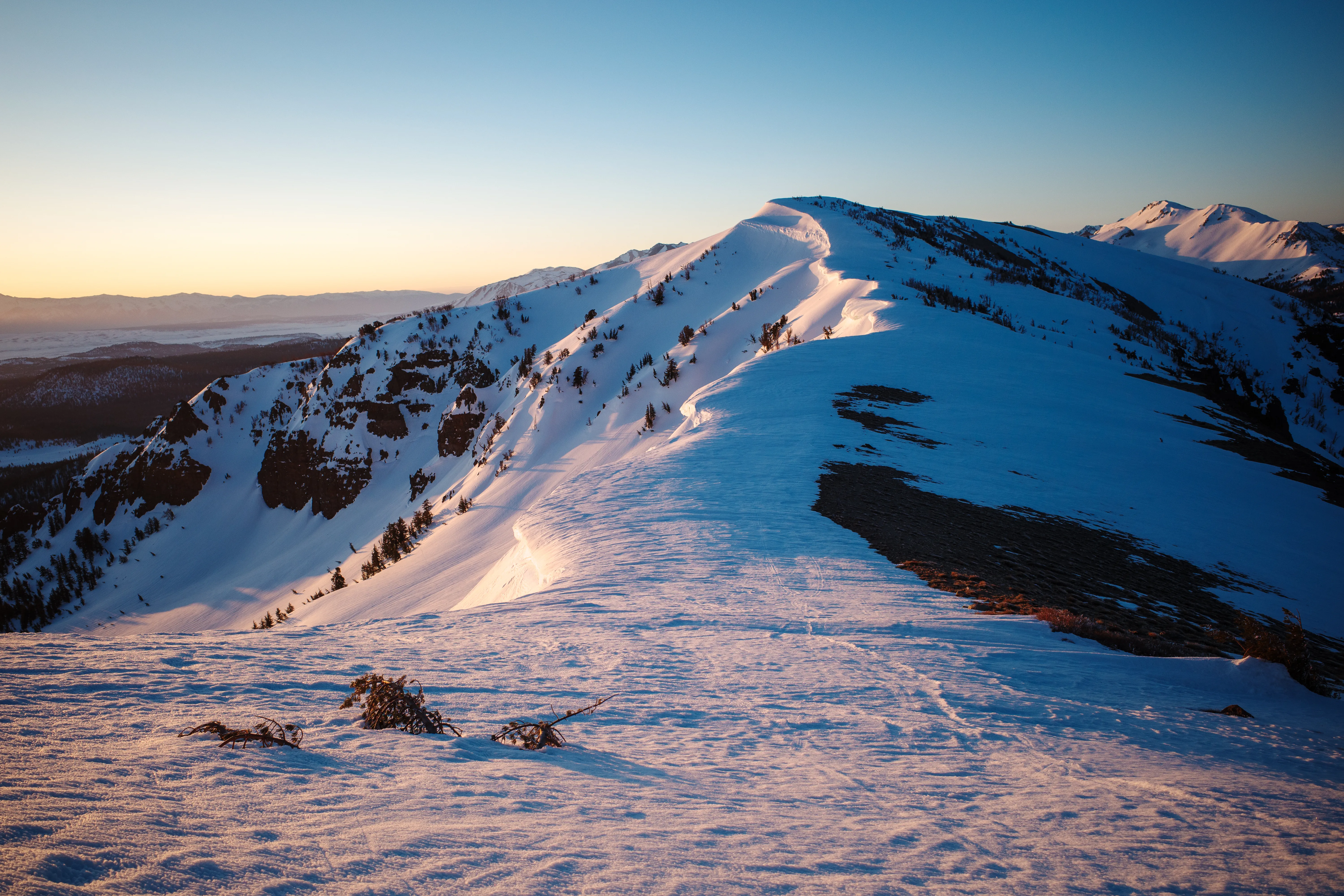
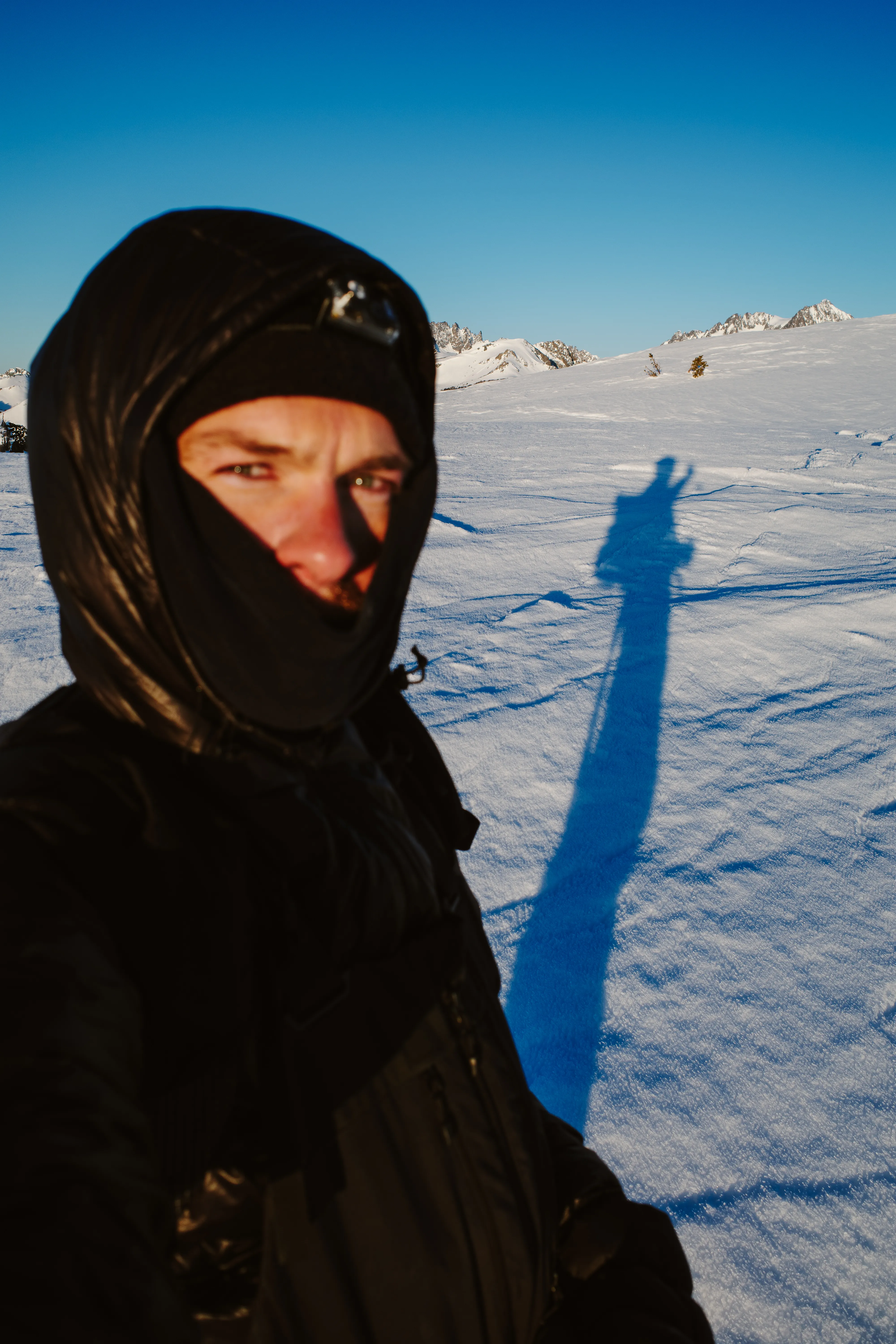
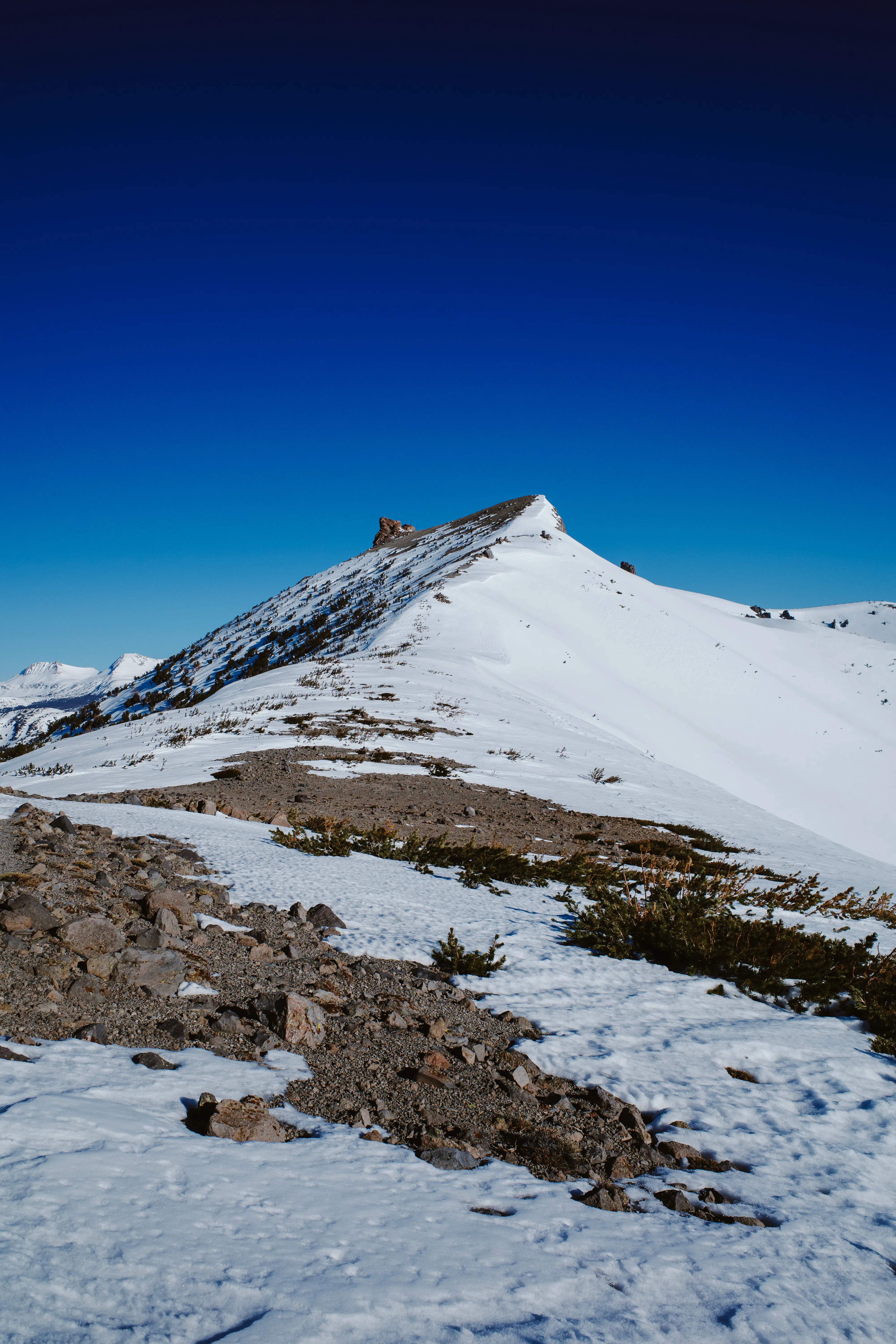
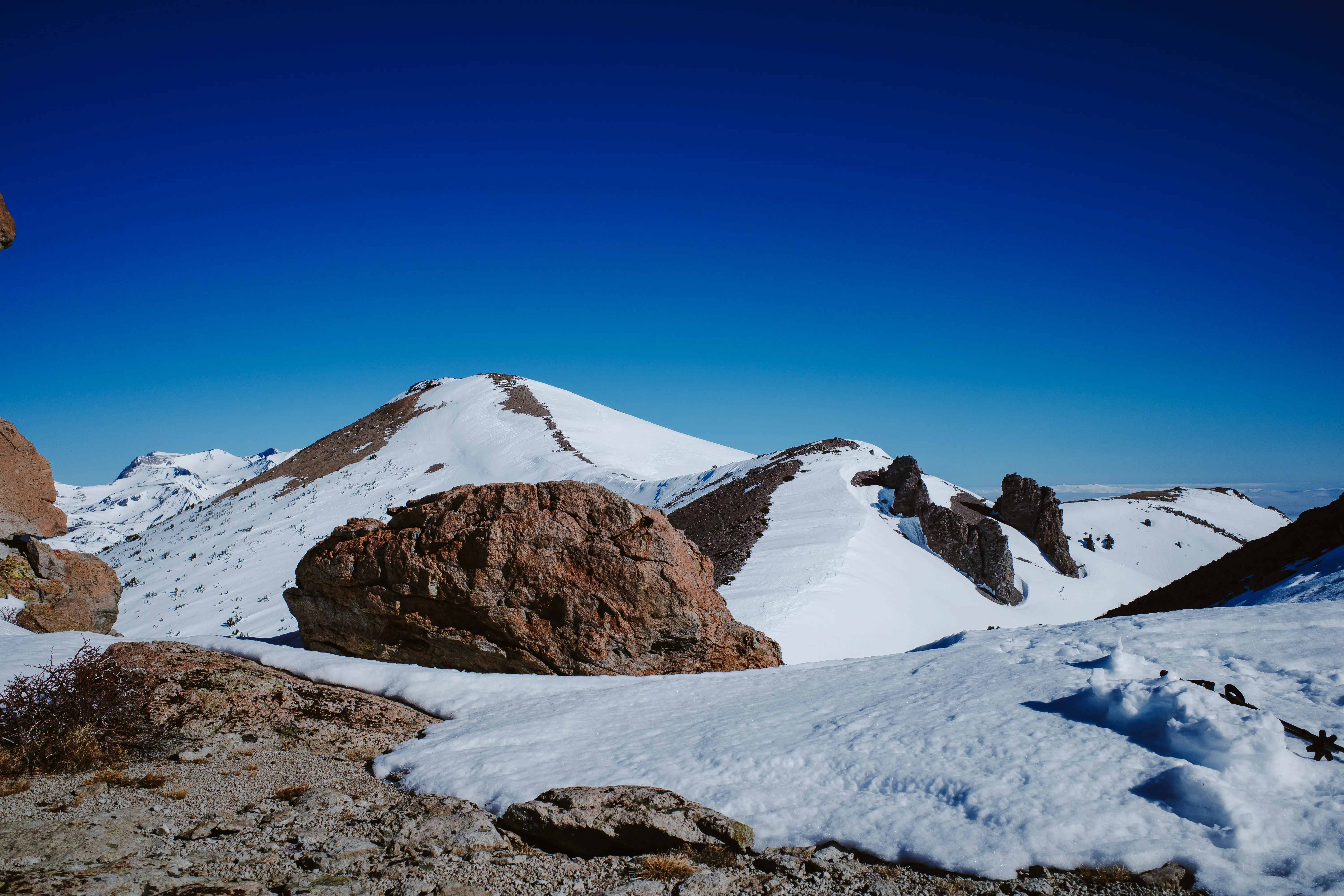
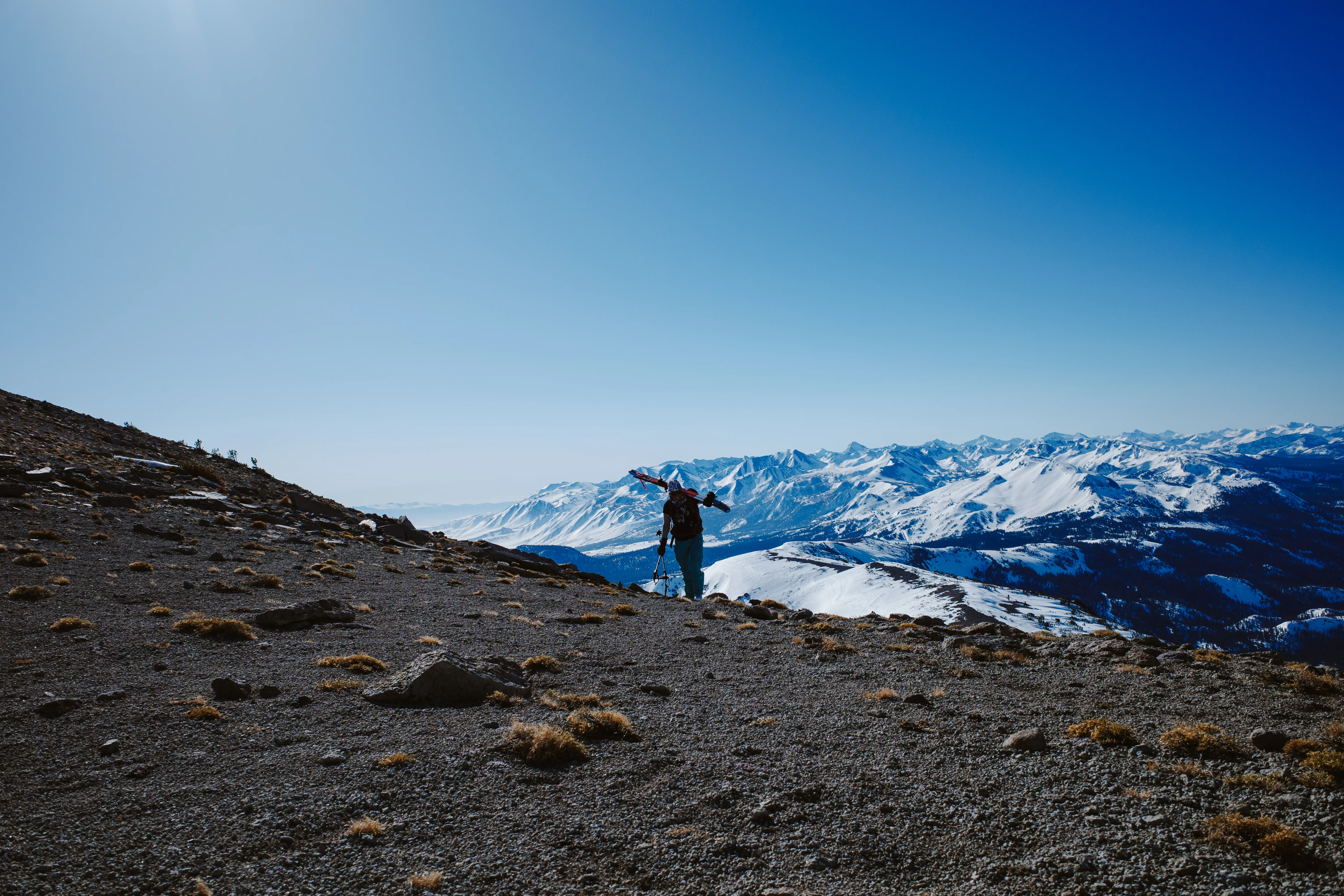
Plans can have an elastic quality. Sometimes they start big, contract, then expand to fill the space. Driving up the switchbacks to Onion Valley my plan is quite logistically complex. Arrive at 10 p.m. after the 5 hour drive from Los Angeles, drop my bicycle at the top, then drive down the grade and north a ways up to Baxter Pass, one of the notorious big passes. It sounds like a memorable time: climb up 7,600 feet and into the Sixty Lakes Basin for an overnighter. The next morning, up and out Kearsarge Pass, hop the bike, descend the grade, then ride back up to the car.
The plan is big, but sound. However, the week was overflowing with work. Pulling up to the Onion Valley trailhead, I’m fried. Split-second decision. Scrap the plan, get some sleep, then have a light, relaxed day with the e-book reader by the lake. Move around a bit. A recovery trip. I settle into the back of the car on my mattress, tucked into the quilt, and doze off.
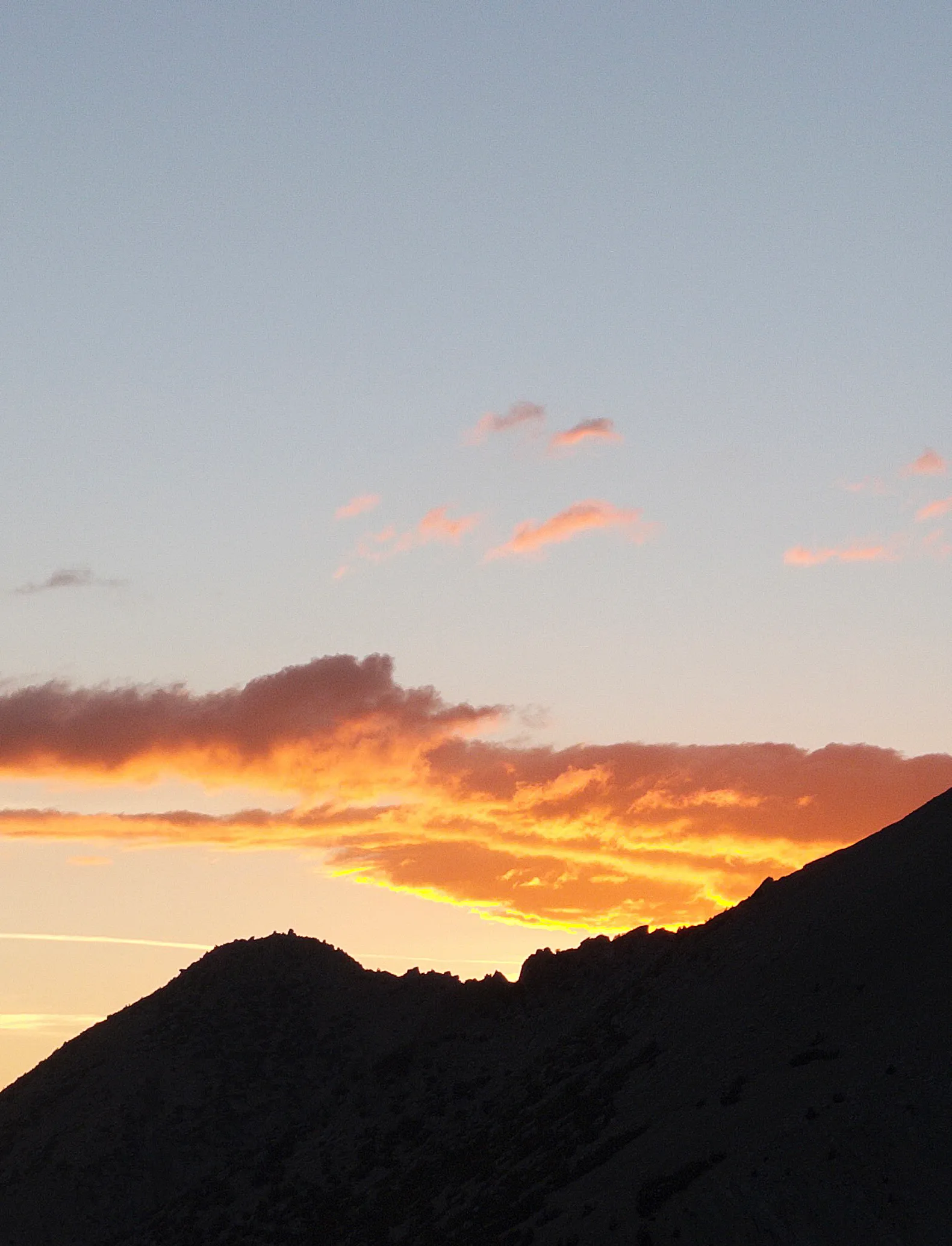
A sliver of glowing orange above the Inyo Mountains on the other side of the Owens Valley wakes me up. I’ve had early mornings the past few weeks. The sound of the nearby stream and warmth of the quilt in the chill alpine air… I’m sleeping in.
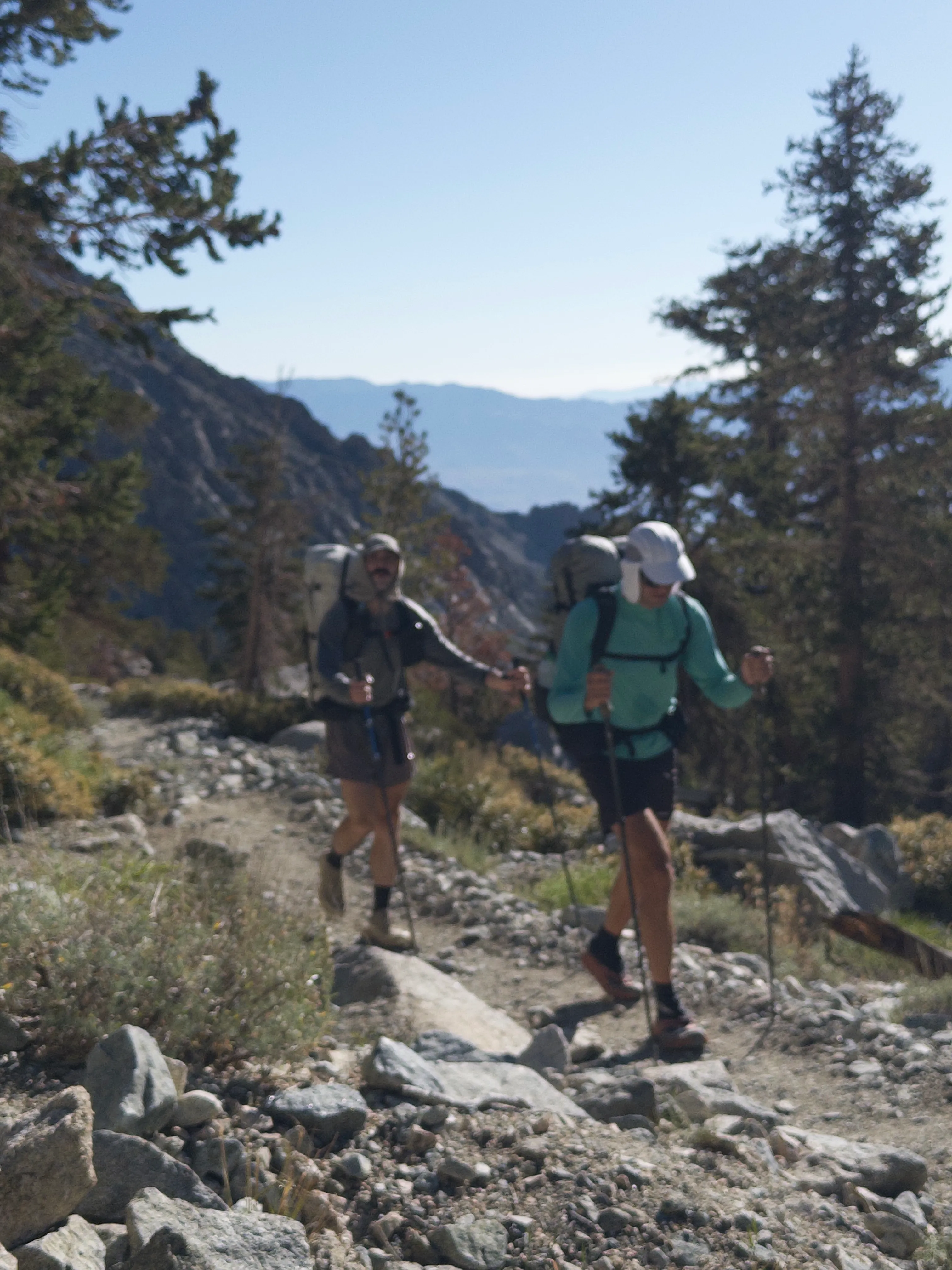
I finally get around at 7:30 and hear someone say my name. It’s Gill! We’re both surprised to see each other. “What are you doing out here?” I ask. “Starting a week on the Sierra High Route with a friend.” Amazing. I feel a little guilt for sleeping in, but this serendipity is too good.
We decide to start out together. I’m still uncertain where the day will take me. We talked about my time having a house for a few years in the Sierra. “Part of having time away from the mountains is you make room to dream about them.” That’s been me the past several weeks, and now that I’m out here, what a contrast.
I’ve only been to Onion Valley once, to ski around Gould two winters ago. Very memorable. When doing the PCT in 2019, I skipped exiting here in favor of pushing to Red’s Meadow. This was my first summer Kearsarge.
Gill and I chat as we reach the top of Kearsarge Pass. “You know, you could hit Forester Pass if you wanted,” he suggests. Forester is the high point of the PCT at 13,200 feet, and I haven’t been up there since doing it as part of the PCT. It sounds perfect.
We cruise past Bullfrog Lakes and soon hit the JMT/PCT junction. We part ways as Gill and his friend head towards Land’s End to start the High Route, and I head south towards Forester.
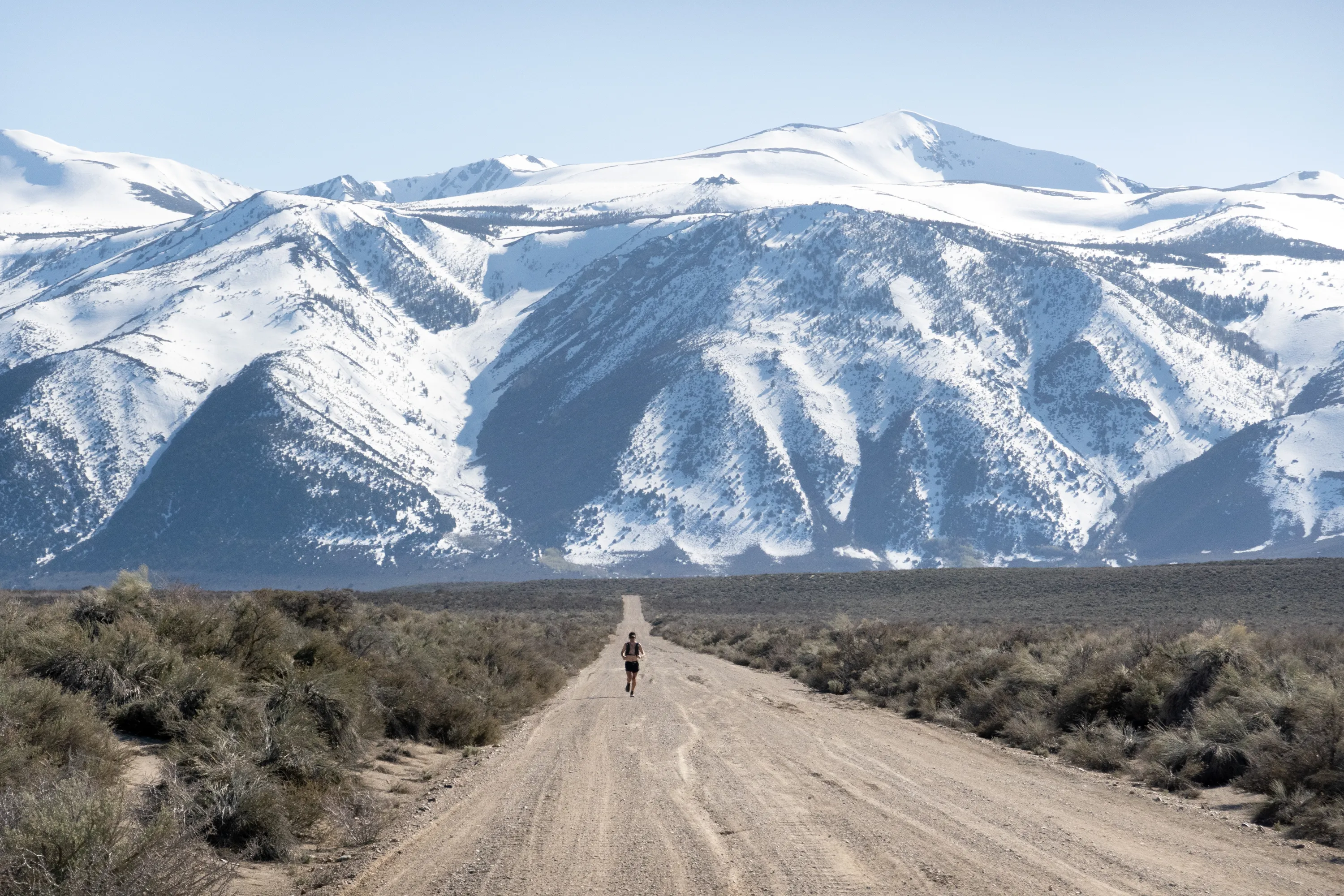
I begin to run a bit, with my fastpack setup on the shoulder. I slow on a climb and hear footsteps behind me. He’s running fast, and as he approaches I recognize the face. “Bentley?” We’ve run East Side Trail Runners’ Wednesday group run several times together. What an insanely small world. We chat and, over the next several miles, hikers ask if I saw that runner. “Oh yeah, Bentley.”
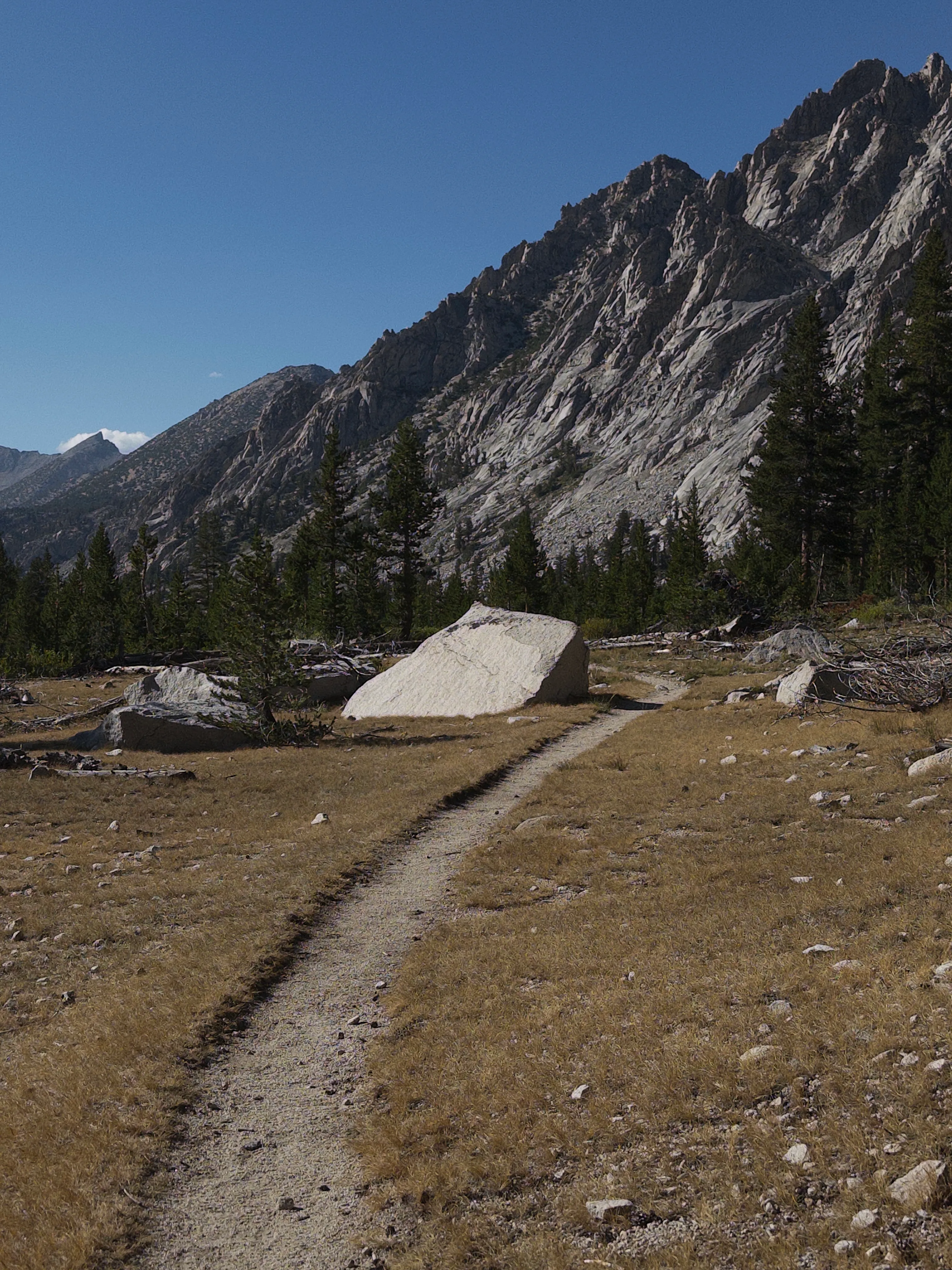
The weather is perfect: cool temperatures after a few days of monsoonal rain, perfect blue sky. The grade picks up towards Forester. Elevation beginsto become noticeable.
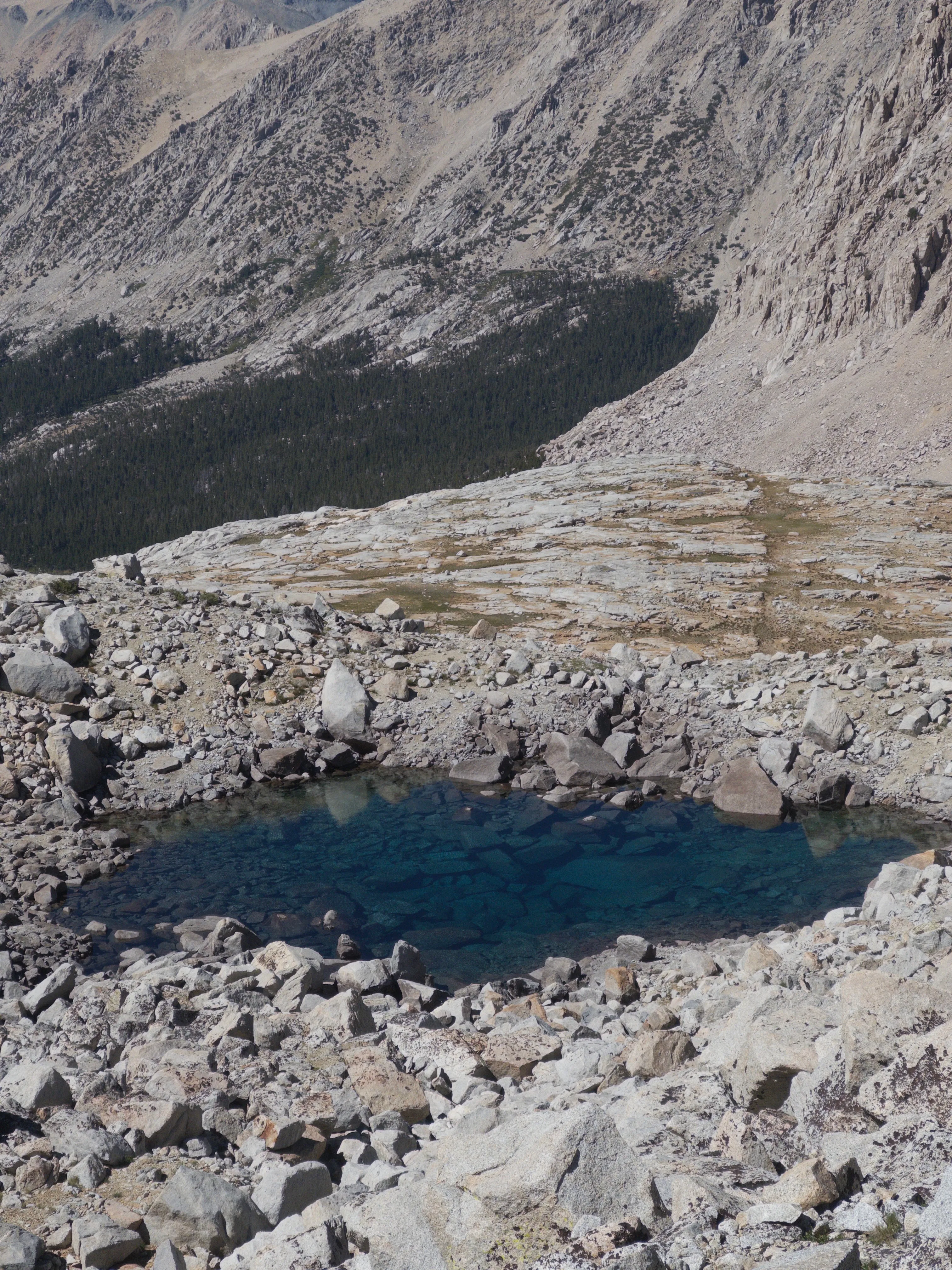
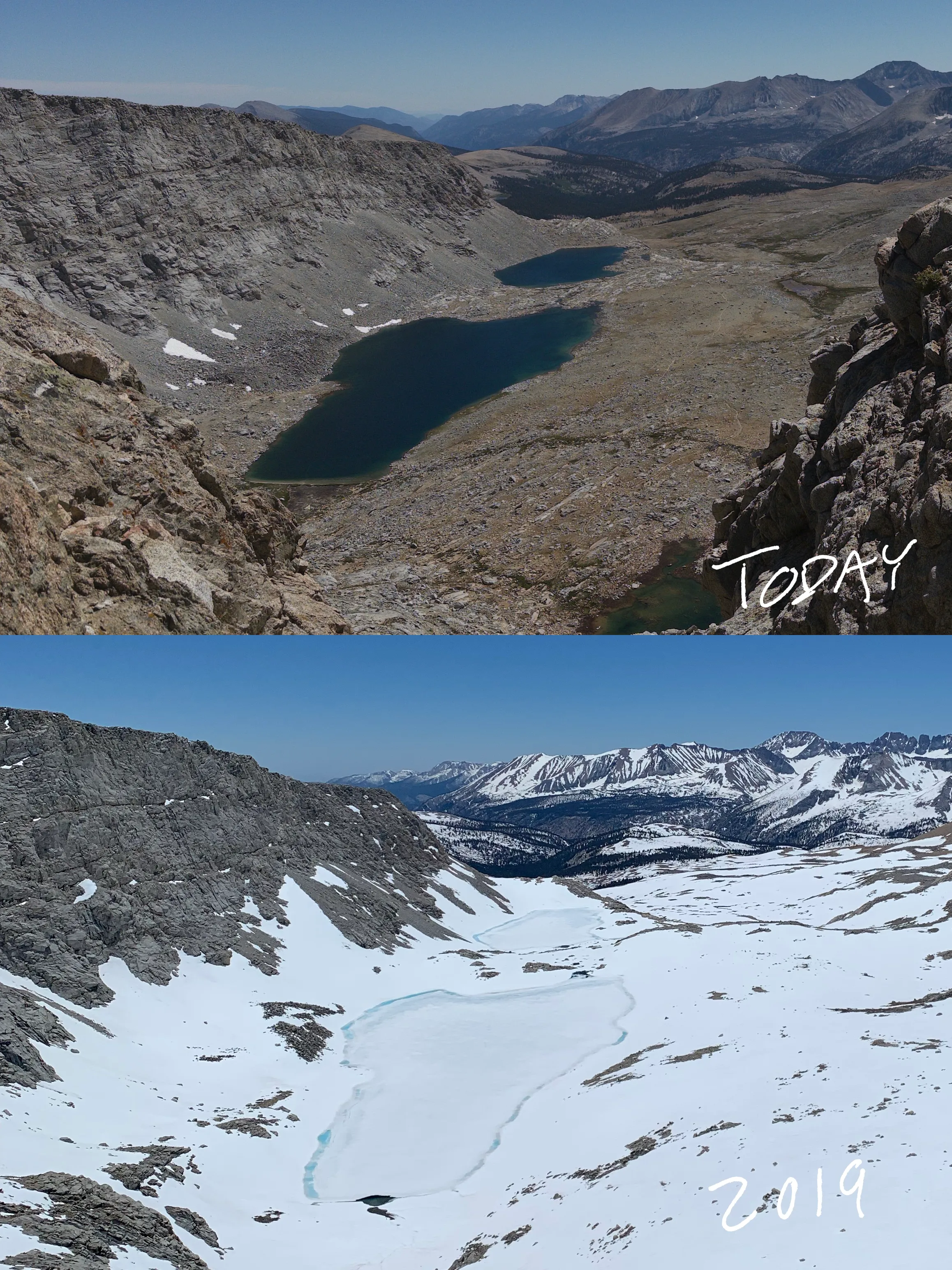
Climbing through treeline, it starts really opening up. Huge views down Bubbs Creek towards Vidette Meadow. In 2019 all of this was covered in snow; the trail now made visible. The cool wind picks up nearing the narrow gap at the top of the pass. A lone sloping rock becomes the perfect backrest beside the SEKI sign.
This was quite memorable on the PCT. The night before, I fell asleep soaked to the core after crossing Tyndall Creek, feeling and running ultra-high with the start of the Big Melt—the point of fear when temperatures stop consistently freezing overnight.
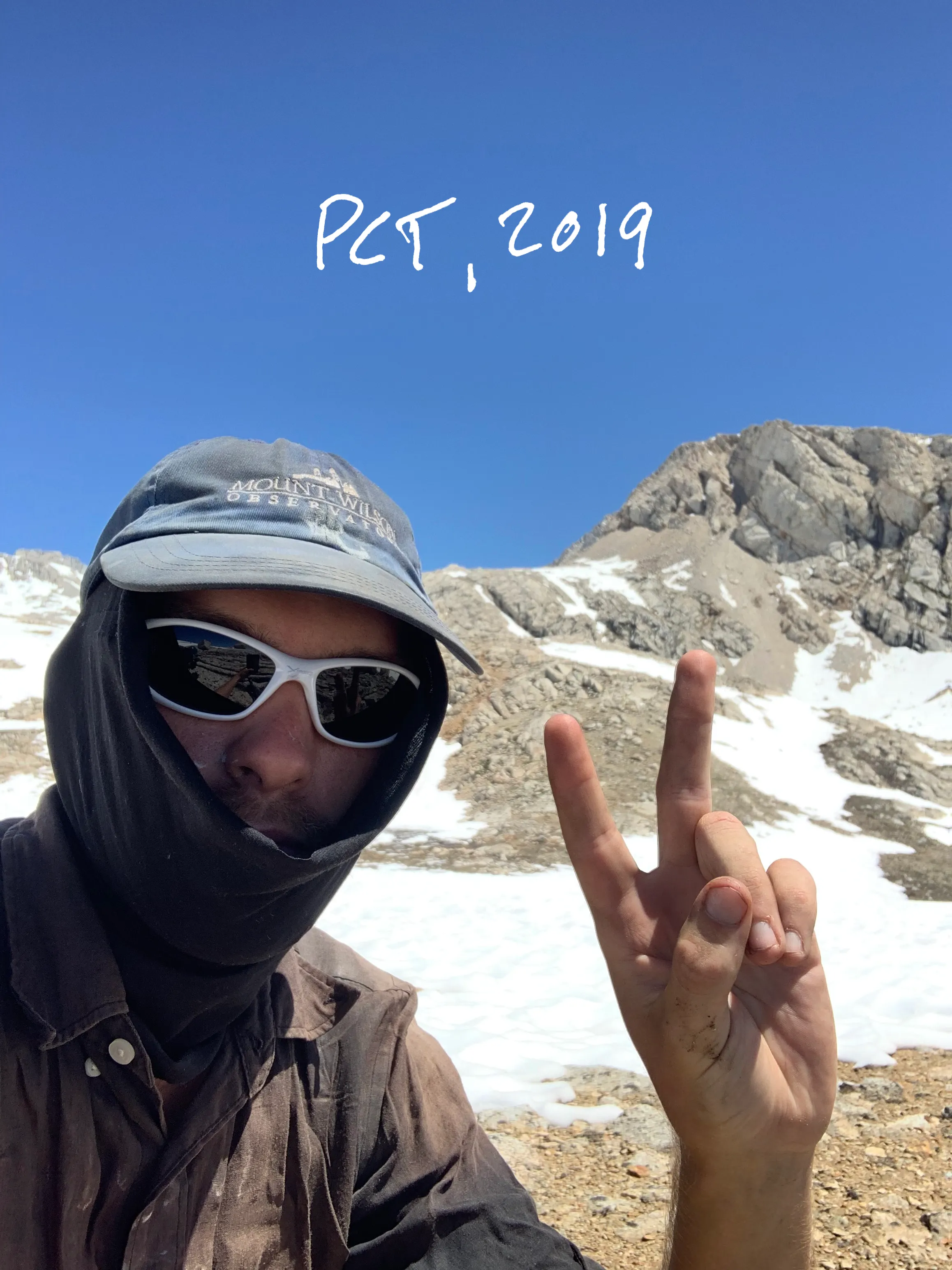
That morning I began moving over the snow towards the pass, a staircase of steps had been kicked in, leading straight up at the base. I caught up to two others, one wearing what looked like a wildland-service firefighter outfit from the ’60s, the other a sleeveless hoodie covered in a print of a tiger’s face.
We introduced ourselves and got talking. Turns out Jeff, in the tiger hoodie, goes by Legend. He had just finished the fastest time doing the Triple Crown—the PCT, CDT, and AT—in one calendar year: 7,900 miles. John, who goes by Airborne, had just set the FKT for the PCT yo-yo, Mexico to Canada to Mexico, and here I was doing my first winter ascent of a pass.
I hadn’t ever seen anyone move in the alpine like this before. The style it was massively motivating. We sure-footed down Bubbs Creek through the valley. The snow coverage was immense. Jon and Jeff decided to glissade, and I hopped on my ass and followed.
Running along here now, I think of the slippage in time. So much life has occurred between then and now. As I move the miles come easy until they don’t. Reaching the base of the climb back up to Bullfrog Lakes, the sun gets lower.
The junction to Glen Pass soon follows. On the PCT you tend to exit Kearsarge and resupplying in Bishop decide to push north to Mount Whitney, hitting all the major Sierra passes in one go. I ended up running out of food at the base of the pass. By the time I arrived at Mammoth, I was quite hungry, and a little crazed.
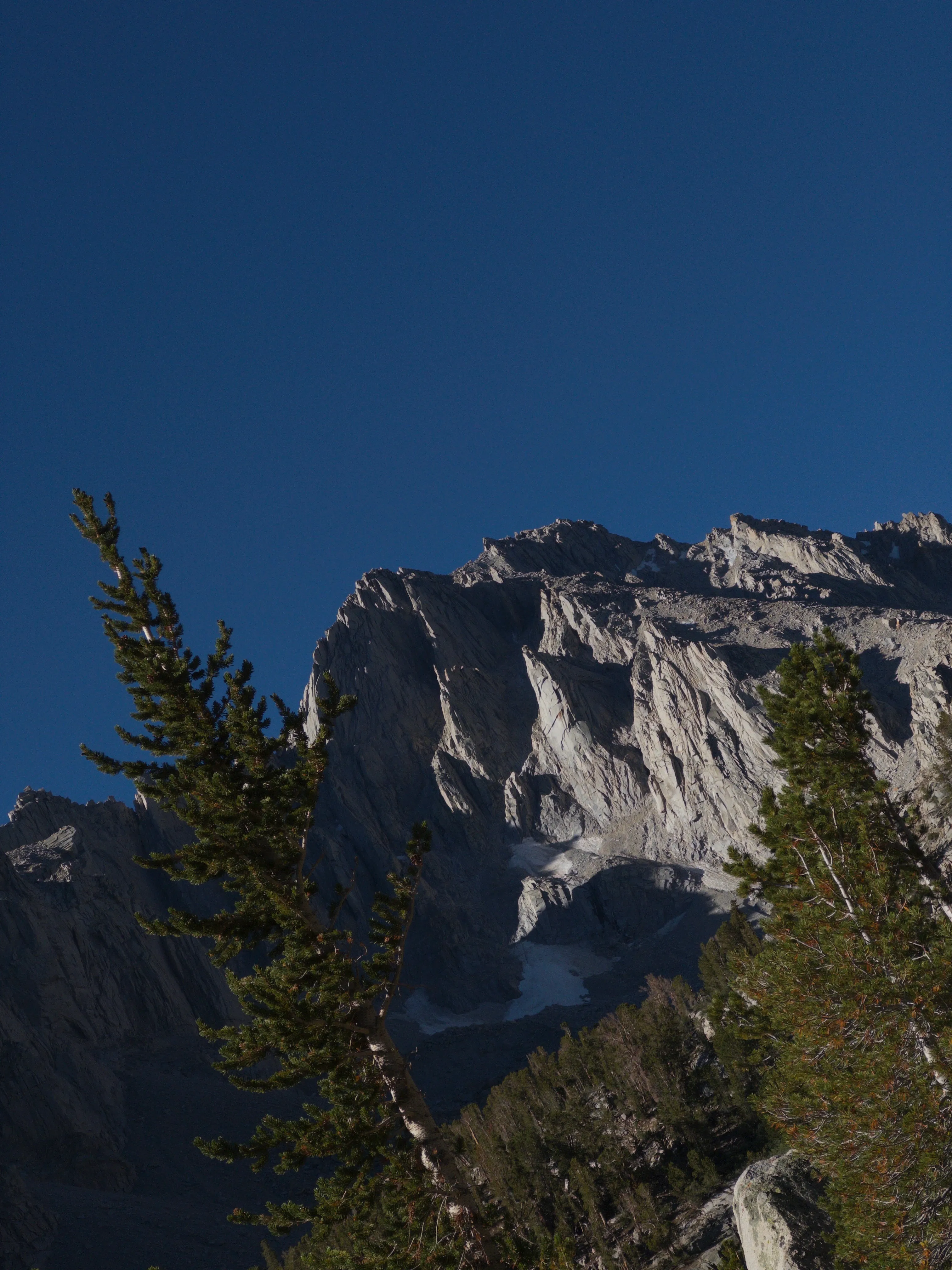
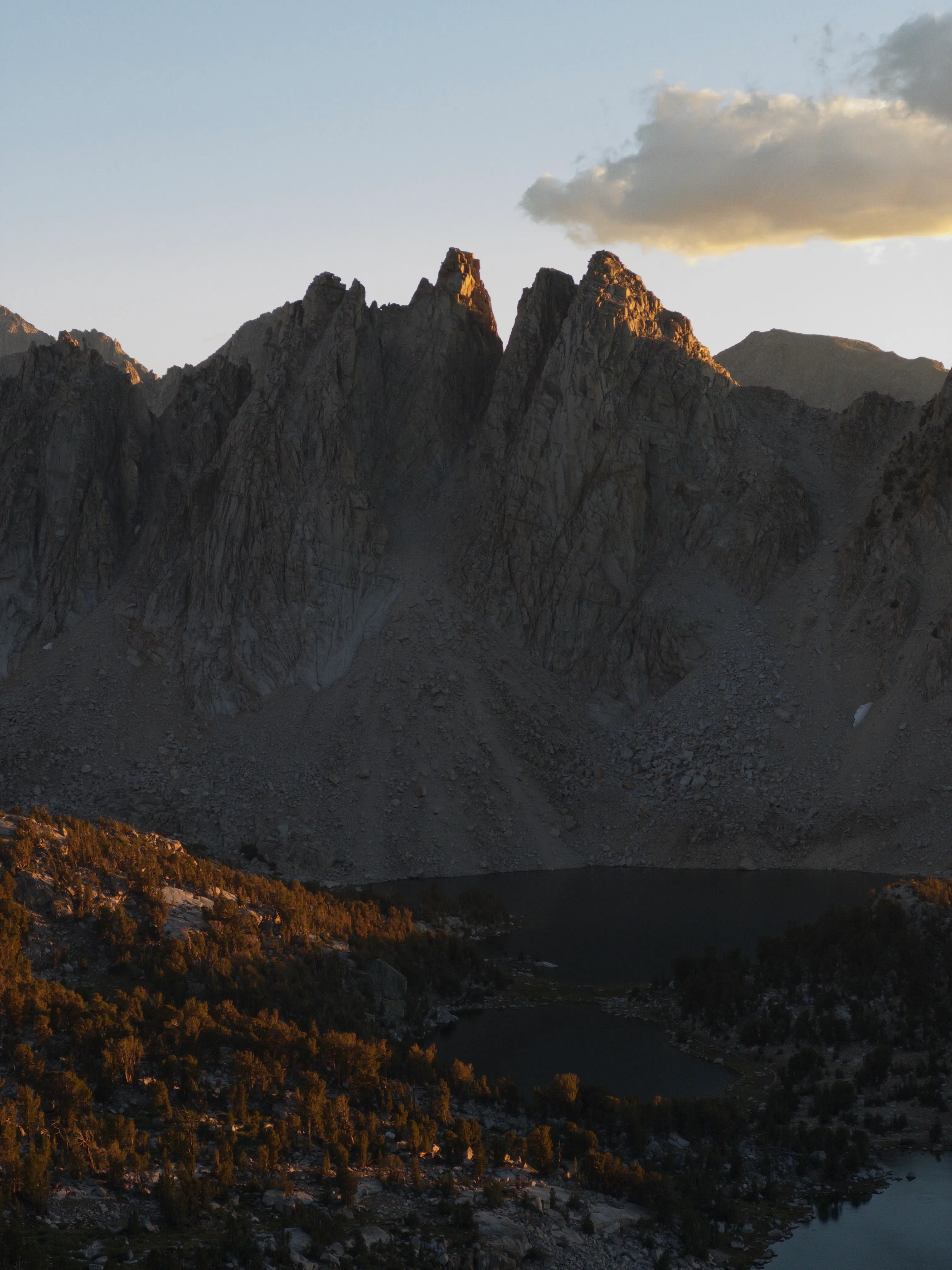
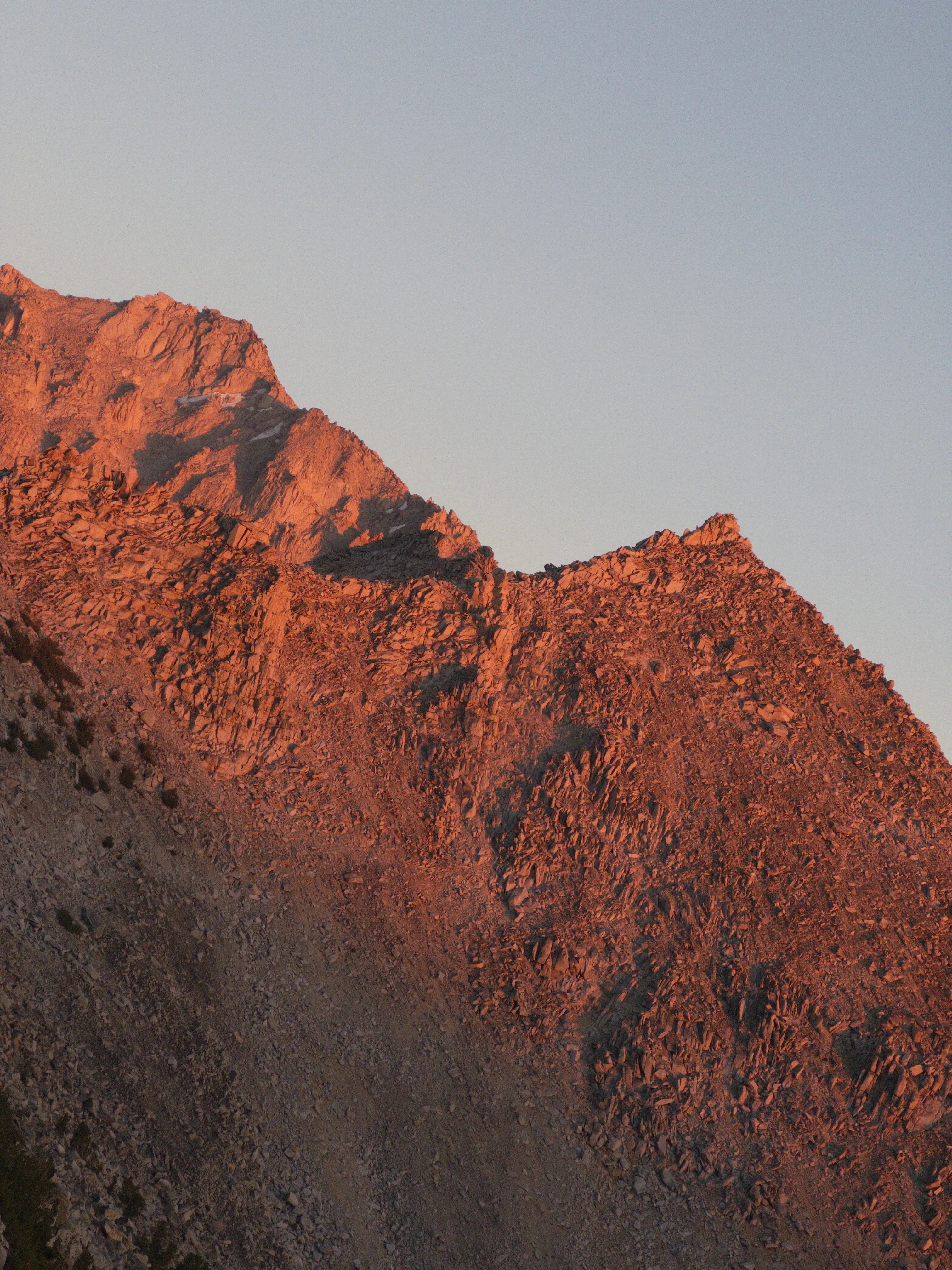
Now ascending the final climb up Kearsarge Pass, the pinnacles are glowing in the last light of the day. I’m feeling tired. About 12 hours and 35 miles of continuous motion, I realize how my heart rate seems stuck at 170 despite how I slow the steps. After a mile or two of this, I notice how shallow my breathing is. Big, intentional, deep breaths now. Almost instantly I feel better, like a fresh start to the day. It’s an incredible surge of energy as I crest the pass just as quickly as the sun dips.
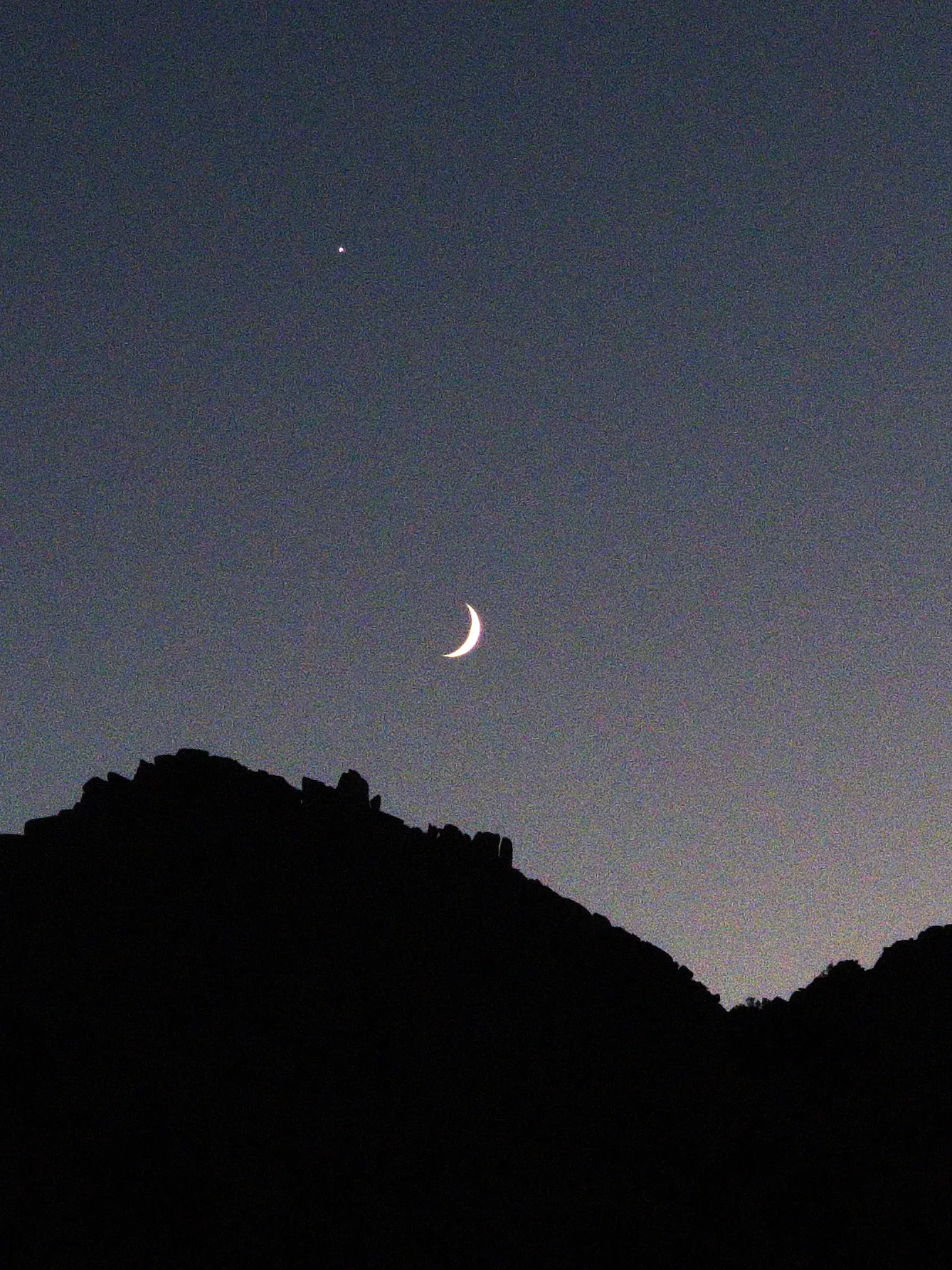
Yesterday a total solar eclipse blocked out the sun, now making it one day past the new moon. It’s dark—very dark. The Milky Way above is so clearly defined that dark bands clearly weave through it. The show overhead is so distracting I almost trip several times. Insane, in these moments—big miles, big skies, big mountains, big time. You really find awe of scale—physical, time, everything. Nothing beats this awareness. You really feel it more than think it.
The elevation almost depleted, the fires at the campground come into view. I make my way to the car, fall on the mattress, dunk several Milanos in a jar of peanut butter, and the sudden stop to the continuous motion creates a sensation of momentarily leaving my body.
You first see it from a distance. A concrete slab spanning the boulevard, across the flow of traffic below, drawing the eye above. I like the building. Its simple forms and material use. You can often reveal more by doing less.
This sense ends once entering the space and looking at the work. The building overpowers it all. Viewing work against the unfinished concrete walls strains the eye. Robert Irwin, when producing large abstract canvases nine miles to the west and sixty years in the past, fell into an obsession with cracks in the wall. The effect it had on the perceptual quality of the work. This building would be his nightmare.
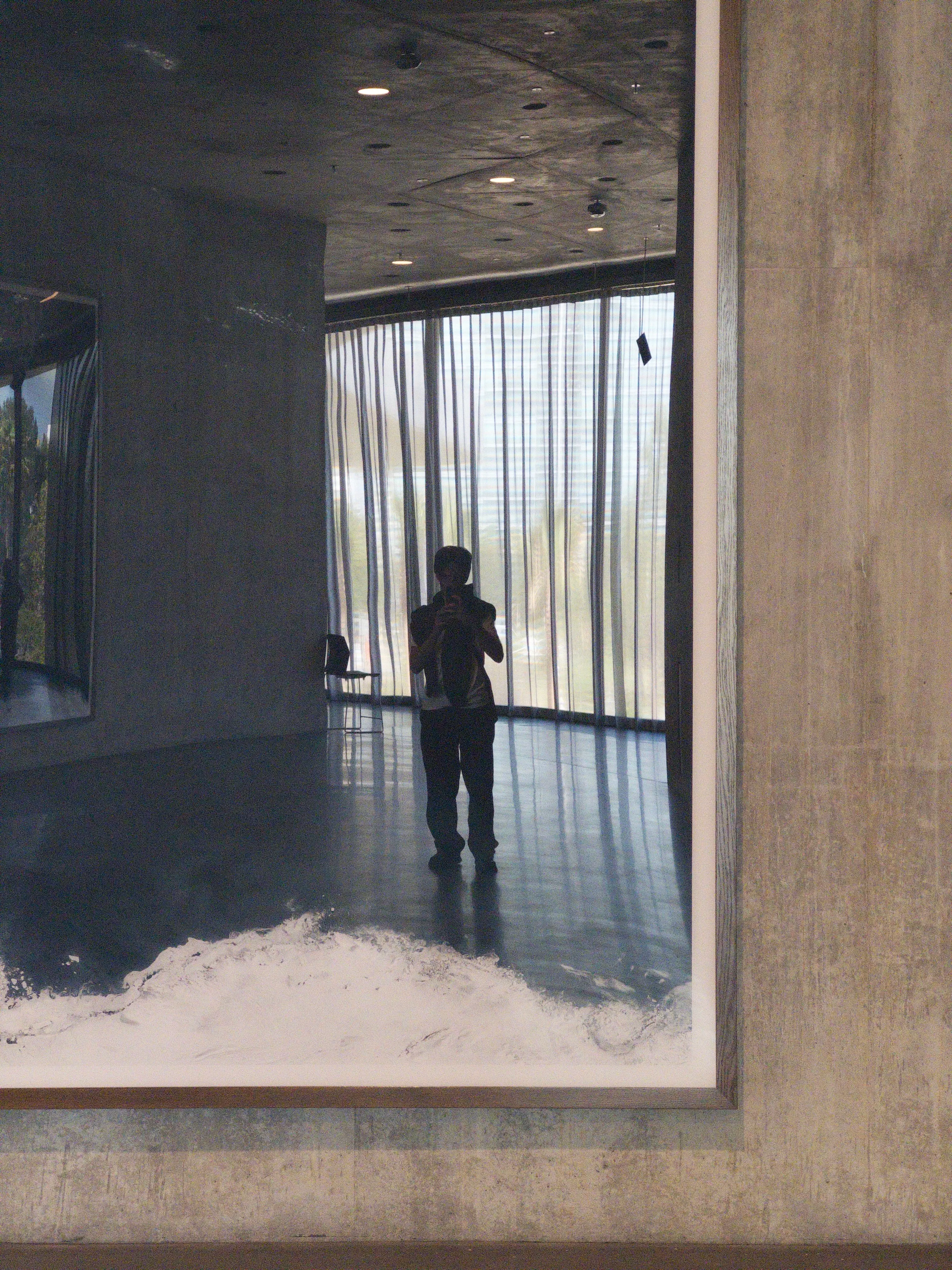
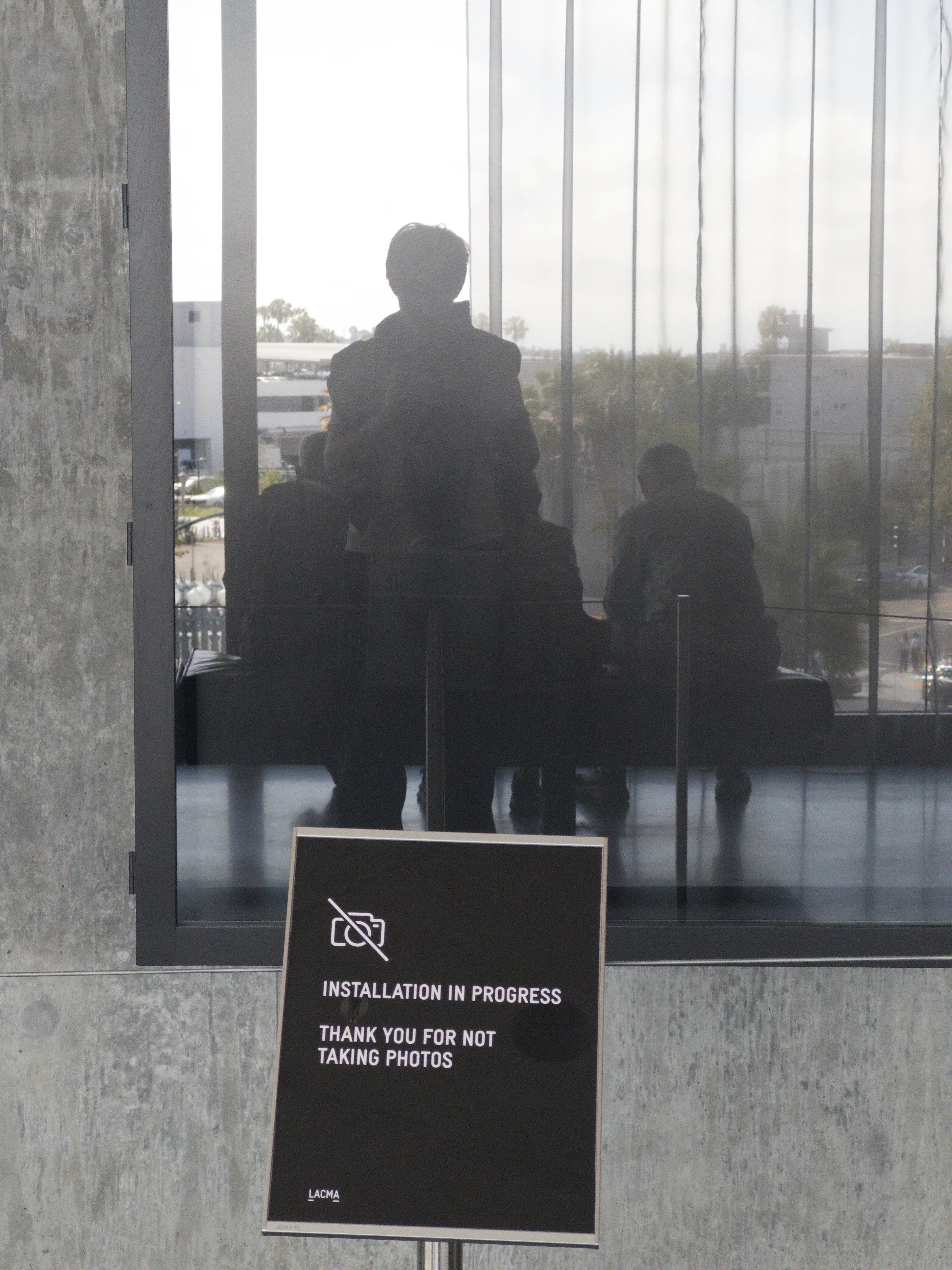
Glass envelops the volume, natural light spills in from all angles. I prefer natural light when viewing work, but only when diffused from above. The Dia Beacon sets the gold standard. But from the side? No thanks. Oil canvases become unviewable due to glare. LACMA tries addressing this with fine drapes, strategically missing in areas as to not obscure the view of the surrounding hills. A complex and distracting moire pattern appears when drapes overlap.
Wandering the floor leads to disjointed confusion. One moment you’re looking at Egyptian artifacts, one unguided turn and, surprise, a Monet. It becomes evident that the openness of the space has been designed around the view outside, not what’s on view inside. Line of sight for the camera takes priority over seeing the work. Los Angeles is the land of the image, no exceptions found here.
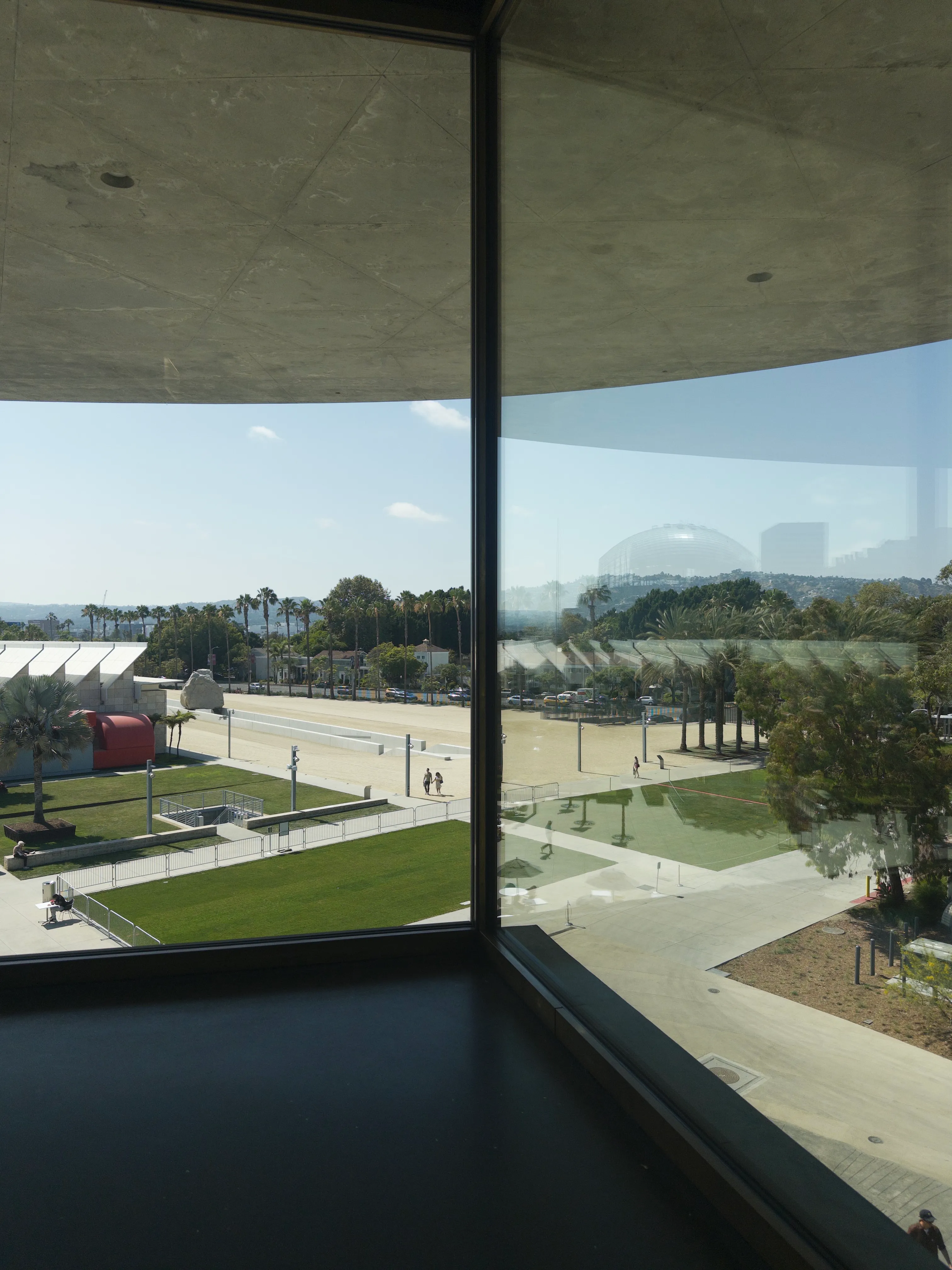
As disorienting as this is, sometimes luck finds you. A Studebaker sits in the sunlight in cherry condition. Beside it a low plinth covered in layers on layers of auburn lacquer. Flecks in the paint reflecting the horizontal rays in all directions. Outside the exterior glass, parking lots full to the brim. A room dedicated to Finish Fetish hovering above gridlock traffic on Wilshire Boulevard… I’m into it.
Continuing to meander, I hook a left. “Plastic ‘is in essence the stuff of alchemy’, wrote French cultural critic Roland Barthes in 1957, invoking the malleable material’s almost infinite transmutability.” I’m excited about this. “Plastic” is my favorite essay by Barthes, and I think of it frequently concerning material use. Specifically when designing interfaces for screens.
The room was full of plastic objects, many produced in Southern California. A breastplate cast in plastic by Issey Miyake. A naturally unnatural object to exhibit in Los Angeles, the land of plastic tits. The air conditioning gently excites a dangling tapestry. Nylon monofilament, multi-layered nylon micro-slit film, aluminum vacuum-coated polyester, titanium-oxide vacuum coated micro-slit film. Now that’s the stuff.
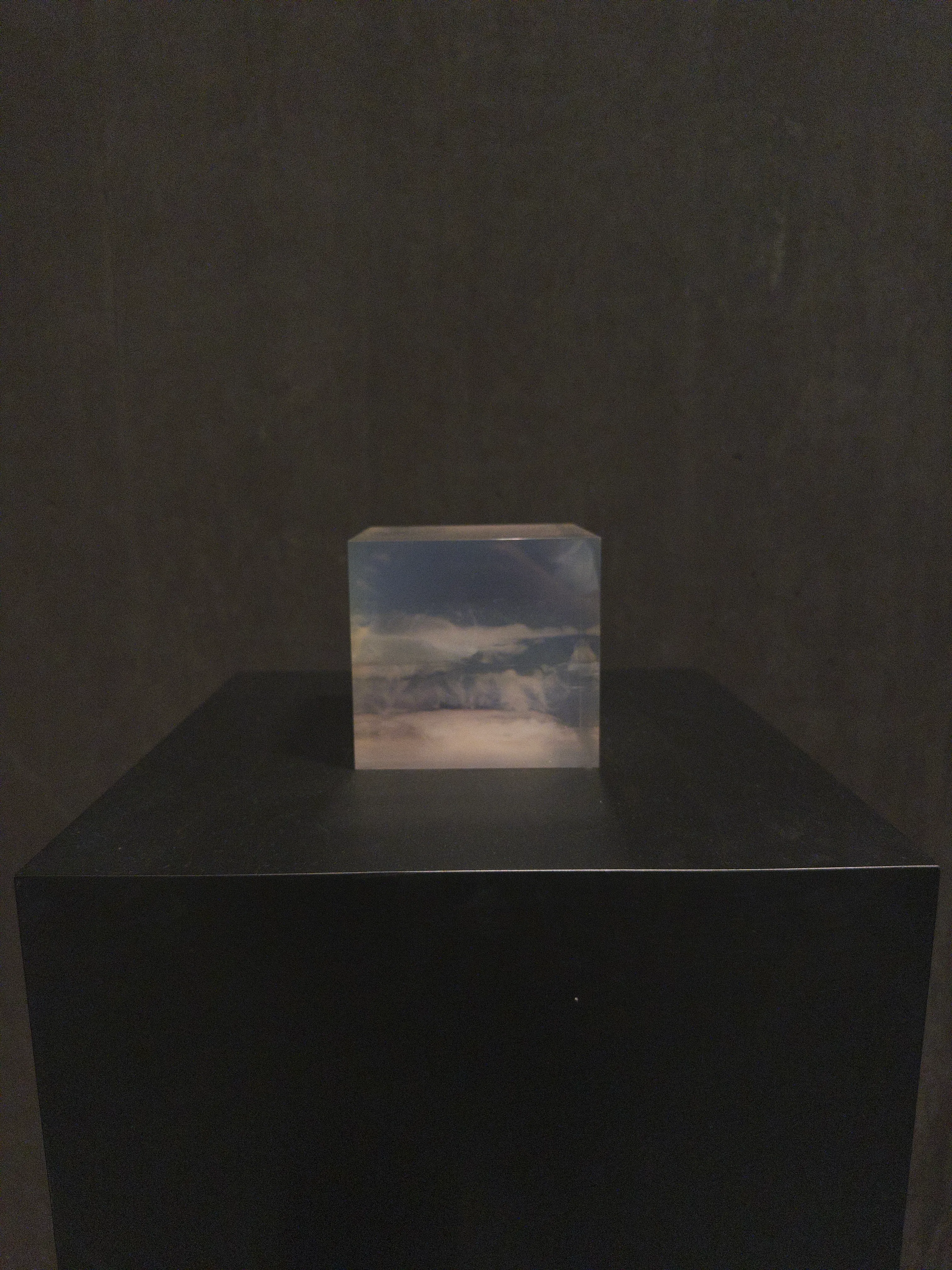
Small Cloud Box refracts the dim overhead light. A cast resin cube by Peter Alexander. June gloom, in a cube, in a room, in a museum, in June gloom.
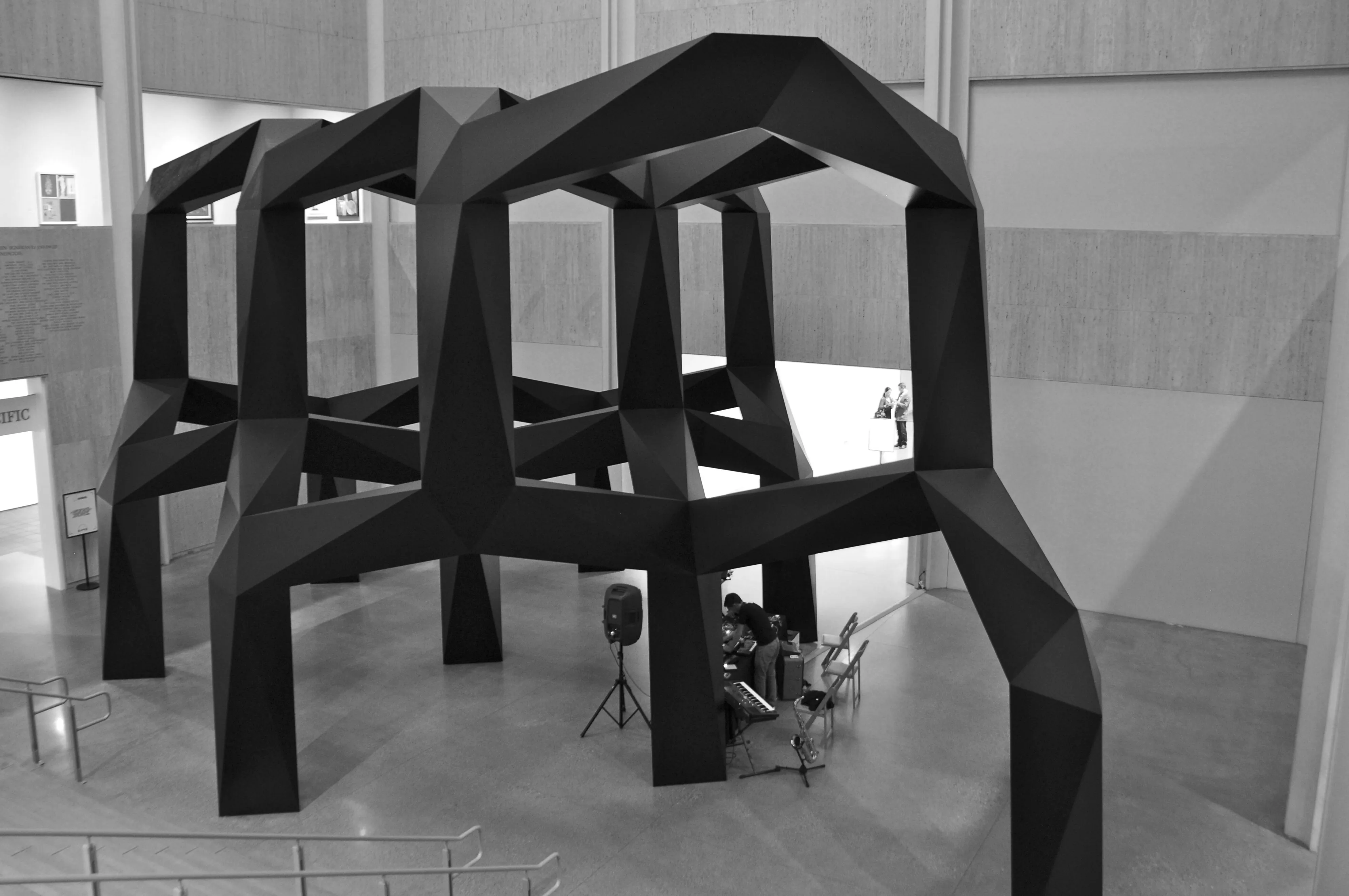
Performing beneath “Smoke” by Tony Smith
Exiting down the stairs back to street level. My last time seeing “Smoke” by Tony Smith was when performing beneath it over a decade ago during an evening of Dublab Programming. It was the focal point when entering the original William L. Pereira structure. I remember being instructed to carefully negotiate movement around it. Now installed outside, fresh bird shit bakes in the afternoon sun on the tessellated black surface. I like the increased accessibility.
I also like the building. But it’s terrible for viewing work. A building for the image.
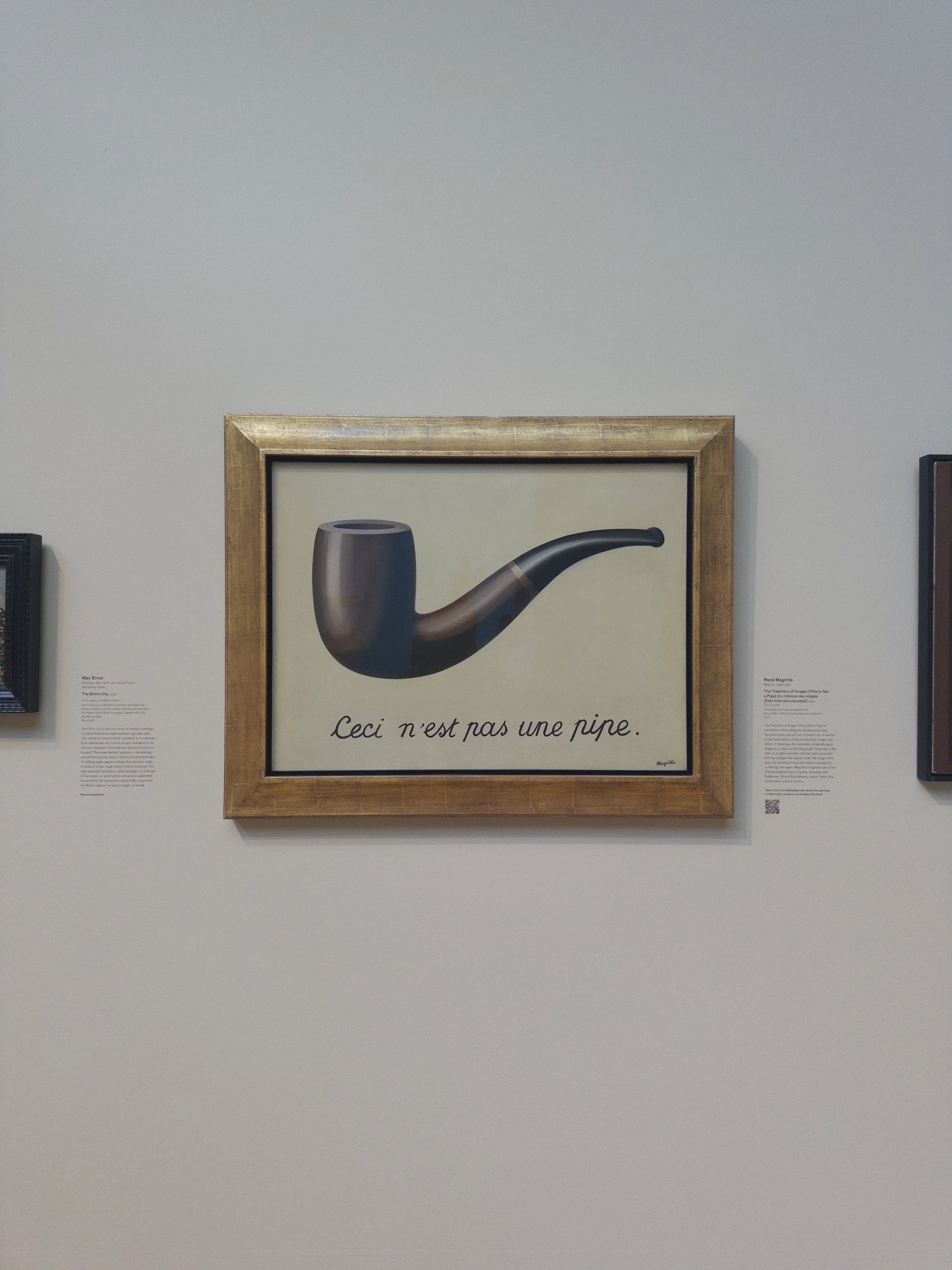
Cross the courtyard and up the escalator to the Broad contemporary. Magritte’s “The Treachery of Images (This is not a Pipe)” on the opposing wall. Part of the permanent collection, I had first seen it shortly after moving to Los Angeles. A pipe painted on a canvas, with the words “this is not a pipe.” I remember reading about it. “An image is simply a representation of an object, not the thing itself.” This was a new idea to me. Simple but true. Seeing it now, I think of how often a thing is confused for something it isn’t, and how this confusion moves and changes through history.
“The Treachery of Intelligence”
The Guston hits. Love to see Sol LeWitt. I’ve never seen a copper Judd wall box. A canvas with three horizontal lines. Two white, one yellow. Robert Irwin. “I painted a total of twenty lines over a period of two years of very, very intense activity.” The best. I hadn’t seen any Bob since some scrims at the Dia. “Seeing is Forgetting the Name of the Thing One Sees” is an all time favorite. Don’t call it a pipe? Don’t call it intelligence? Just see.
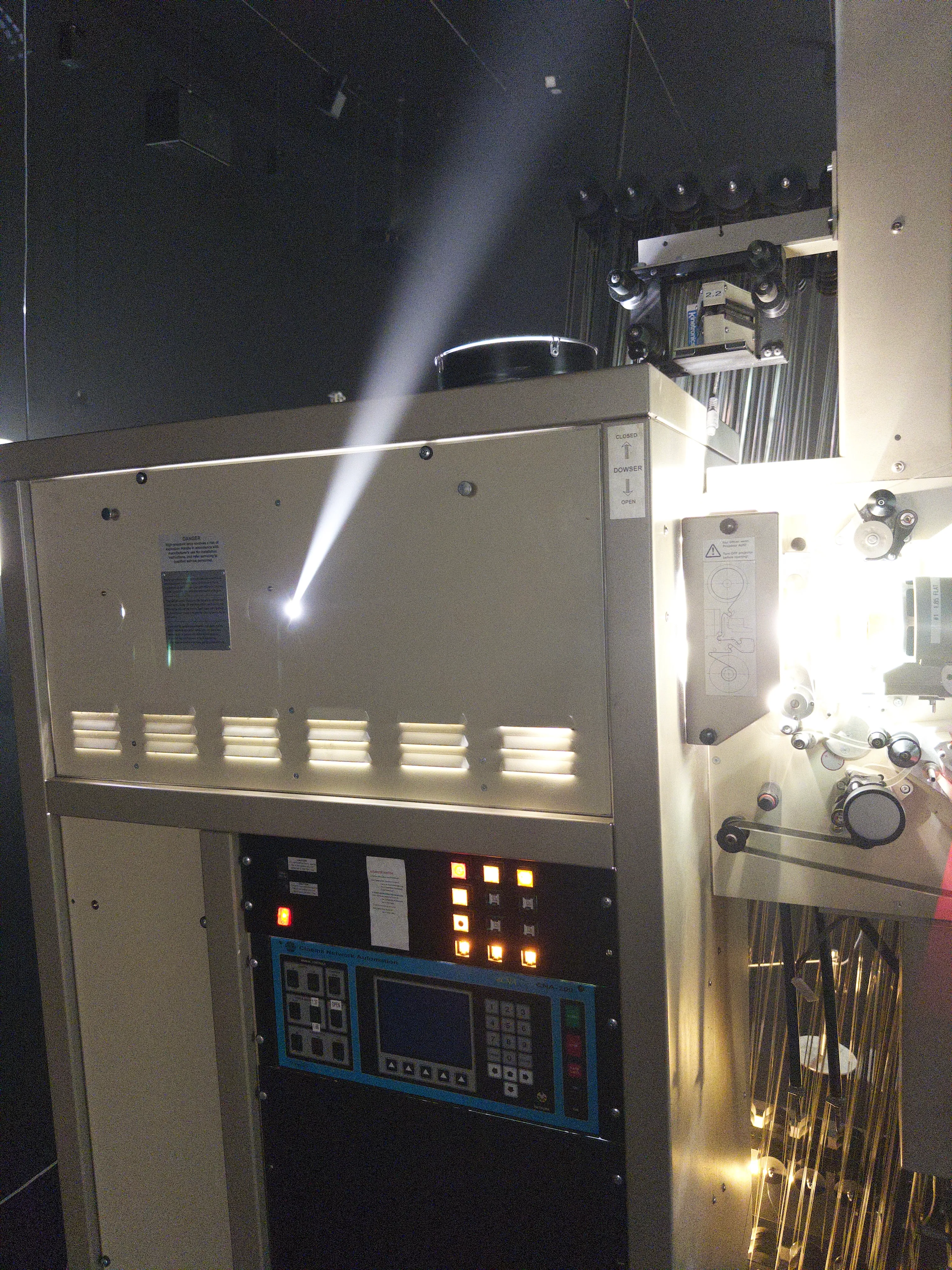
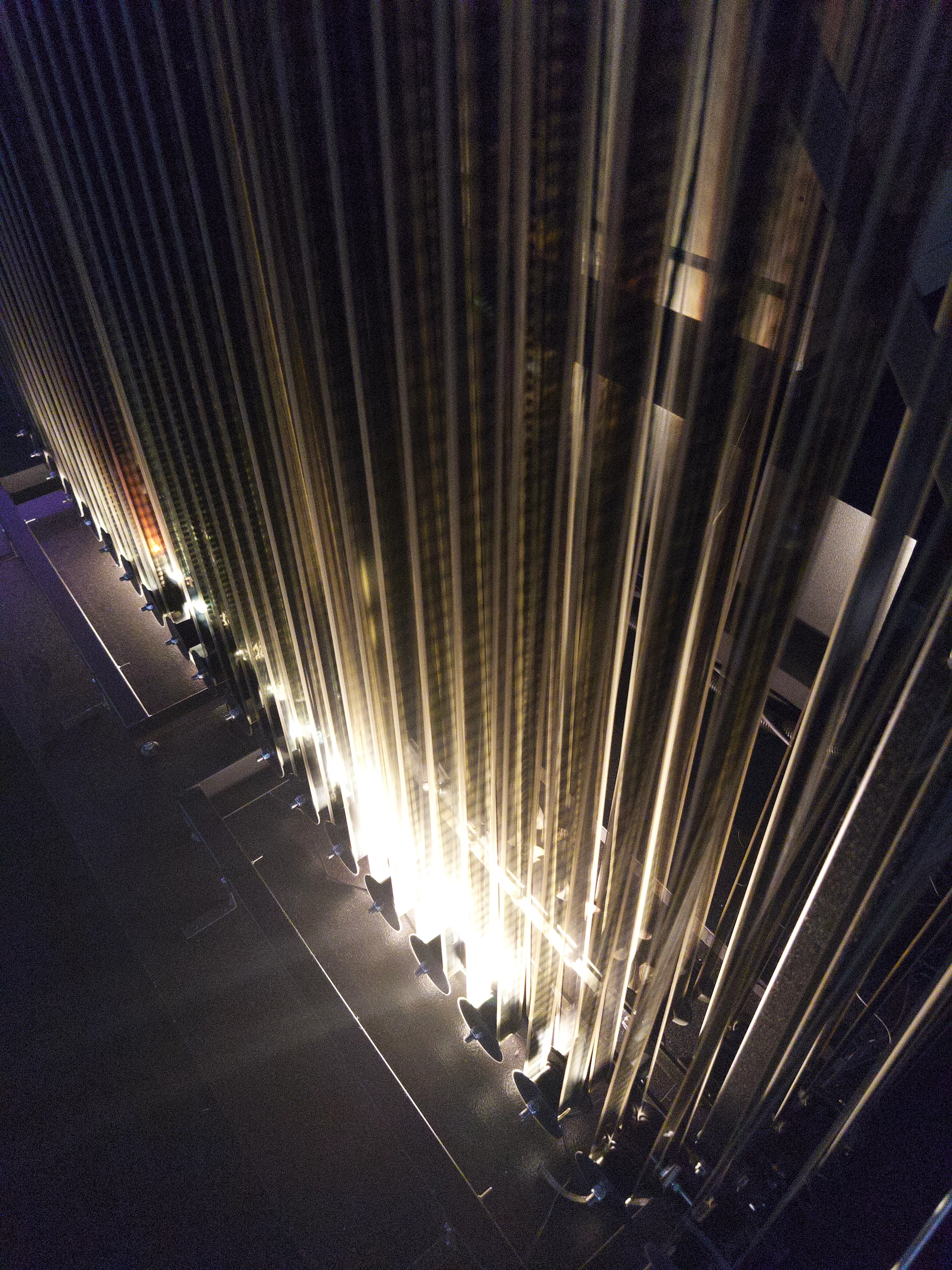
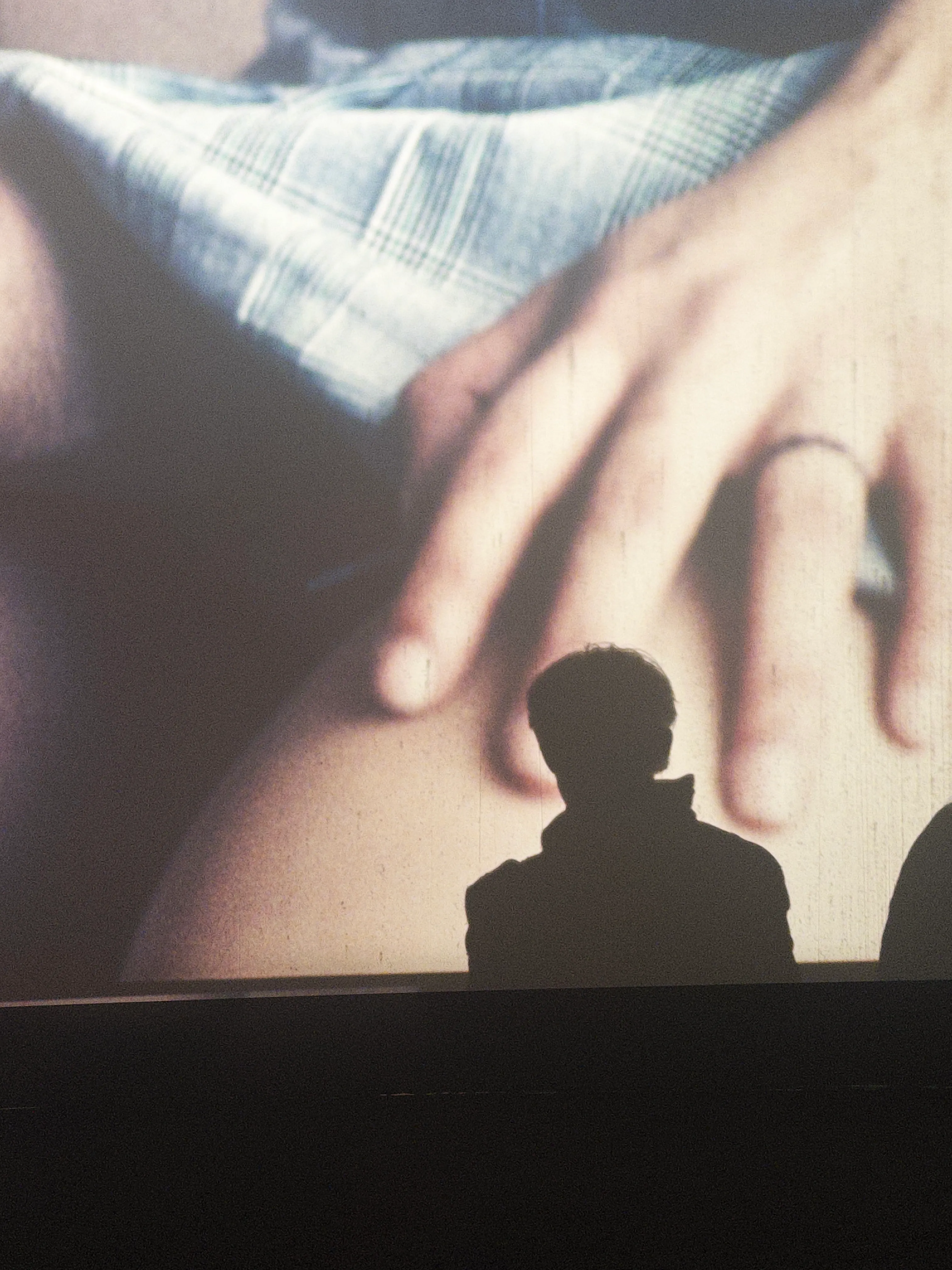
Ducking behind a black curtain, feeling my way along the edge of a hot, loud, and deeply dark room. Towering machines with light spilling out of them consume miles of film on display, zagging all over the place. The mechanical complexity and precision of these old analog machines reveal the mechanics of the image. I’ve never seen analog projectors of this scale this close. I see what inspired Paul Virilio when writing “War and Cinema: The Logistics of Perception.” How the mechanical advancements of the automatic machine gun made possible the motion film camera. Both shoot, one a round of bullets and the other a canister of film. The mechanics largely the same. One leads to the other, feedback takes hold.
War and cinema. War and image. I think back to Magritte, and how my mind continuously wanders these days to the nature of intelligence. This afternoon plays out as the government puts export controls and is revoking access to the latest foundational models like Fable, Anthropic’s flagship model. War and intelligence. How does intelligence fit into all this? We’re presently at an equivalent moment to when projectors were the size of rooms. Images no longer static, no longer paint on canvas, but put into motion. Tricking the eye into seeing something that isn’t there. Seeing a thing for what it is can be quite hard.
At least twenty minutes have passed since entering the room before looking at the images being projected. Violent images, none of them real. Just images. I watch the volumetric light made visible in the haze.
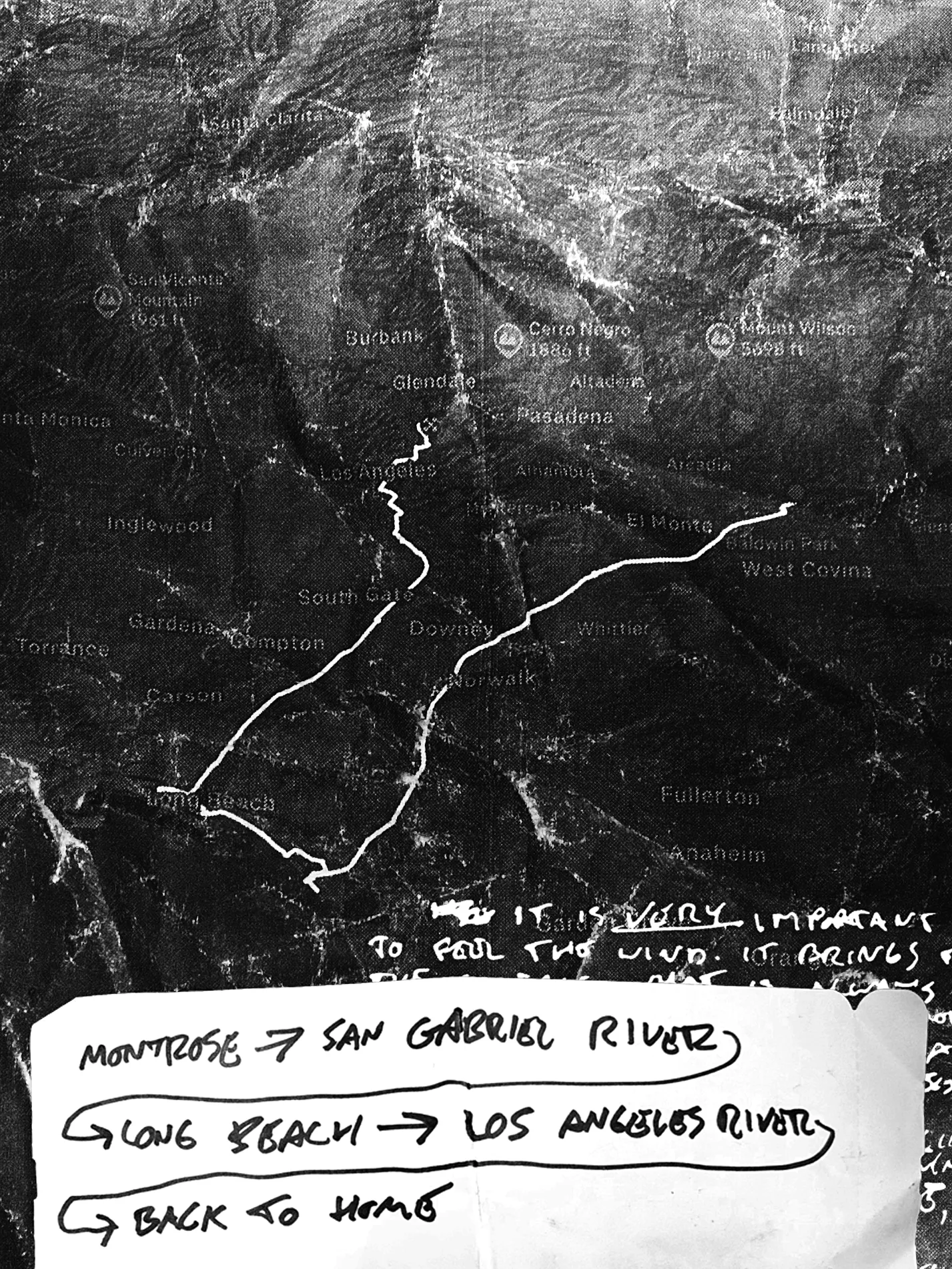
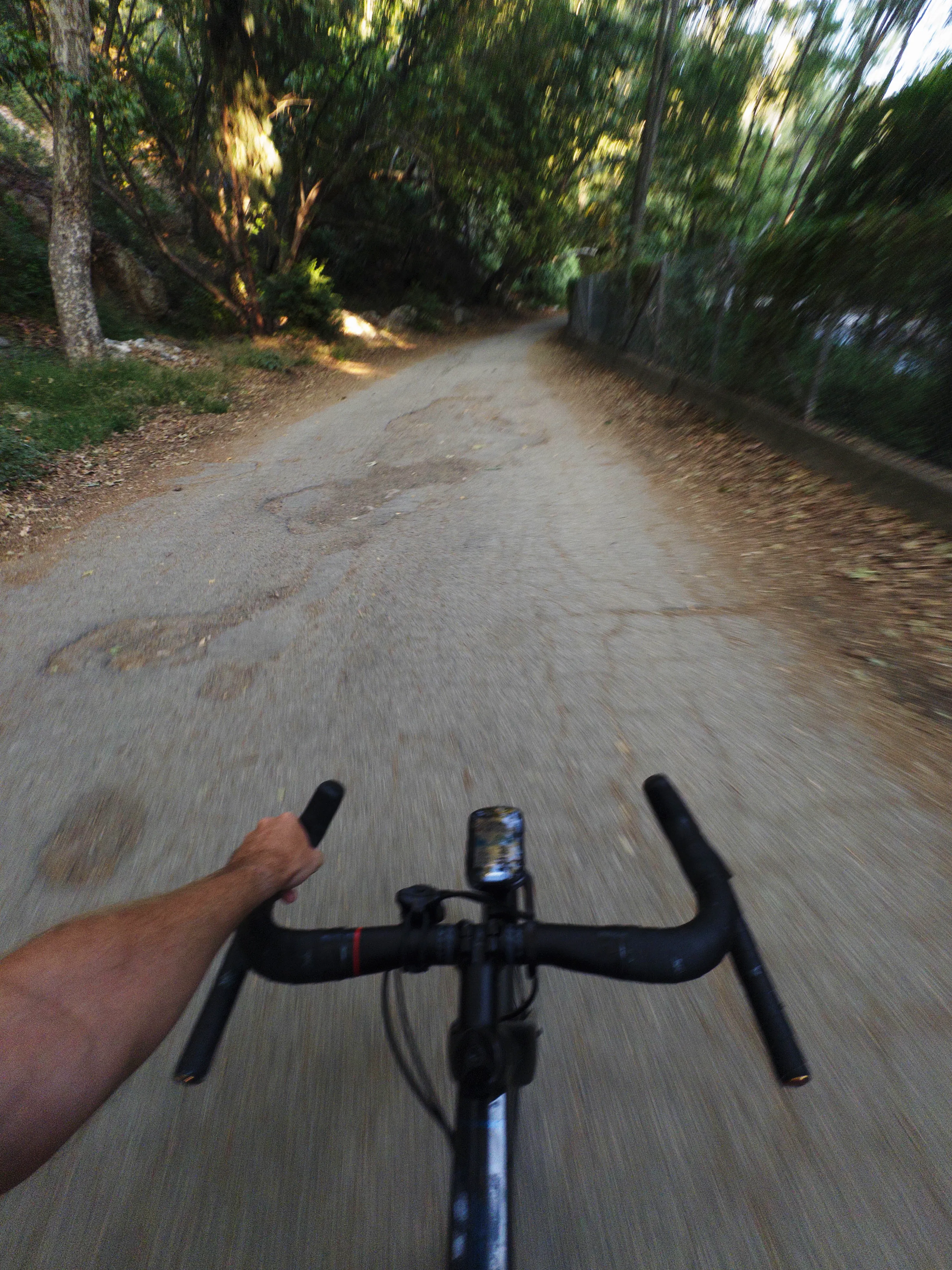
It is VERY IMPORTANT to feel the wind. It brings to the surface what is always true. A medium we all move with and through. Is it a headwind? A tailwind? An absence? A presence? Do you feel the resistance or the push?
Get a bike and you increase a sensitivity to air and wind and body. At first when you’re on the bike, then increasingly when you’re off the bike. A crucial shift in distance and duration uniquely through an exchange between the biological and the mechanical.
Riding as gesture towards not being one to participate in “the forgetting of the air.” Bike as tool for awareness of the air. The wind. The arch-mediator that mixes everything together. “Air never takes place in the mode of entry into presence, except in the wind.” Movement into presence. Thanks, Frank.
You find yourself in places you have no reason to be, other than the route affords good riding conditions. Less traffic, better surface. You may pass a 7-11 playing very loud classical music through cream-colored speakers mounted streetside. You might stand there listening for some time. A path terminating at the port, the scale leaving an impression of awe like the granite walls of Yosemite.
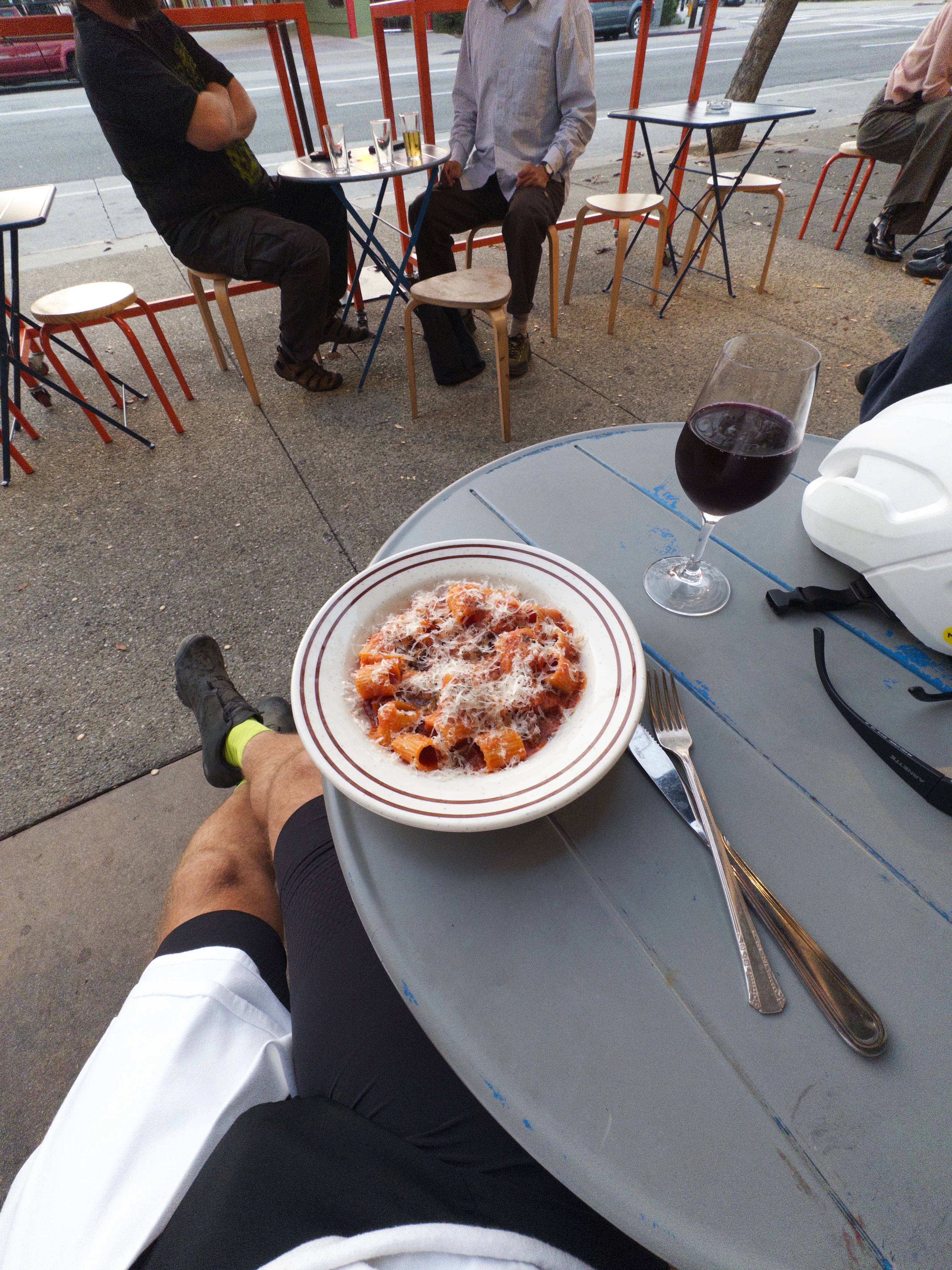
Walls of fragrance. Clouds you’d be shielded from behind the glass of the car. Blooming jacaranda. Water reclamation. It all hits. Want to pick a route? Follow the nose. Bring a friend. Bring two. Bring twenty. What’s another plate of pasta and glass of Boulay?
Sit atop the saddle and let the scene pass by.
Blink and the day has passed by too.
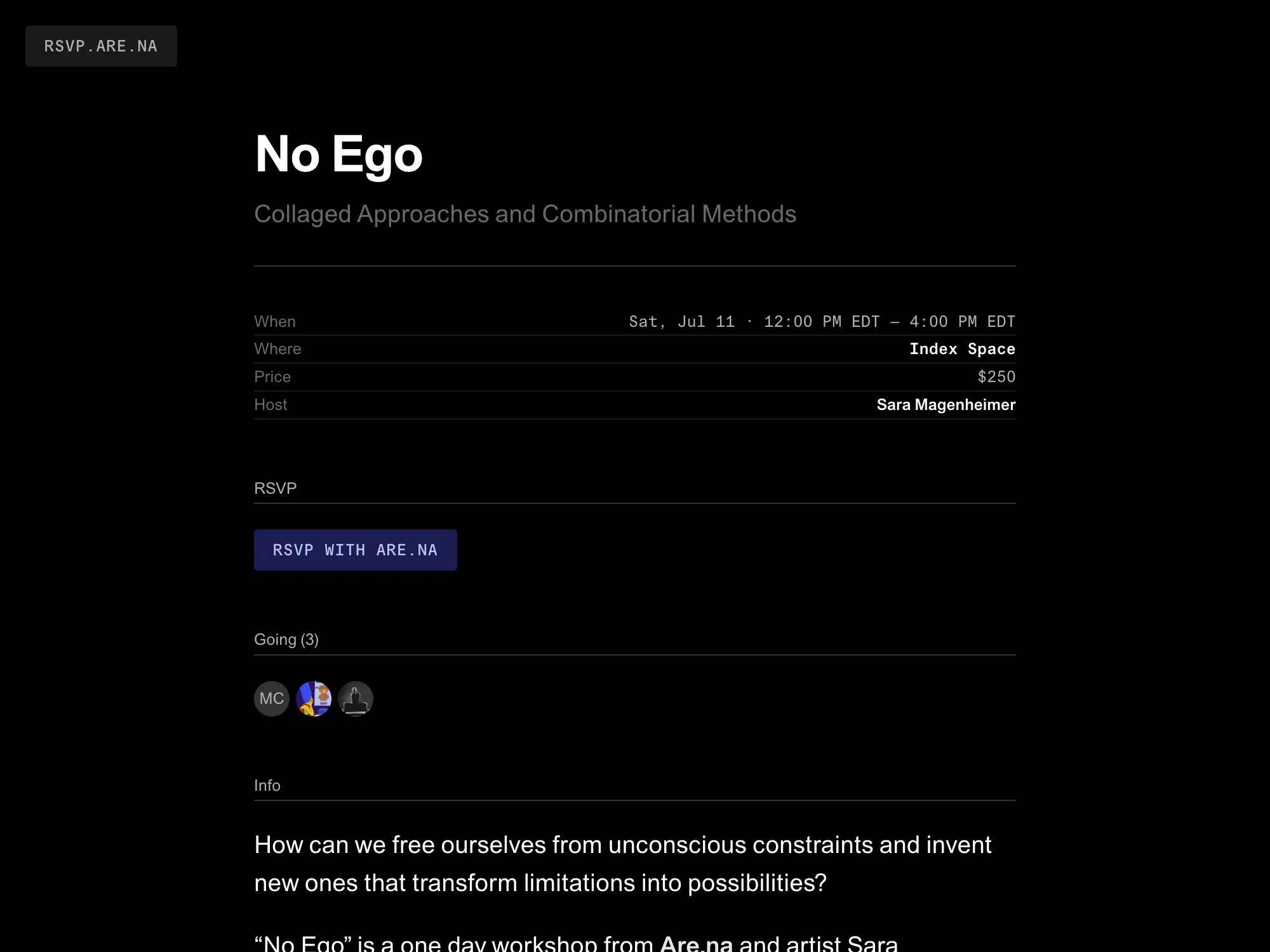
Are.na is teasing an RSVP app at rsvp.are.na, where you connect with Are.na to RSVP to events. I have thoughts on this.
rsvp.are.na
In trying to explain Are.na, I often return to an infamous channel. “How do you describe Are.na at a party.” It’s quite funny, because like most all things good, Are.na is undefinable. Particularly at a party where no one is on Are.na.
But if you asked me, I’d say Are.na is less about the interface, or the functionality. That is all necessary in support of making Are.na possible. But it is not Are.na.
It’s the set of values, principles, and the people who connect them that makes Are.na what it is. People defining and occupying a space where they draw connections between what they love and value and care for.
So if you go to a party where the only way you can attend the party is to be on Are.na, you don’t need to answer the question of how do you describe Are.na at a party. Everyone knows. It’s in the air. There’s built-in connection and shared context.
This is in stark contrast to something like Partiful, which is for absolutely everyone and no one simultaneously, like many apps and platforms. No signal. Just utility. Just an interface.
Don’t get me twisted though. The interface for Are.na and the mobile app is critical, and has recently improved drastically. I find myself using it more often as the ergonomics fit into my life better. The updated web client optimized around speed and performance set the tone. The mobile app ran away with it. But I wouldn’t say it’s the differentiator here. That’s the utility. Are.na is the people.
But of course, examples of pure utility and interface exist which feel deeply connected to the principles and values of Are.na. The attributes that give it that quality. Single-player tools like Obsidian come to mind.
So what’s the difference?
Partiful is going about it funded by venture capital, playing the blitz-scale playbook. Are.na is supported by the people who use it through subscription. There was an early equity crowdfunding campaign, but most of the contributors were already users, and it was a pittance compared to the typical venture check.
It’s impossible for Are.na to be that venture backed blitz thing. Why? Because you can’t scale the care and the love for something in a way that you can scale the pure utility of something. Love isn’t legible to capital. It’s not a resource you can extract. Obsidian feels similar. It’s pure utility, but a sense of love keeps it focused for a specific group of people on the receiving end of the tool.
We’re at this moment where “pure utility plays” can be spun up so fast. You have a thought, and the next instant you can interact with it. This can be lighthearted play, or nefarious attention-fracking. The hard thing is defining the principles and values you hold, and sticking with them long term in the way Are.na and Obsidian have.
For them, it doesn’t matter if the user-base scales beyond a very reasonable place where sustainability is achieved. You actually don’t want everyone becoming a user. You want a narrow group of people who get it.
One of the biggest challenges for Are.na is how not to scale at a certain point. I could see Are.na getting flooded with people trying to RSVP for certain things, but it’s not very likely, as RSVP isn’t core to the utility Are.na provides.
I’d be interested in seeing how the Are.na context could be used to shape the RSVP process. Allowing only those who’ve had an account longer than a certain period of time. Or a certain number of channels and blocks. Perhaps a certain number of connections from others. You can only RSVP if you attach a channel to your request, and it is reviewed to inform approval. I can see how these requirements could lead to certain social traps, too.
I’m curious to see how this may or may not continue to be developed, released, and used. The tool itself is simple. You can connect the Stripe API to a vibe-slopped version in minutes. Or simply use Partiful. So why use it at all? For that same indescribable quality that makes answering how do you describe Are.na at a party an impossible thing.
I personally want to use this for a writing/reading group I’ve wanted to begin for years and years. The focus is Trip Reports. Time spent in movement. On foot, on skis, on bikes, whatever. Looking at it with deep perceptual awareness and appreciation for environment. Often trip reports live as carousels on Instagram with a brief caption. I want to know what actually happened, and I want to be able to riff with you and ask questions. Maybe eat some snacks, too.
Make it a picnic. Some picnics are writing-oriented. Other picnics are reading-oriented. They can switch. Long live Are.na.
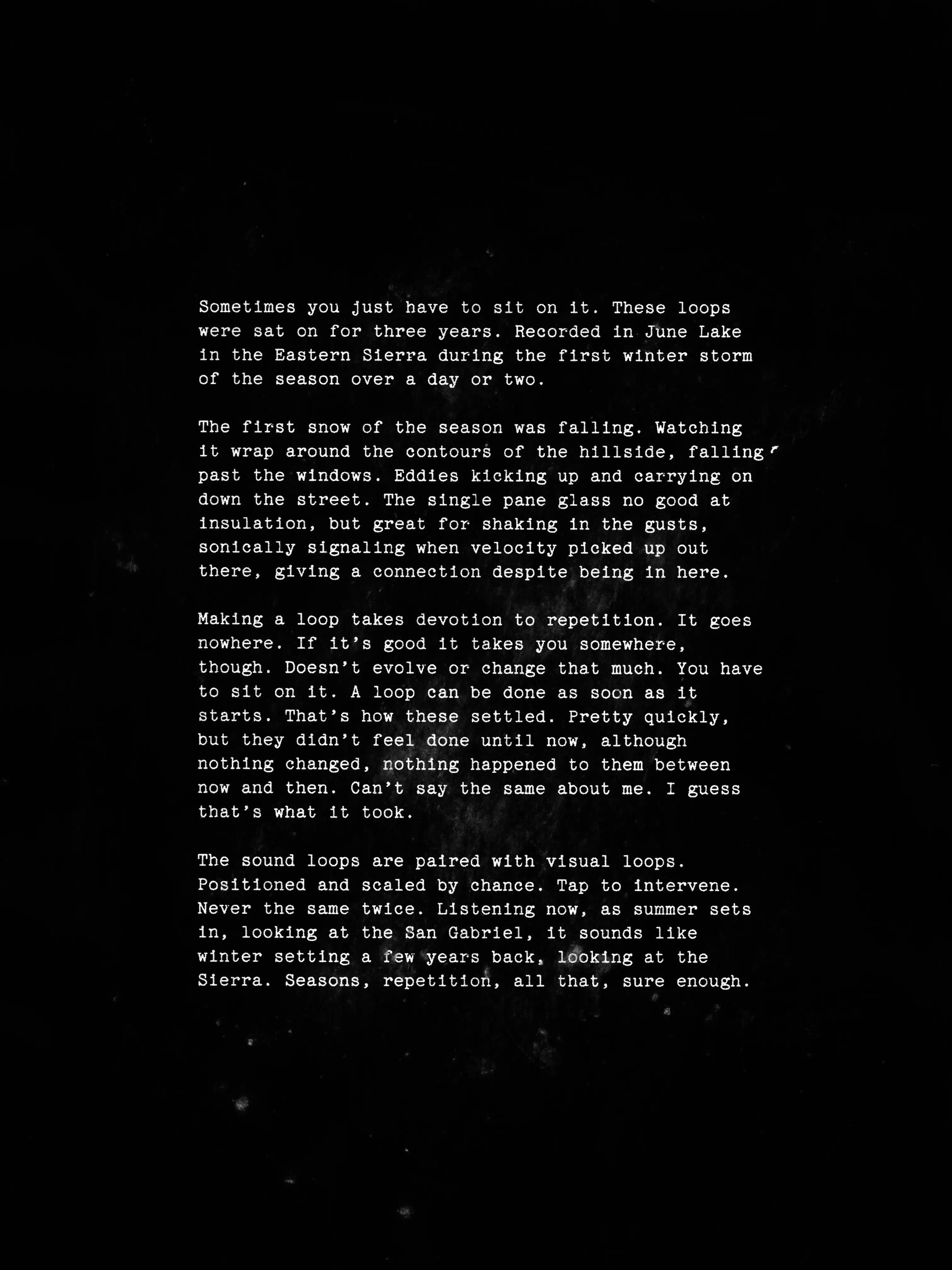
Sometimes you just have to sit on it. These loops were sat on for three years. Recorded in June Lake in the Eastern Sierra during the first winter storm of the season over a day or two.
Snow just starting to fall. Watching it wrap around the contours of the hillside, falling past the windows. Eddies kicking up and carrying on down the street. The single pane glass no good at insulation, but great for shaking in the gusts, sonically signaling when velocity picked up out there, giving a connection despite being in here.
Making a loop takes devotion to repetition. It goes nowhere. If it’s good it takes you somewhere, though. Doesn’t evolve or change that much. You have to sit on it. A loop can be done as soon as it starts. That’s how these settled. Pretty quickly, but they didn’t feel done until now, although nothing changed, nothing happened to them between now and then. Can’t say the same about me. I guess that’s what it took.
The sound loops are paired with visual loops. Positioned and scaled by chance. Tap to intervene. Never the same twice. Listening now, as summer sets in, looking at the San Gabriel, it sounds like winter setting a few years back, looking at the Sierra. Seasons, repetition, all that, sure enough.
You can download the tracks, the video, the source for the interactive player by tapping download. You don’t need to install anything. Just drag the index.html file into your browser. If you want to fuck around, make it your own, replace the videos, replace the tracks, drag the folder into Claude Desktop and start describing the changes you want to make, remix it, whatever.
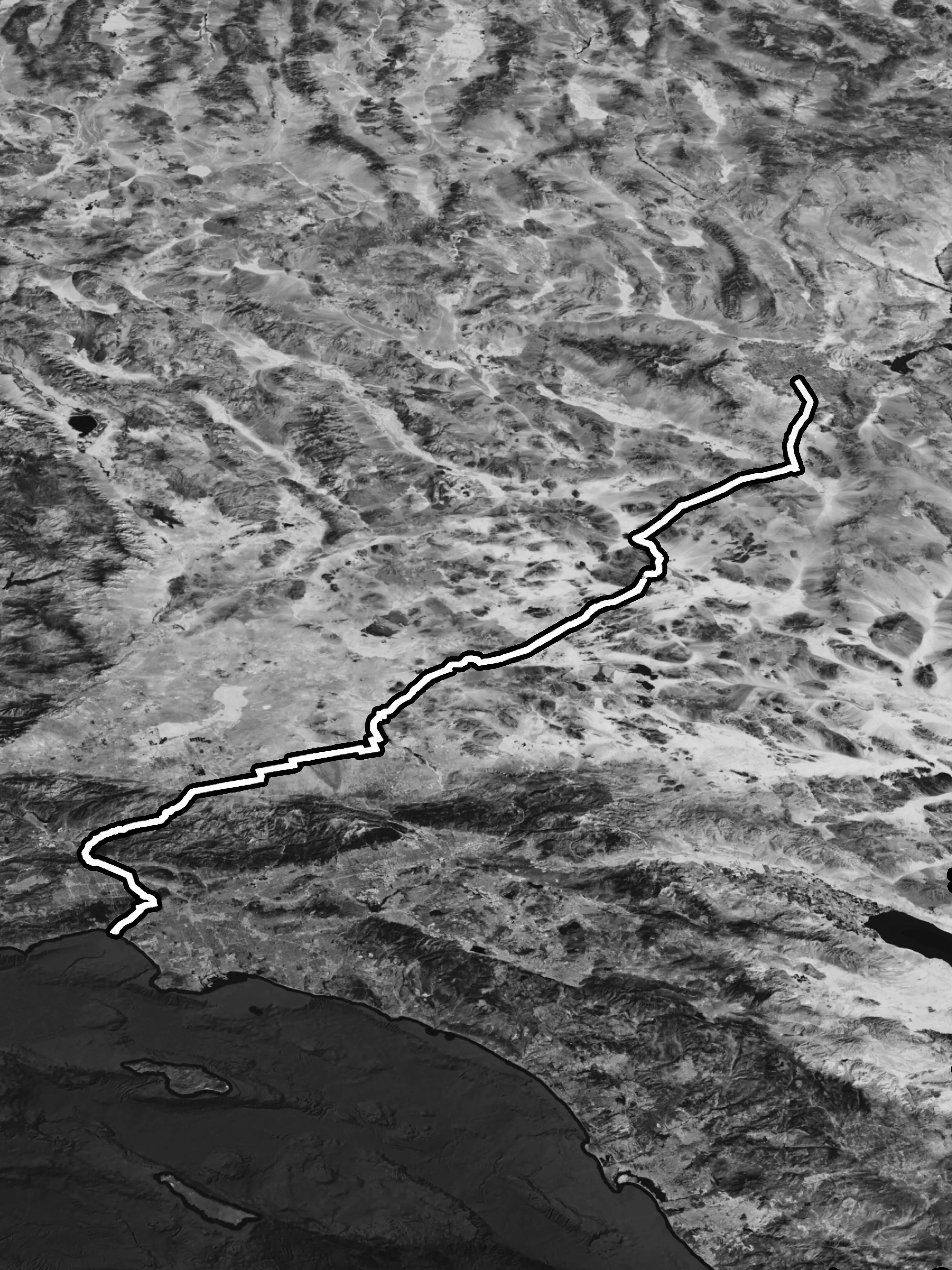
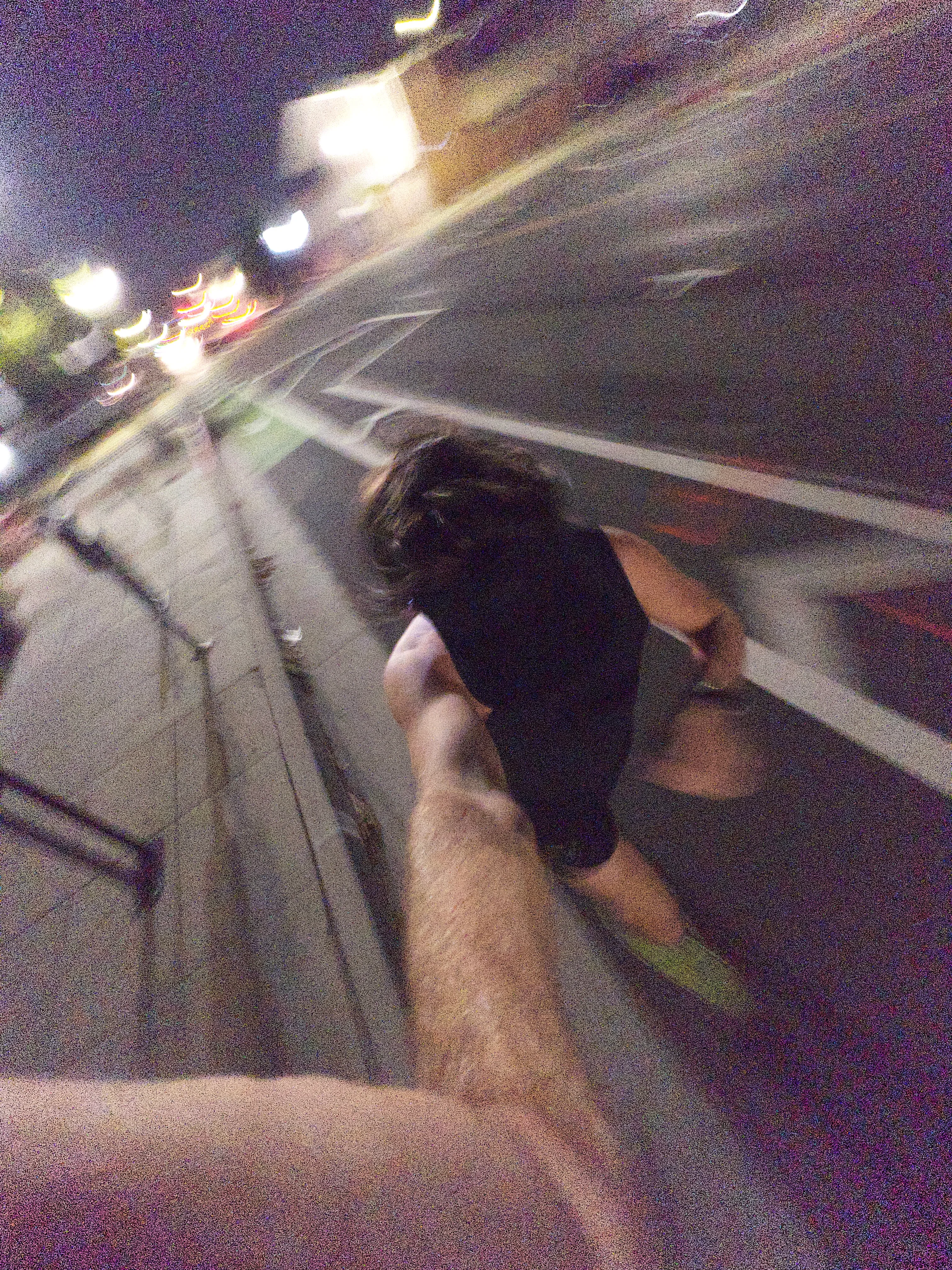
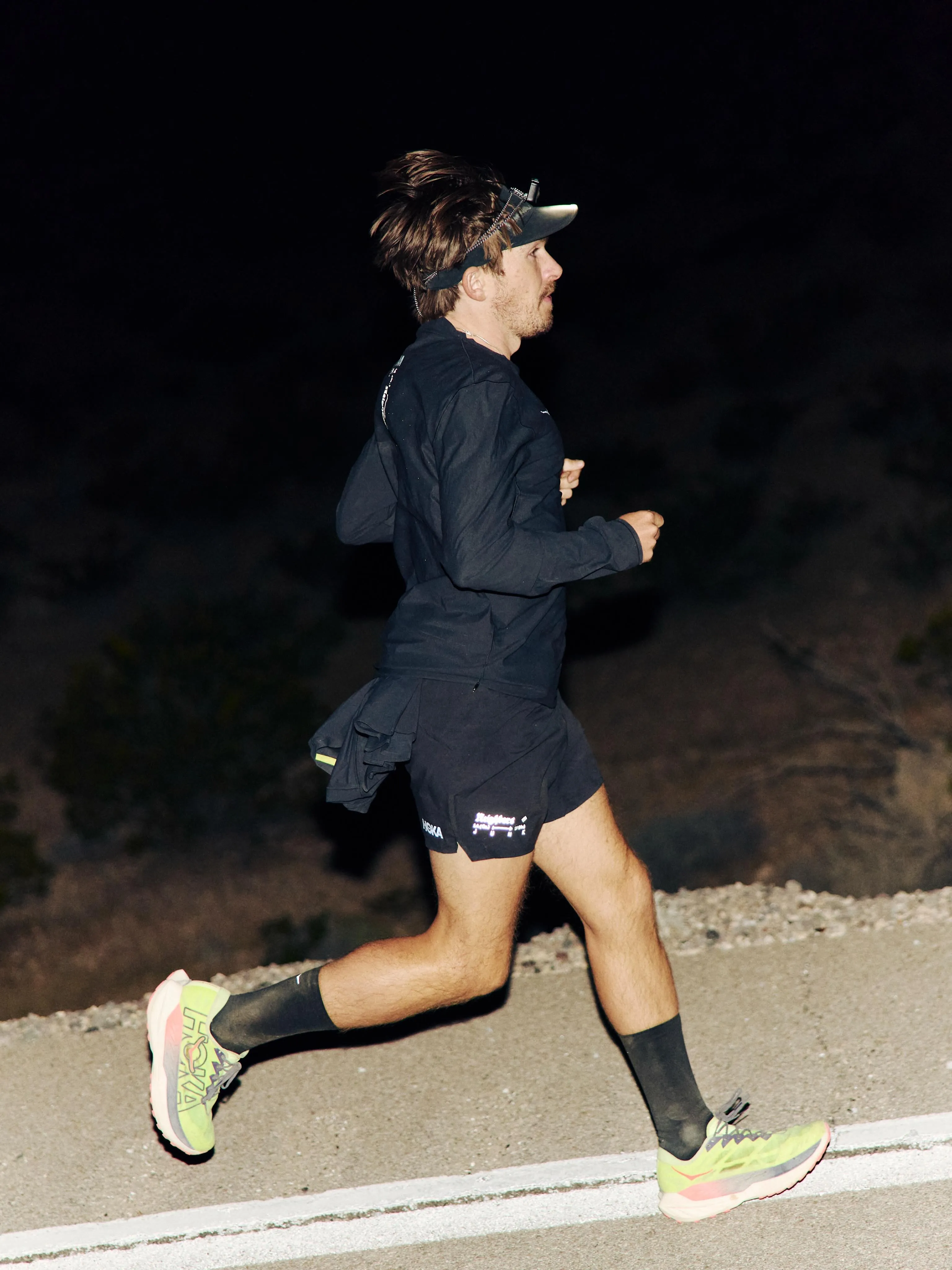
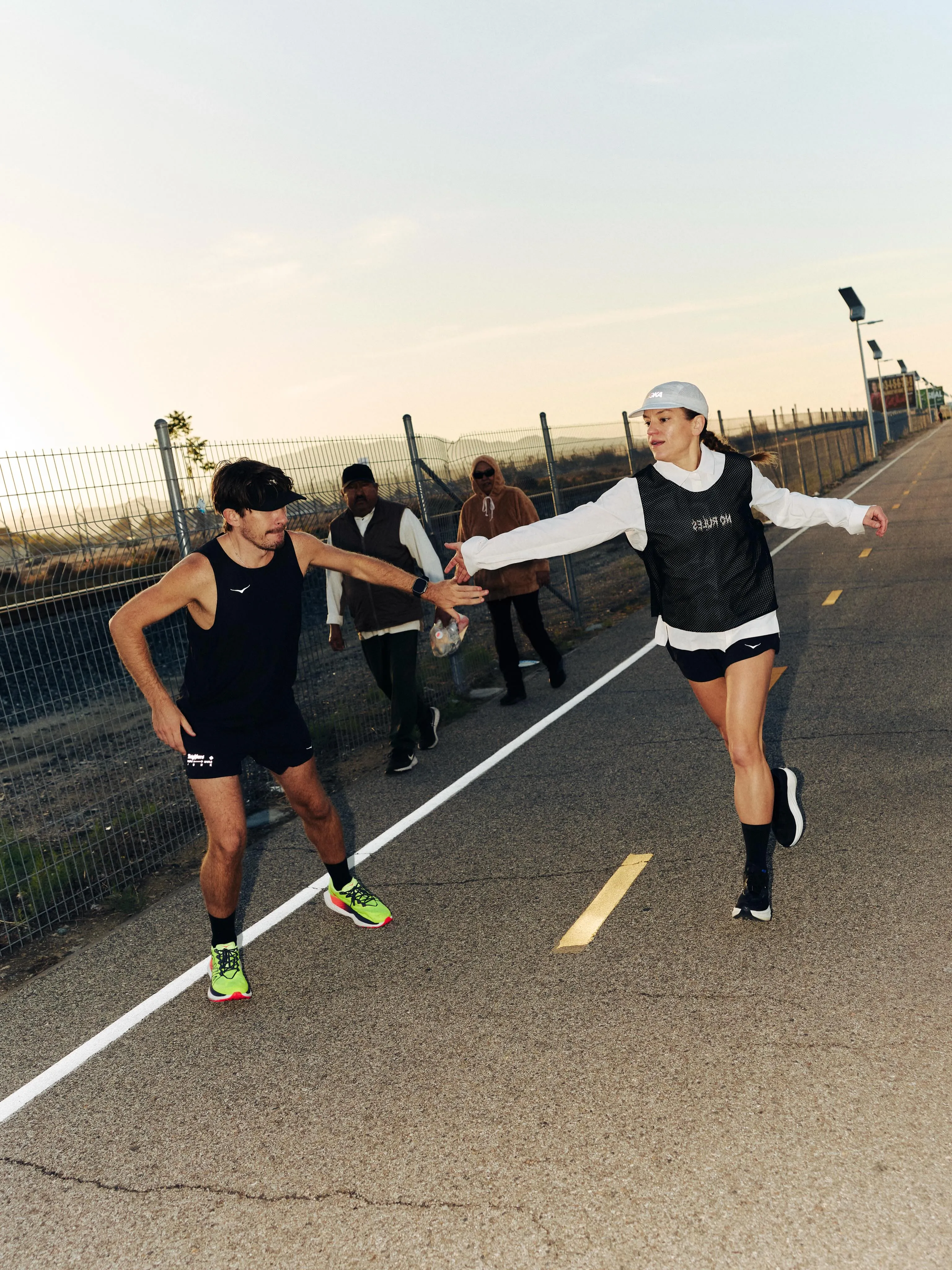
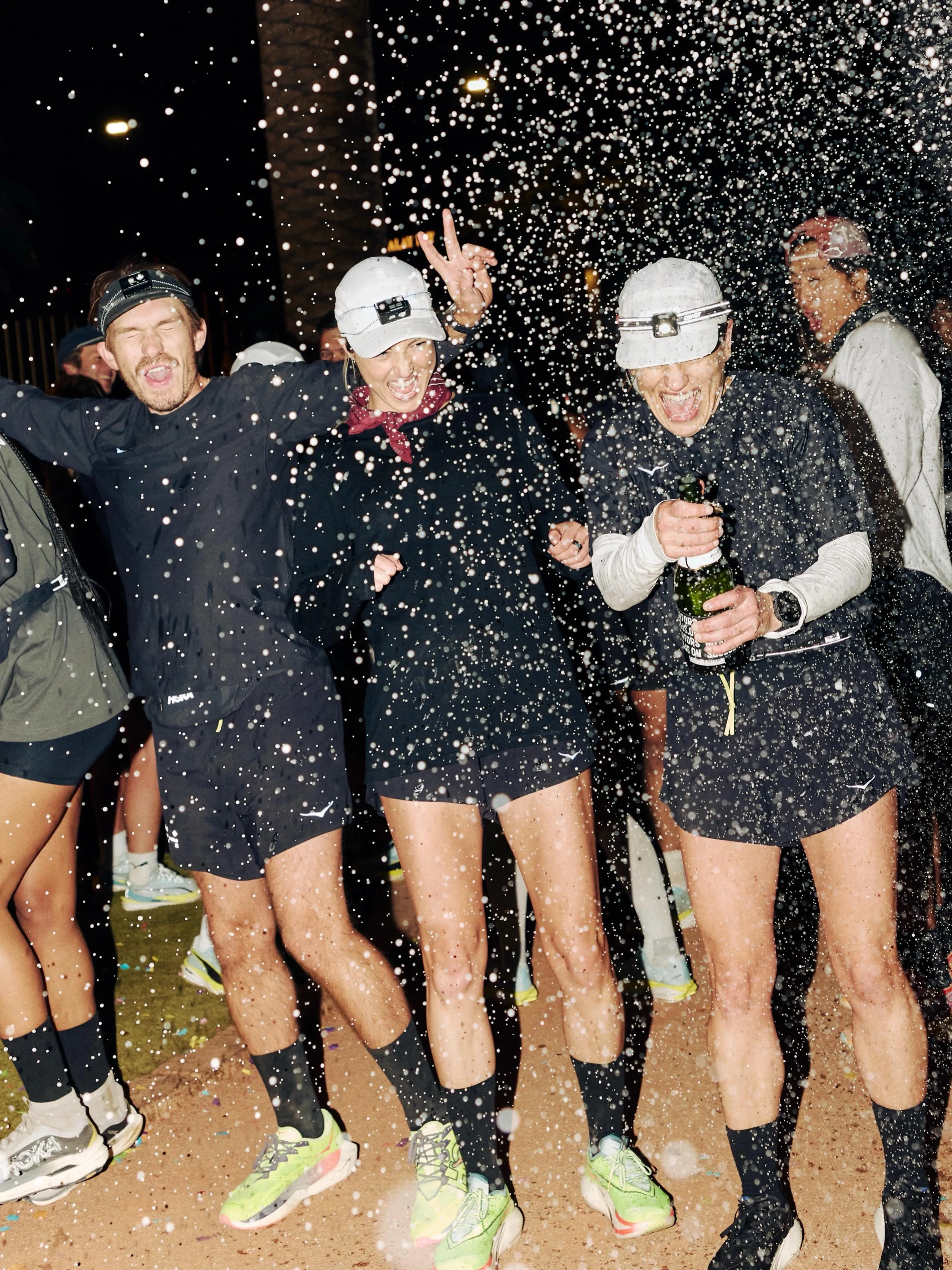
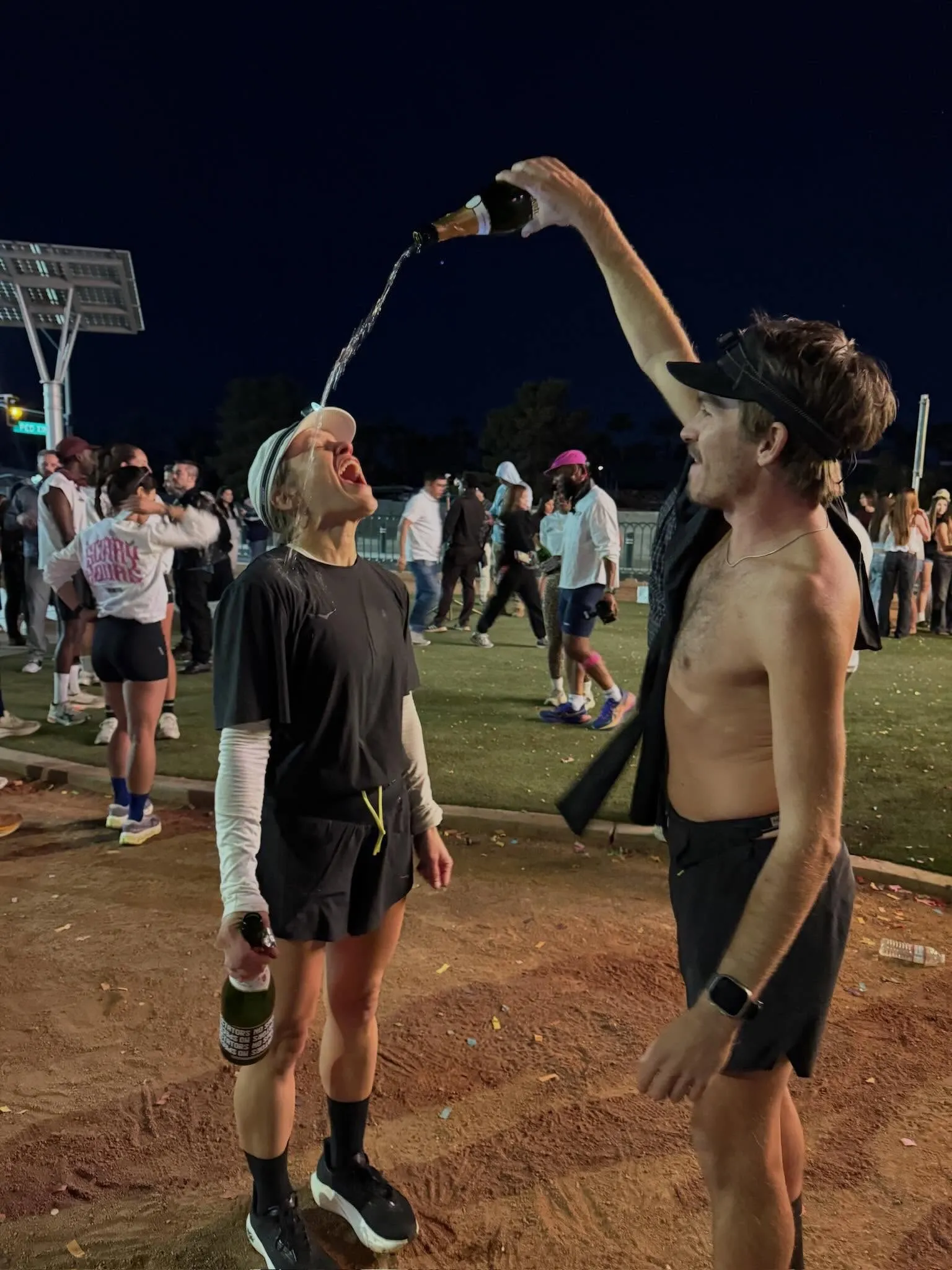
300 miles, 41 hours. 6 friends on foot, 4 crew. When you get asked “want to run a relay race from the beach to Las Vegas” one possible answer is no, but then none of this would’ve happened. Gather in the lot. Heavy eyes but we snap each other out of it. Rough idea, we head out.
Cold front spilling down Newhall pass, headwind like a hurricane climbing into the desert. Sand blasted. Hop out, run, handoff, hop in, again and again and again and… a lot of movement, a little progress.
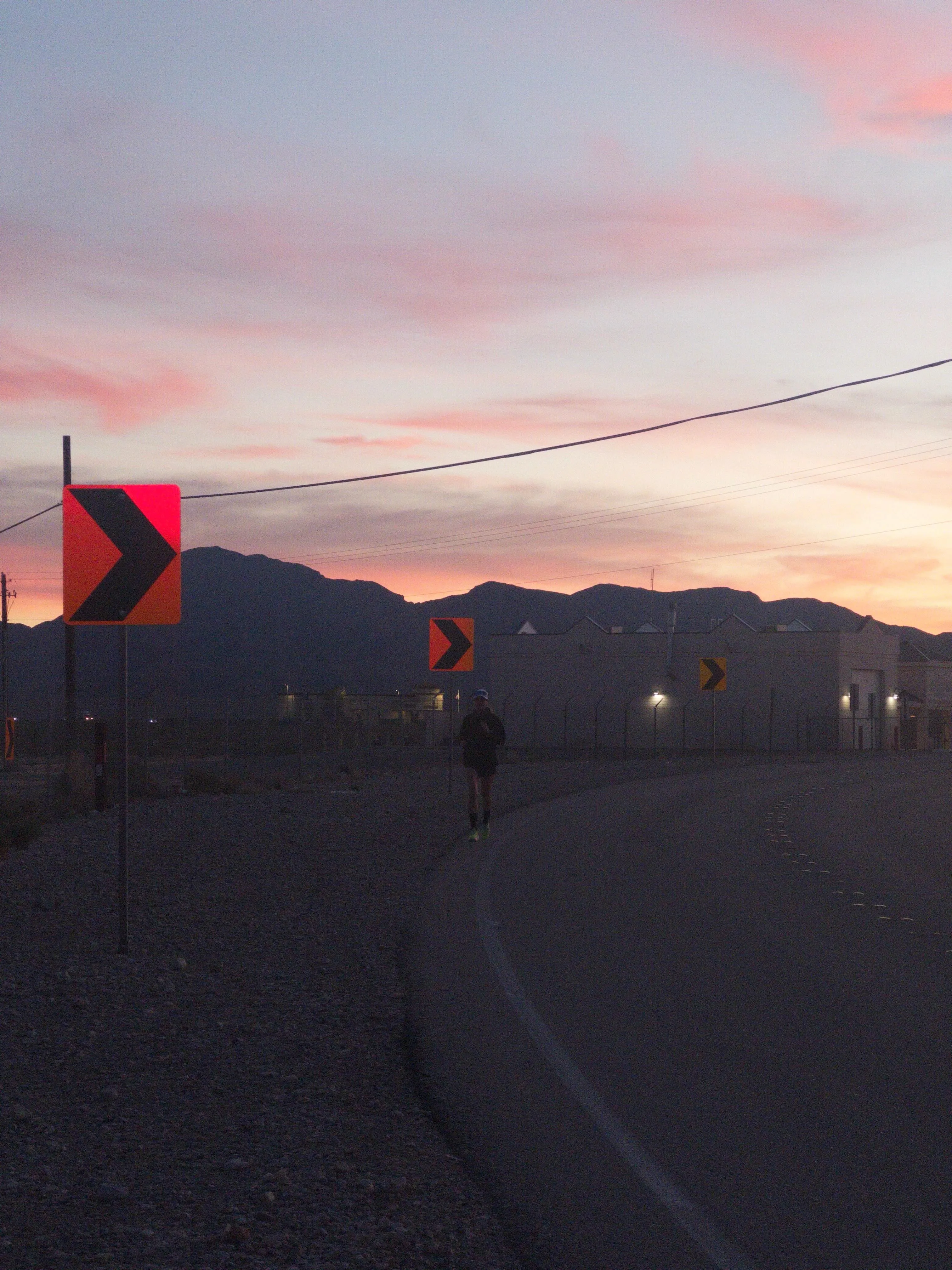
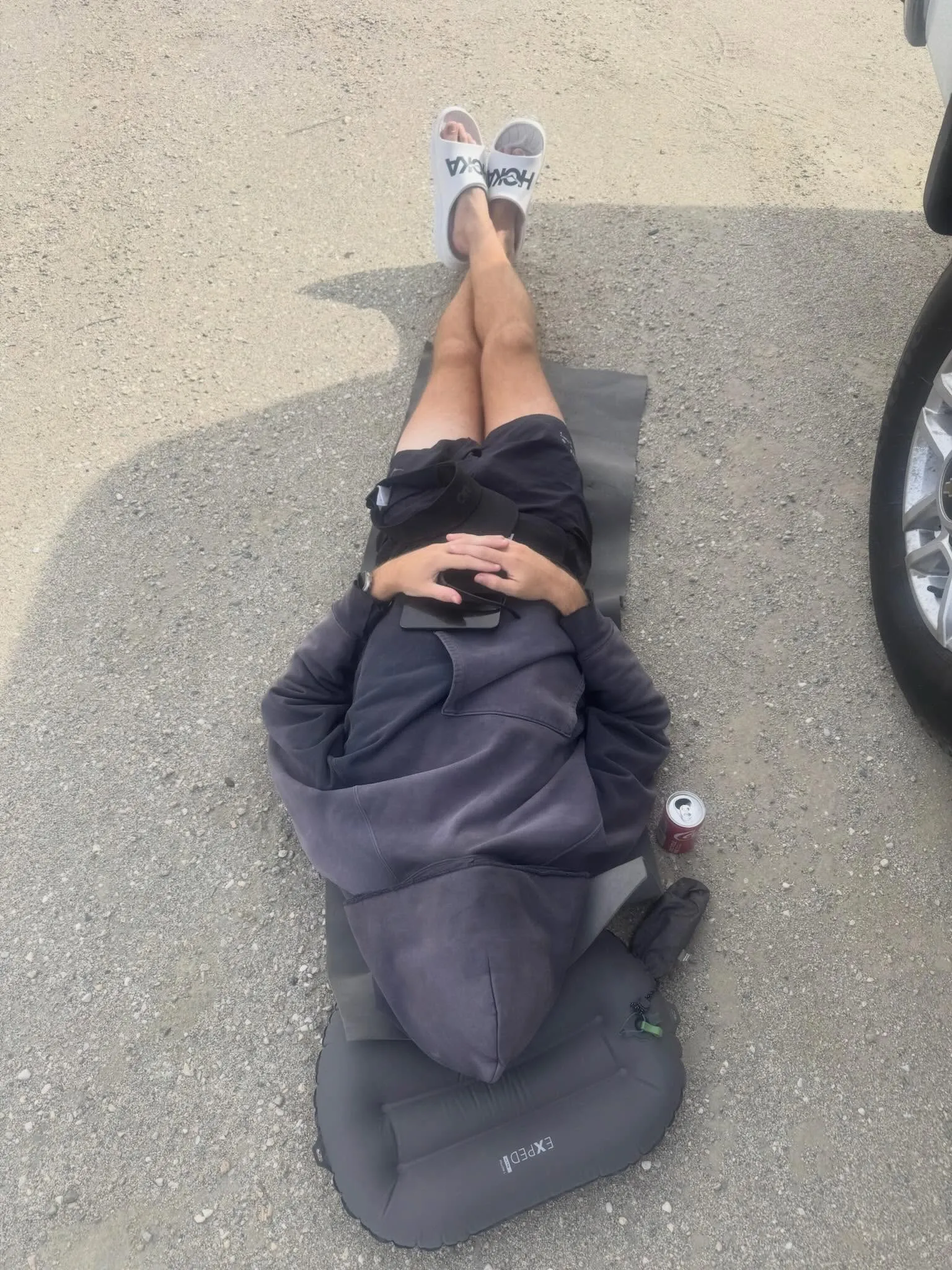
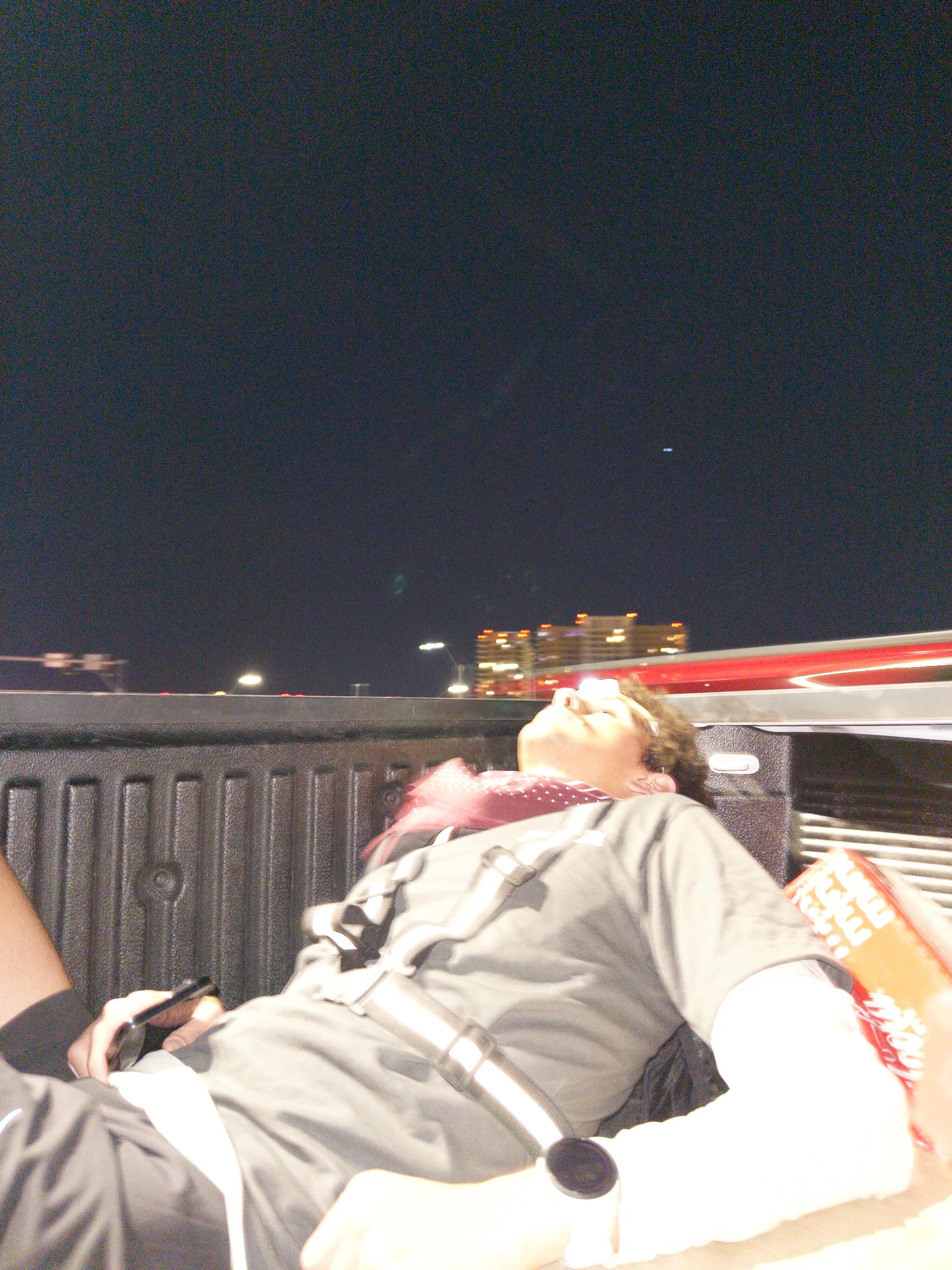
Ruffles and Electrolit never tasted so good. Pour the crumbles over me and let me bathe in it. Dirt naps never last long enough. Dogs bark as the sun dips heavy, headlights rip past while hugging the shoulder. Moonlight illuminates folding terrain as the chaparral cast dancing shadows.
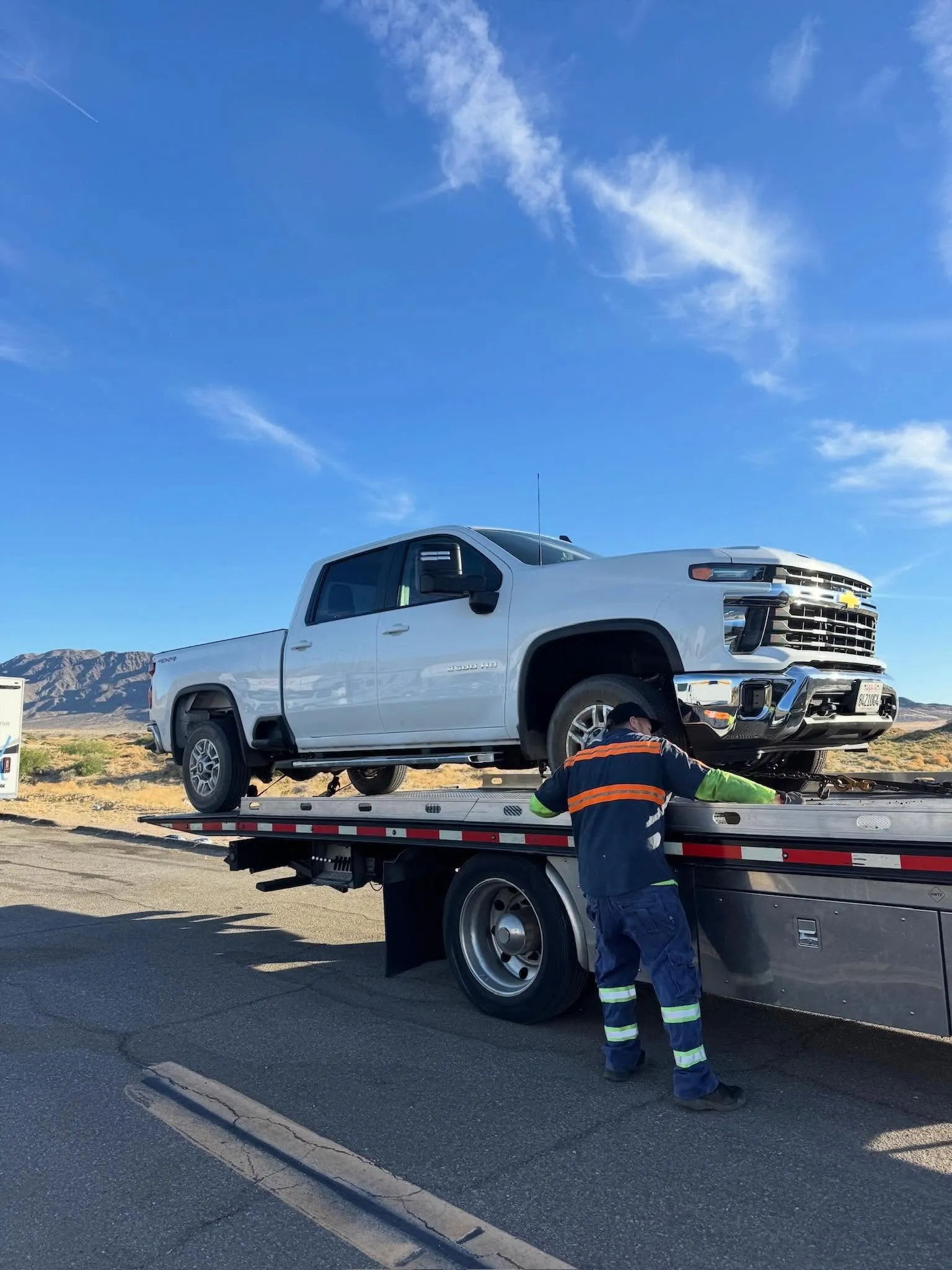
Sunrise. Heavy duty trucks aren’t supposed to fly like that. Any snapped necks? Somehow not. On the feet, on the toes. The other truck tosses in the hat and I might not be far behind. Tow it in. Sleep? What sleep? Nap here, nap there.
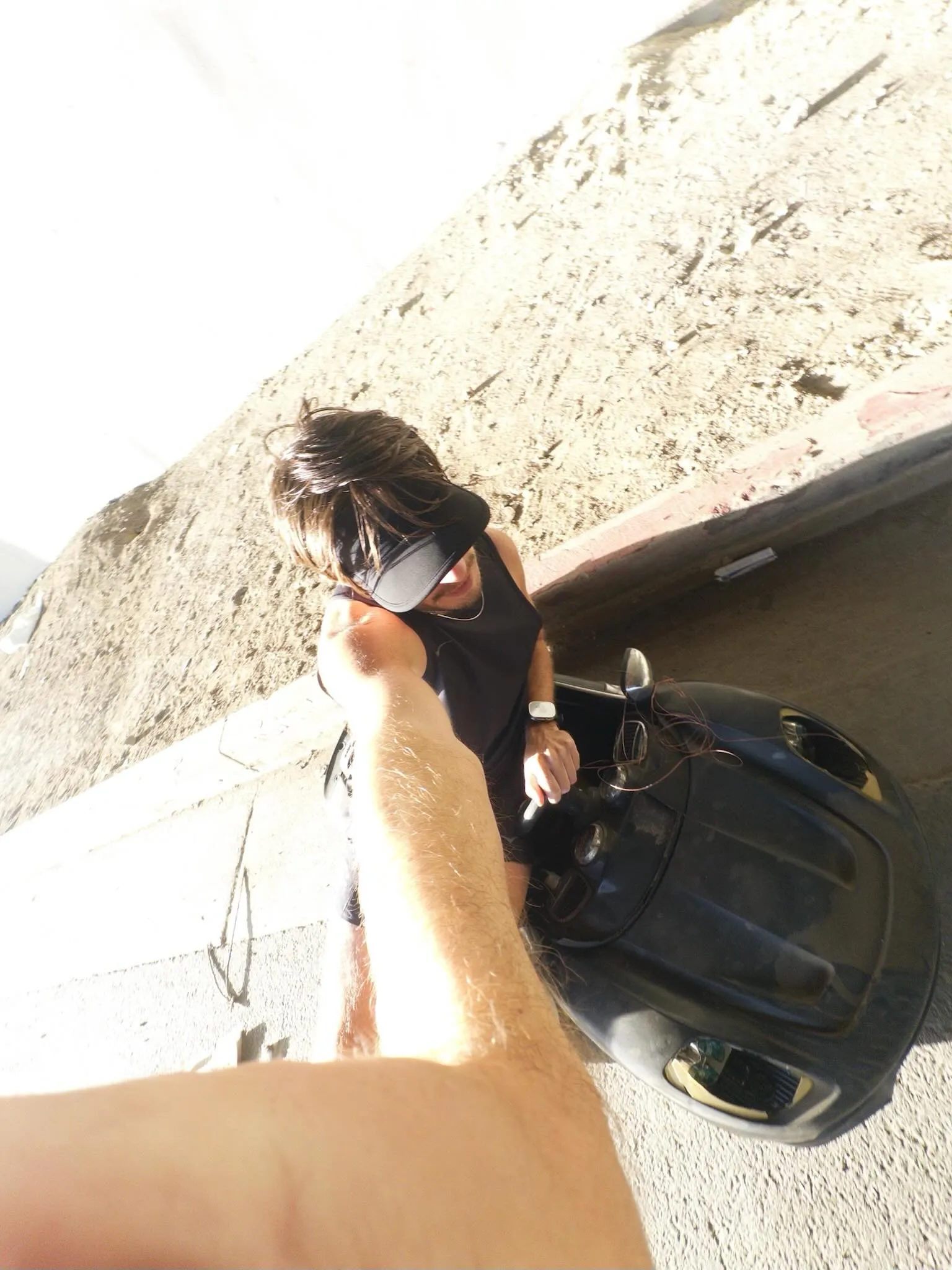
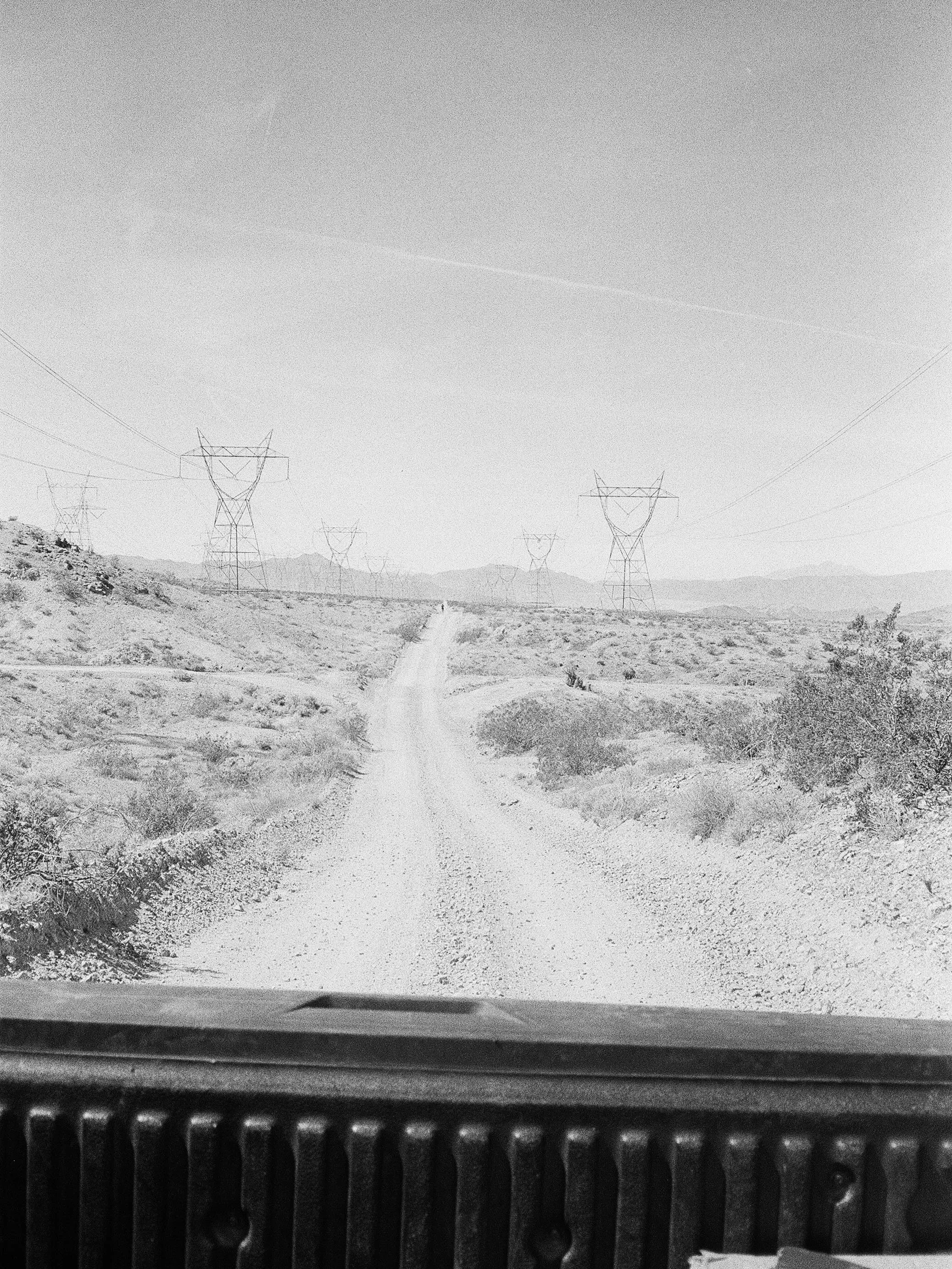
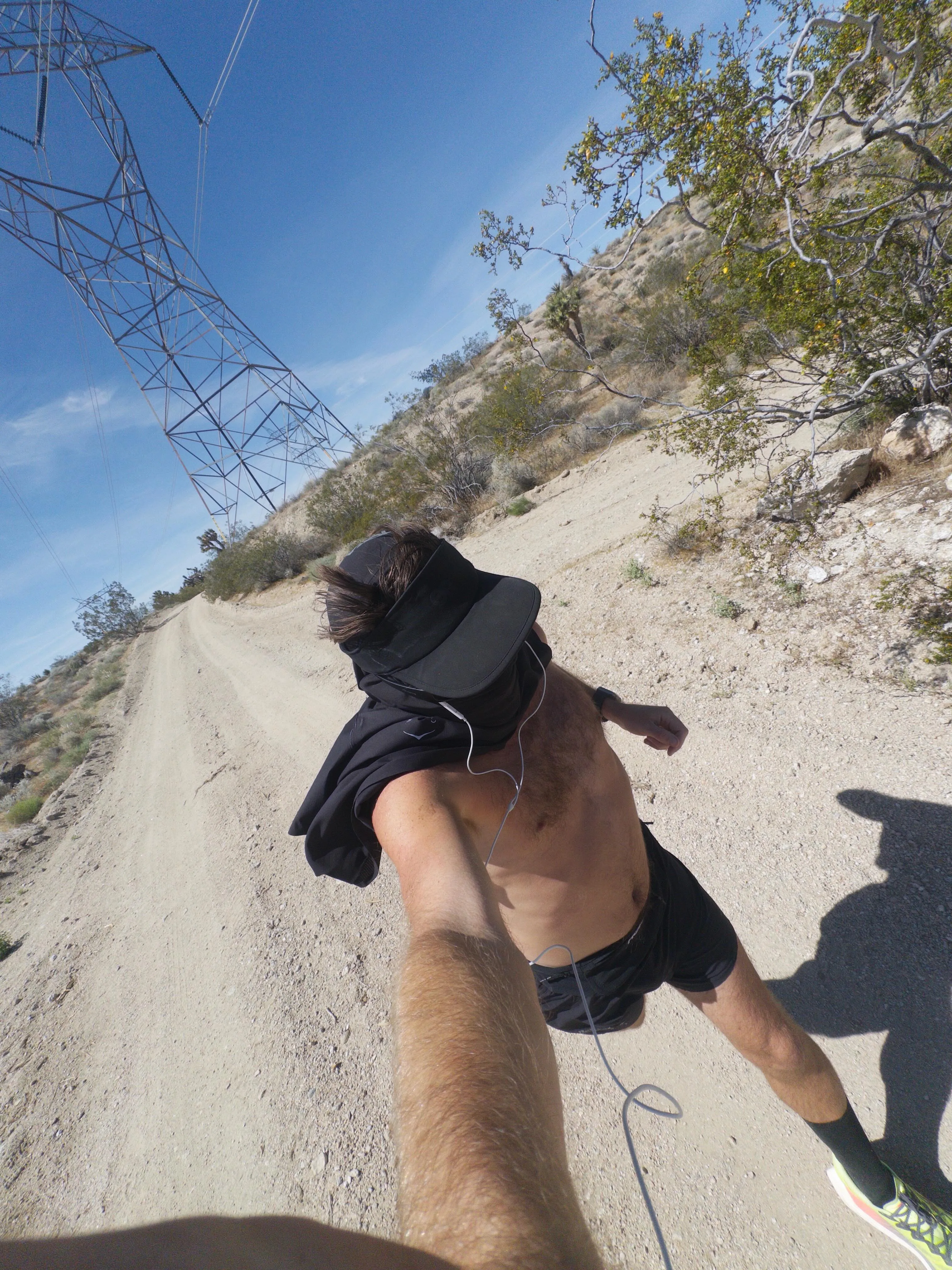
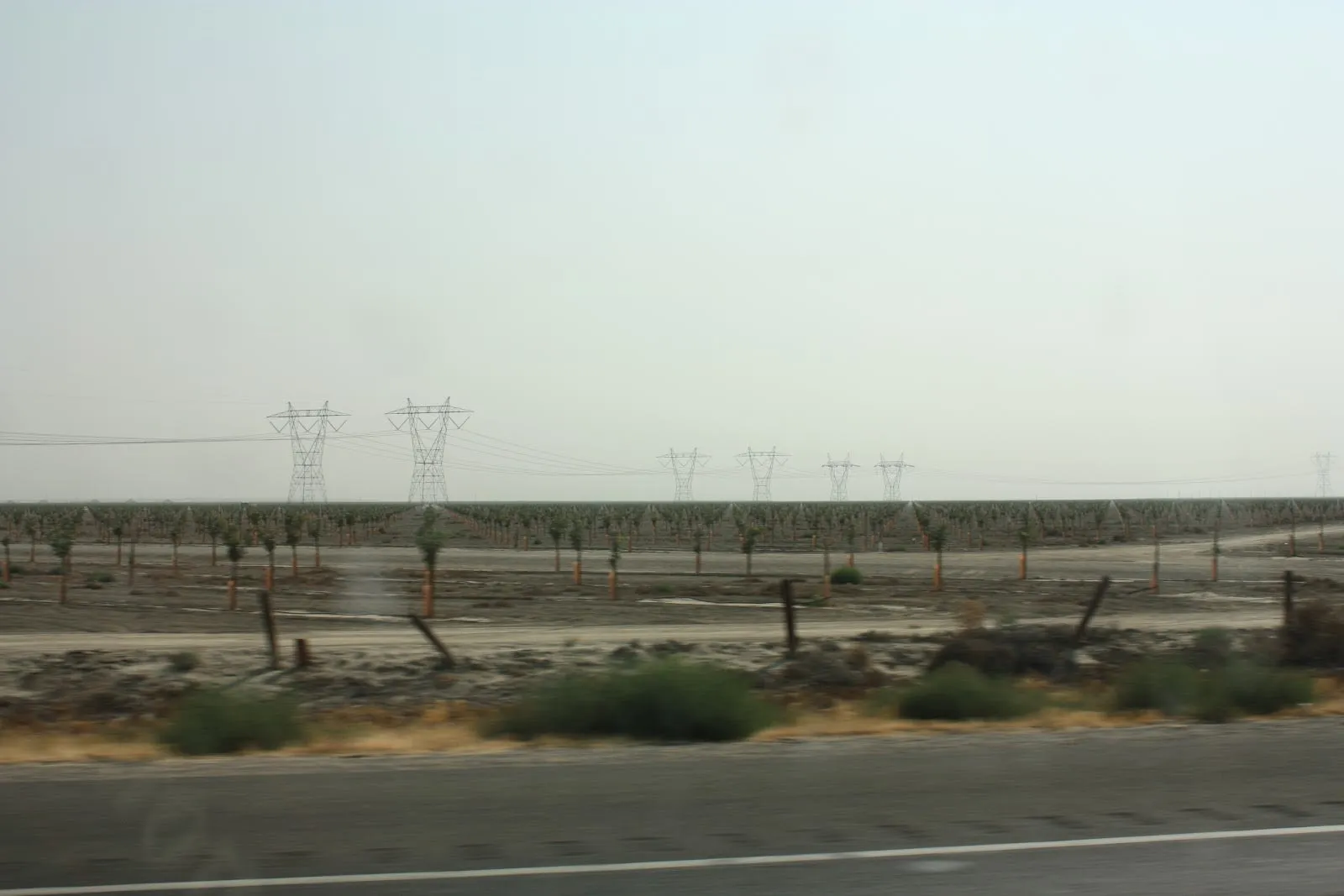
Roasting under power lines in the mid day. Where do they lead? Doesn’t matter. Another step, might as well be for eternity. Only this, always, forever, why not? Earth spins beneath our feet as we fall eastward towards the light. Forget the plan. Whoever has legs toss yourself out of the truck bed and get moving. Sprinting or crawling, whatever way it goes.
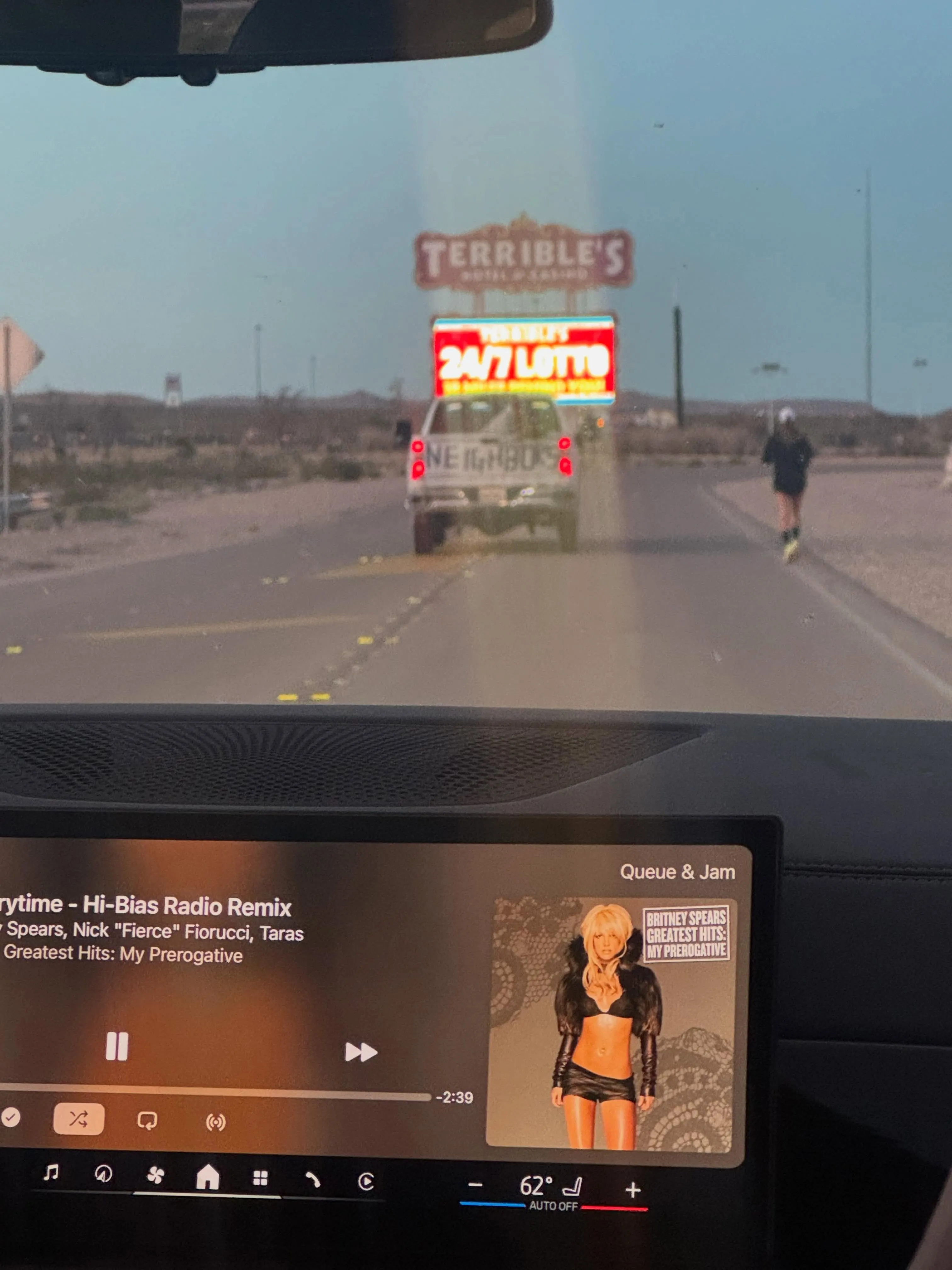
A special serving of 50 miles for each. Exiting the void, entering the mirage. Here it is, take it. Meandering the casino floors in a daze. Casino bathing in the style of forest bathing. Let the dust settle. There is always something to Learn from Las Vegas.
How I work today looks very different than it did a year ago. Or even a month ago. I’ve always been a generalist. Design was the gateway—making visual things. Making things interactive lead to a technical proficiency and learning how to program. This is now called “design engineering,” but the motivation was to do whatever necessary to see an idea through from conception to completion.
Not thinking along discipline, but intuitively doing what is needed to see a project through, is the direct result of my schooling experience.
I stopped attending school at age ten. Fifth grade was the last of it. We tried homeschooling, and I briefly had a curriculum, but I was online, and it quickly became purely interest driven. Loosely inspired by Montessori, but effectively unschooling. Not learning as defined by topic, but by curiosity and interest.
Because of this, I feel like I’ve been doing the same thing along a continuous meandering path since that time. It was only possible by having direct access to the open internet, and the ability for anyone to self publish permissionlessly. This enabled following my nose through everything and anything.
I’ve felt a similar increased ability to run while using nascent tools for programming assisted by AI recently.
Being a generalist and generating connections across wide ranges has guided me to leading product at startups I’ve either co-founded or joined as senior leadership. It involves many parallel feedback loops of direction and review. “Prompting” in a sense. There is a lot of gluing things together into a cohesive whole. Doing it effectively requires a deep understanding of everything a product requires—ideation, research, design, engineering, positioning, operations, etc…
I’m typically involved in the early and final stages of everything. Conception, polish, and giving the thumbs up. Call it the first and final 15%.
Finding myself in this position is a reflection of being a generalist with a slight “T” shape for design. Everything is driven by the idea, and I do whatever is necessary to enable the idea’s existence.
I love working with a team. A strong collaborative partnership that clicks is a gift. AI is not going to replace that.
But there is a kind of magic when you’re in the zone. Trying to keep up with an idea and holding on for the ride. AI tooling has recently gained the ability to do that middle 70% of execution remarkably well. Of course you have to lay the groundwork and follow it up with polish. But it’s exceptionally good at high velocity work with someone leading the product with care.
Working in this way has become known as “vibe coding.” A term that checks out. It’s very intuition based. Kind of like sailing. You’re at the helm, and you set the direction, but how the AI responds influences the path you take, just like the sea. It reveals things along the way you may not have stumbled into otherwise.
Currently I’m using Cursor, Claude Code, and Devin to work on Cycle. I’m not a great backend engineer, so I’m using it to write database migrations and API endpoints. I can pull down generated types from Supabase and reference the schema when using Claude Code to make a pull request with entirely new surfaces. Yes, it often takes a few hours of finesse to get it where I’d want it to be, but compare that to a week or two working with a team and the latency of revisions.
To my unschooled brain the ability to observe the AI is my greatest excitement. When working with a team you often must delegate. Many find this difficult. There aren’t enough hours in the day for you to do it all, and it’d drive anyone mad being on the receiving end of someone hovering the entire process in order to sponge it up, or asking for a detailed explanation of each decision to satisfy curiosity.
When prompting AI you see the process dictated in real time and are able to follow along. You see the logic playing out. You can ask for detailed explanations after a result has been generated. You can zero in on specific areas of personal confusion. It helps you better understand and think about the product you’re creating.
There is a misconception that the primary affordance of AI is increasing velocity. Of speeding up arriving at an output. In a sense this is true, in the same way a pencil speeds up your ability to make a legible mark on paper. But it is also a remarkable learning tool. You can ask limitless numbers of questions to satisfy your curiosity without, well, driving it nuts.
None of this is without contention. I have no idea the implications of what this means for labor, creative or otherwise. I don’t believe being a cog in the machine is sustainable. That detached phone it in mentality. The places where it’s possible will not exist much longer. Maybe that is ok. I don’t think it’s good to feel detachment from what you’re doing. It’s good to care. It may be difficult, and you may experience disappointment and pain by doing that, but it’s real. It’s important to be hopeful, and that involves risk, as does anything good.
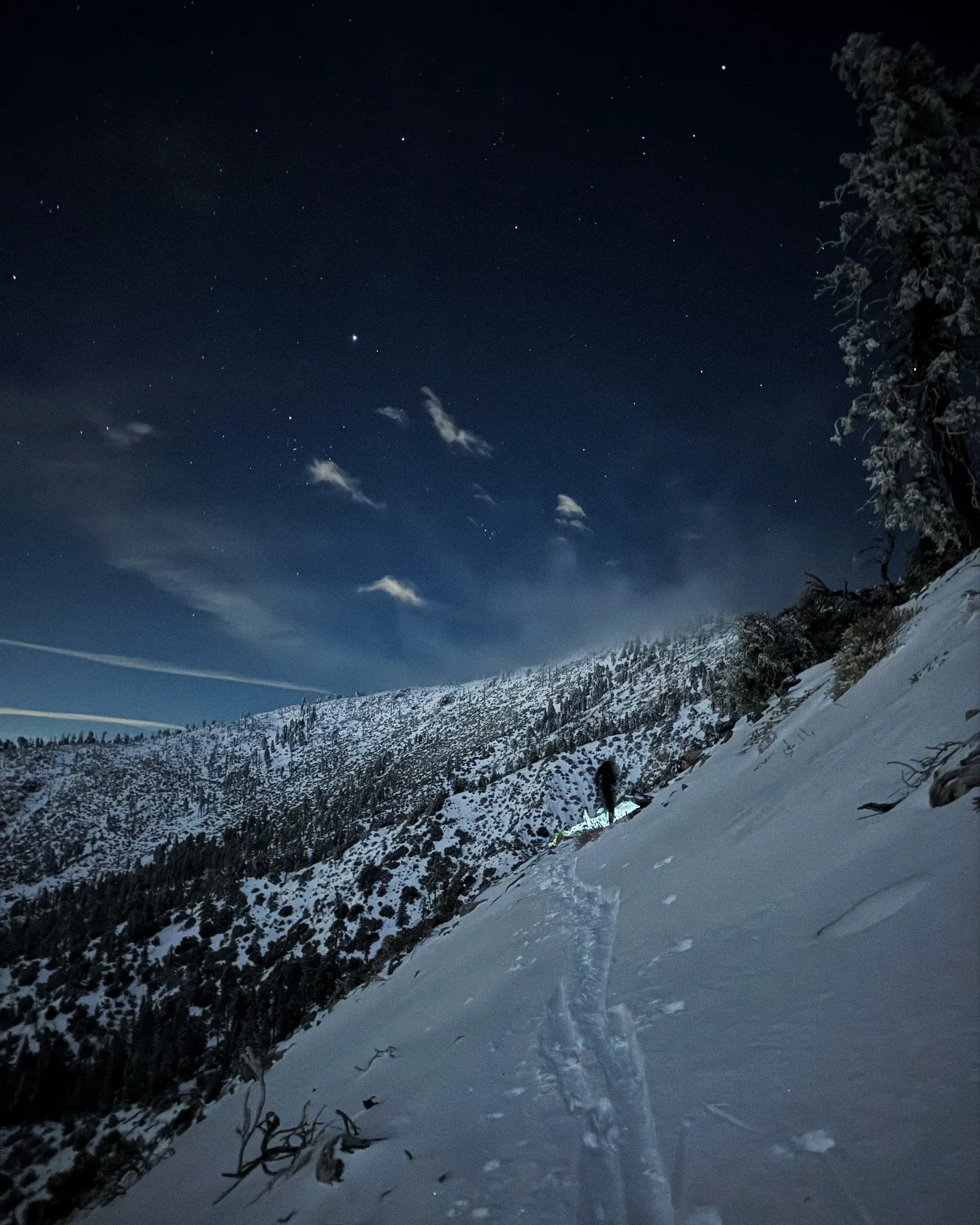
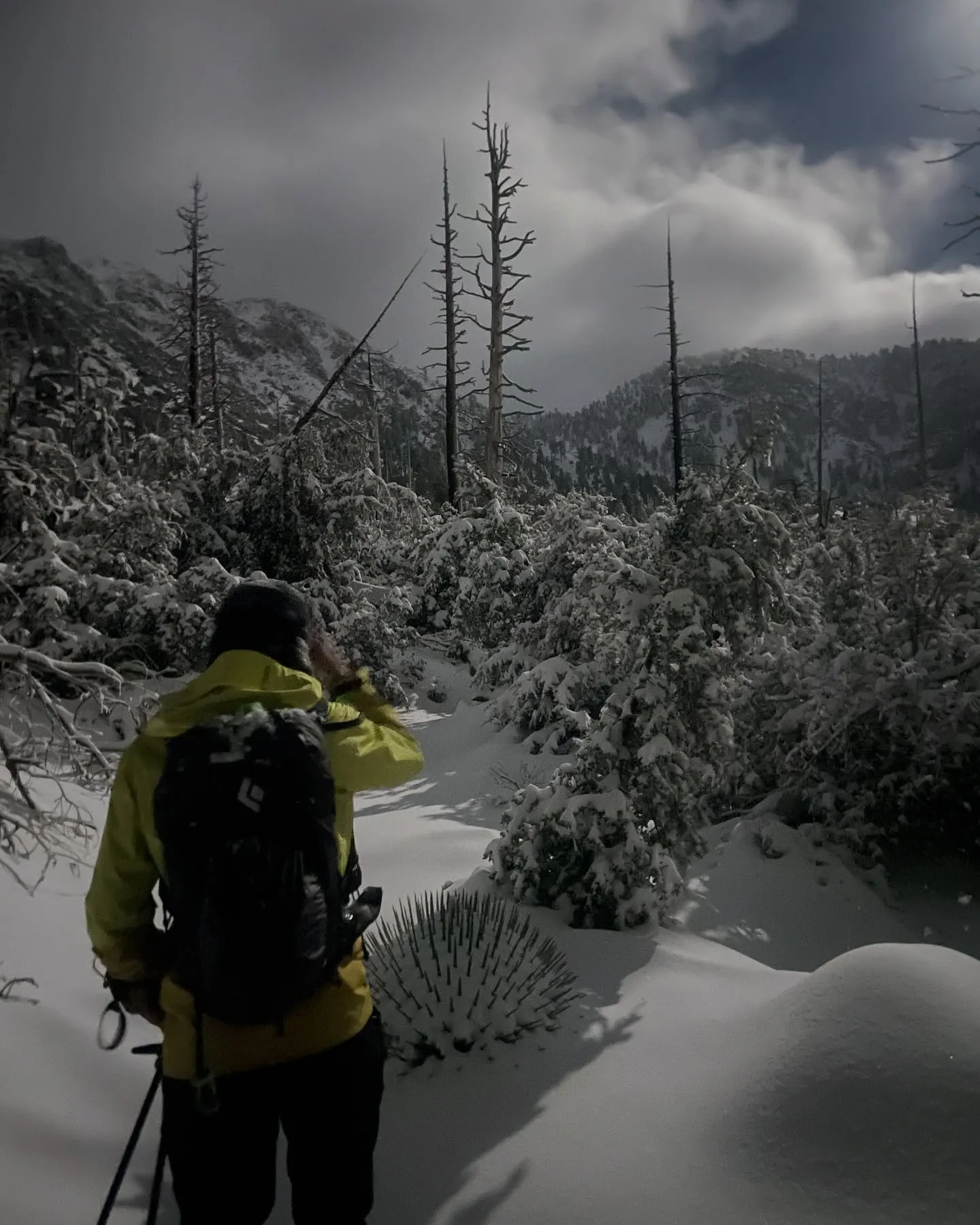
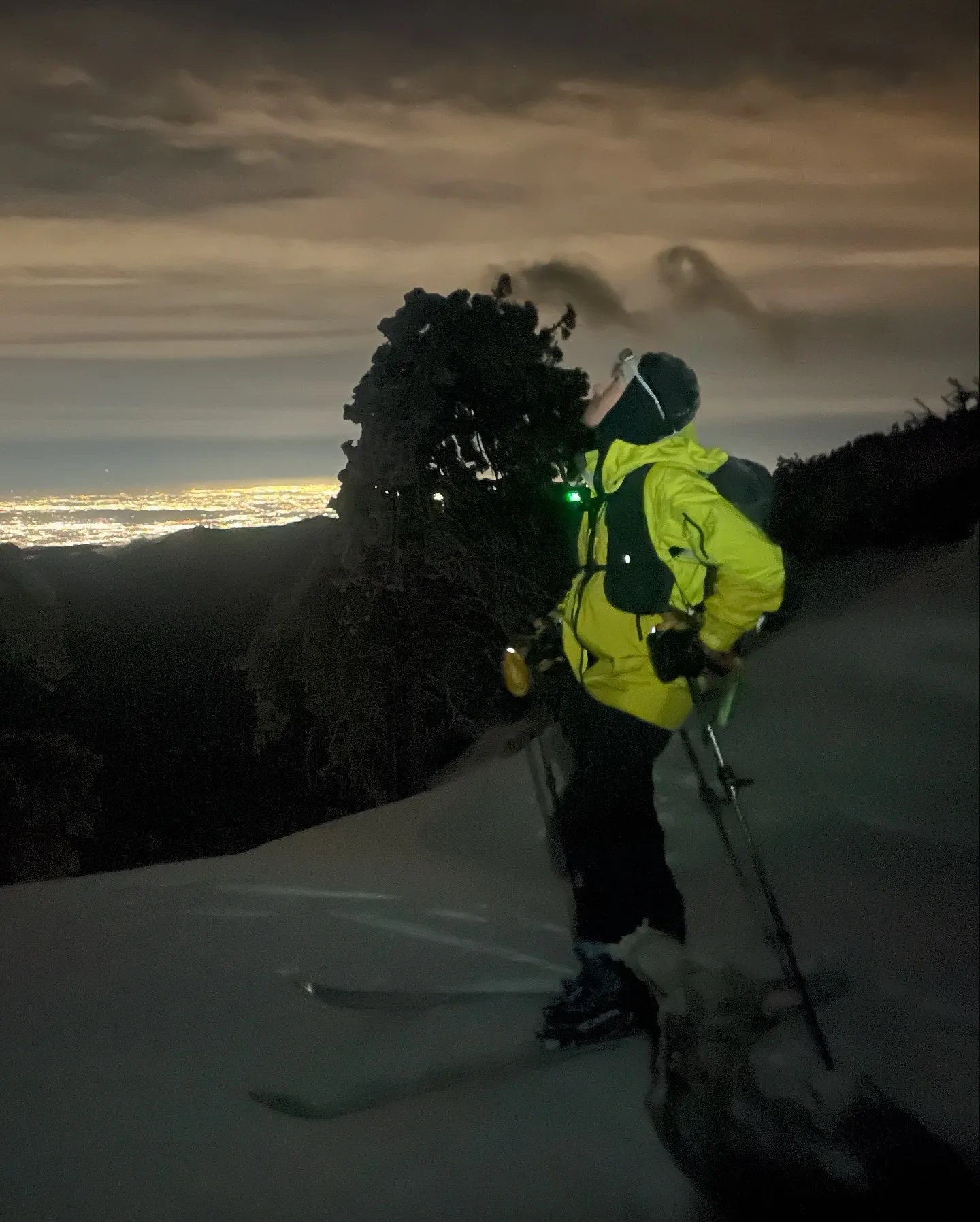
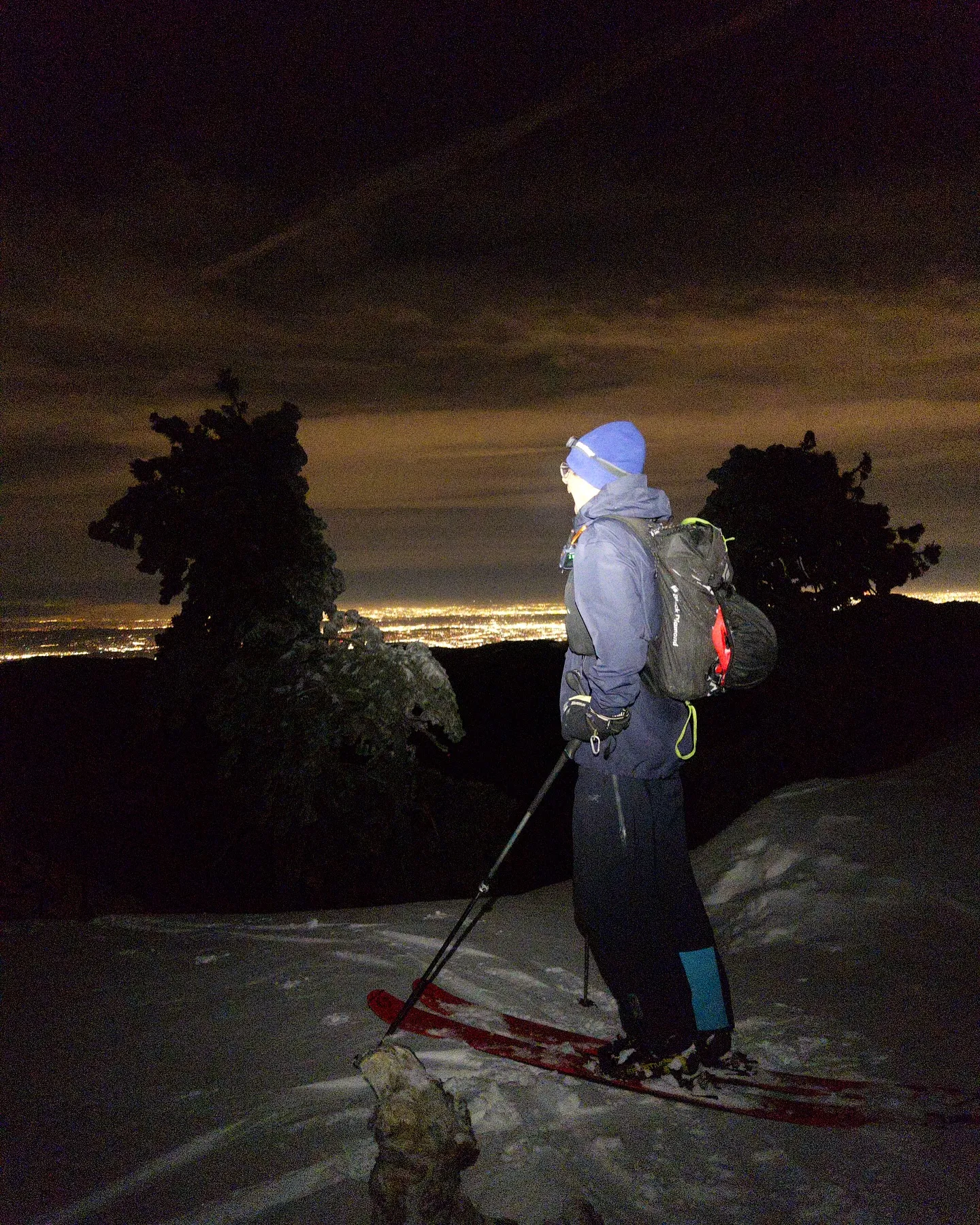
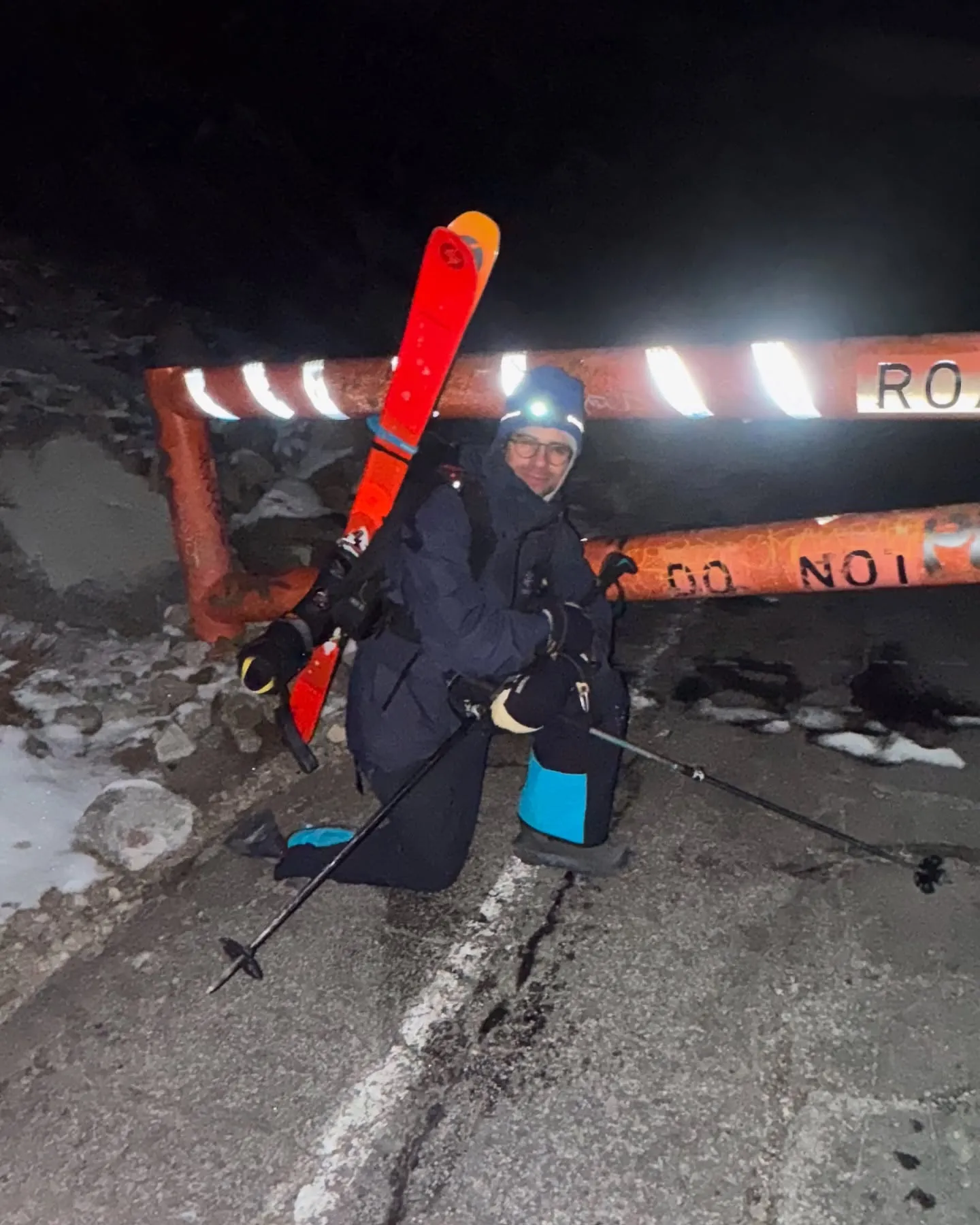
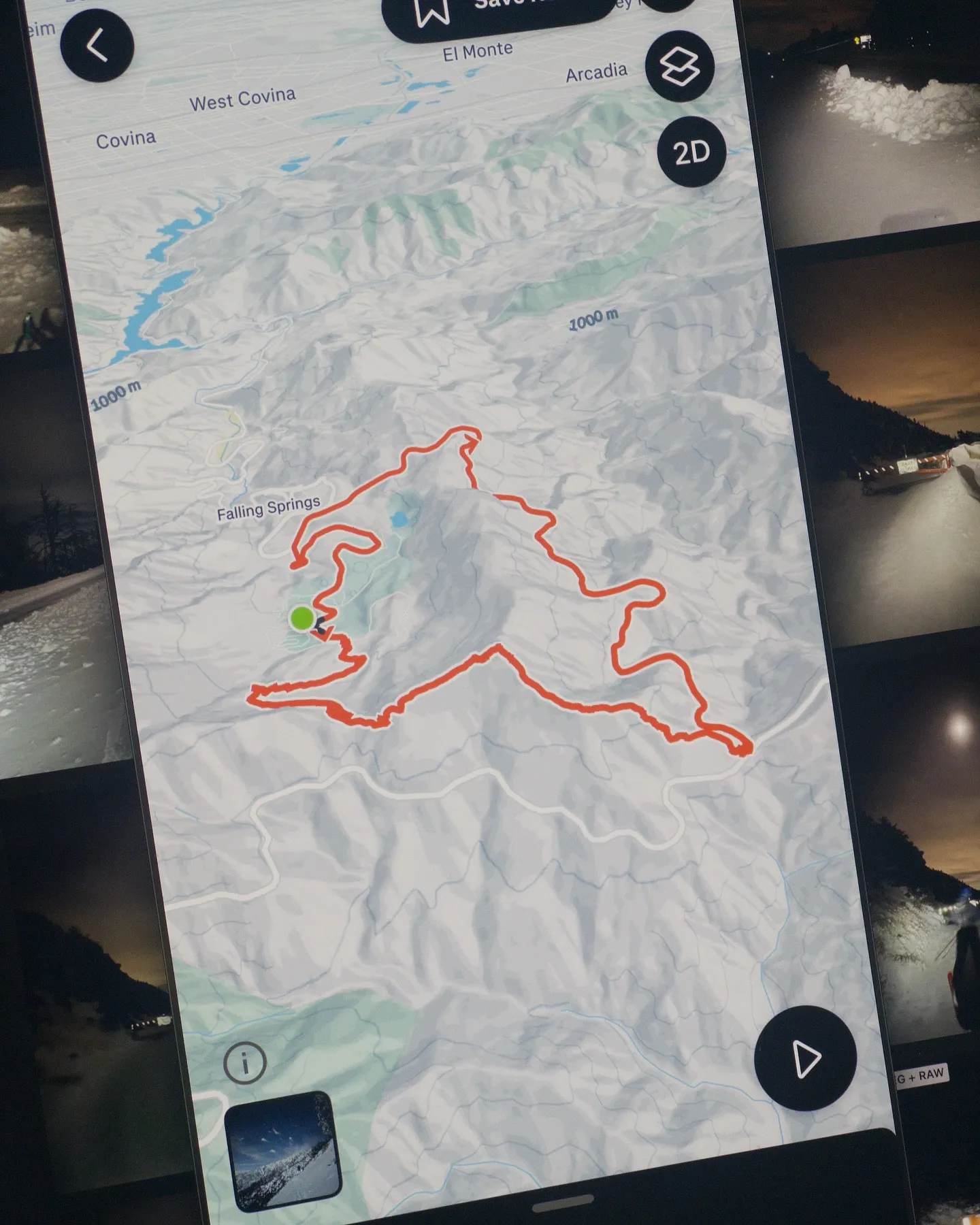
This was a once in a lifetime evening in the local mountains of Los Angeles. Sometimes it all lines up. This was one of those times. Two days of snowing in the San Gabriel with a weather window during a clear night. Turns out there was also a total lunar eclipse. What! @_alex_reed and I drove up with the hope of skiing powder turns with the city lights beneath us. We aimed it at Crystal Lake not knowing how coverage truly was going to be, and a looping route covering 16mi and 3.5k vert drawn up the night before.
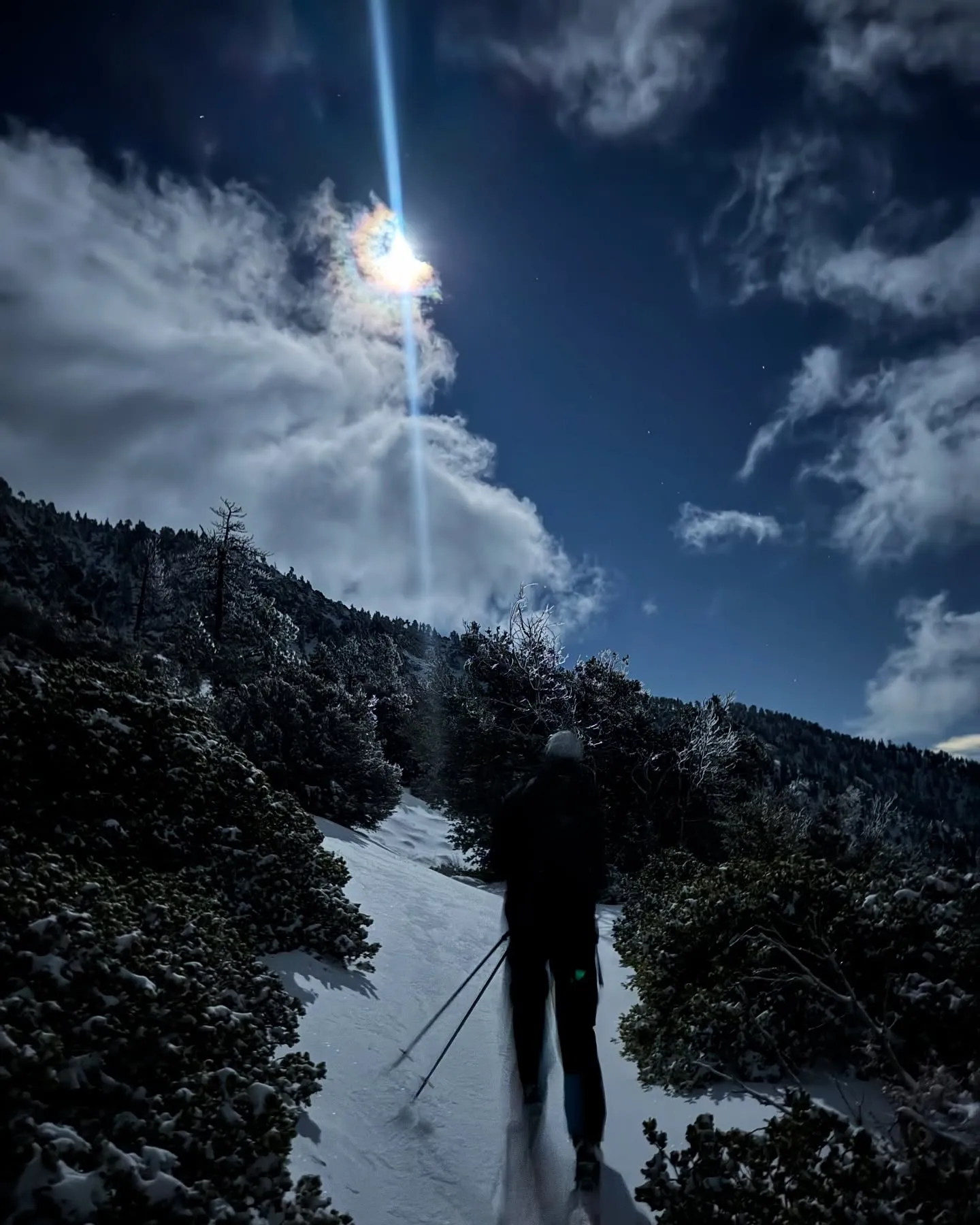
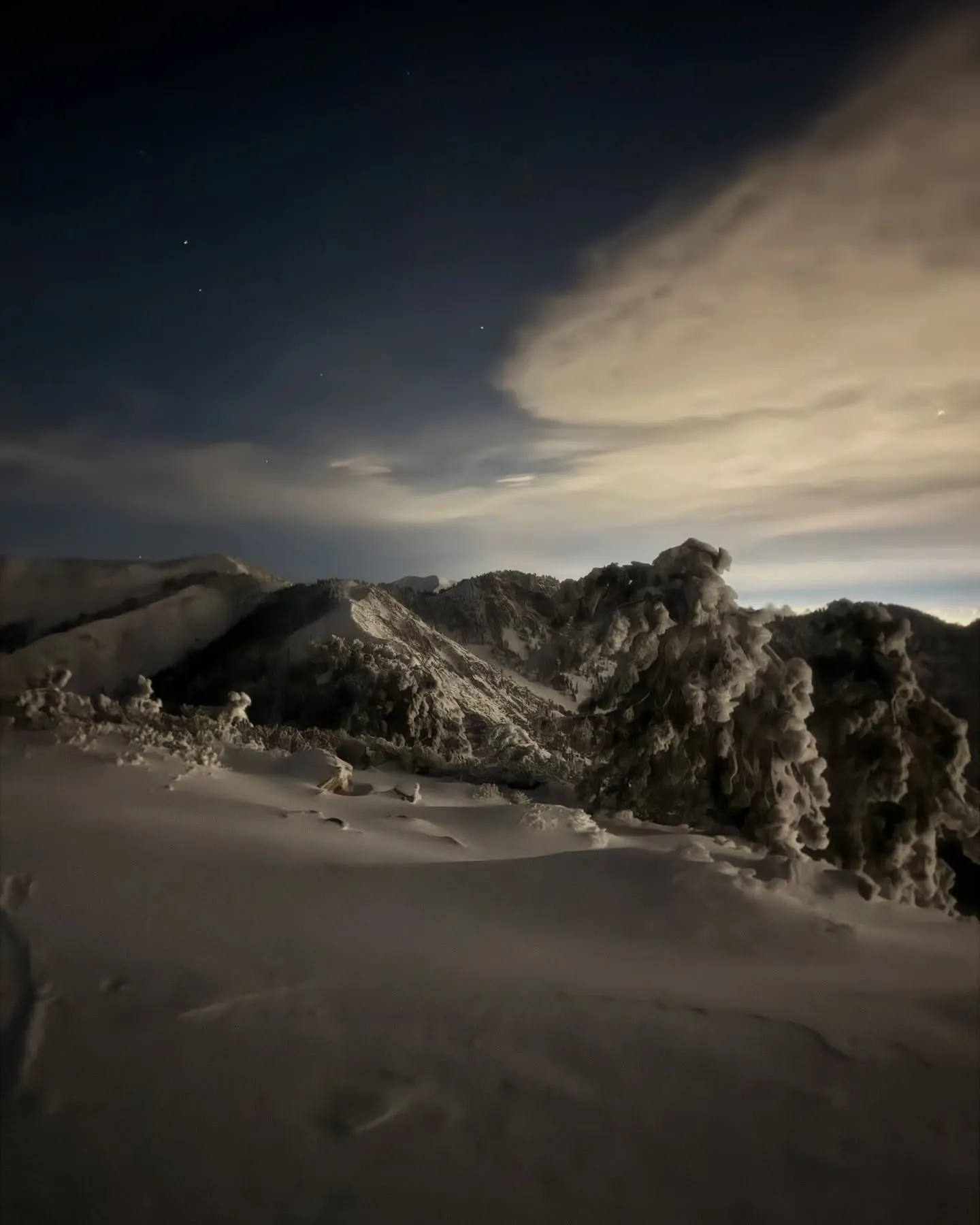
We began, skins on (no joke), at Crystal Lake at 9pm. Climbing up to Windy Gap was illuminated by the still full moon. No headlamps needed. The manzanita falling over the trail due to the weight of the snow and rime ice. Just had to power through. Some wind board firmness on exposed sections left us wanting ski crampons. The celestial event began as the earth’s shadow became visibile overhead.
Just as we gained Windy Gap the eclipse entered totality. Deep deep red. The glow of Los Angeles below us, the snow reflecting the distant street lamps. No words, truly. We climb and summit Mount Islip. The wind picks up and temperature greatly drops. Can’t feel the hands, feet are drenched from the uphill pace. We duck into the remains of a cabin and transition for the downhill.
I can’t believe we are getting powder turns under a full moon in the San Gabriel. It’s good. Really good. We stay high and aim for Islip Saddle. This is magic. The chaparral begins to poke out of the snowpack as we descend, and just as it begins feeling a little precarious the Silver Moccasin Trail emerges beneath us. We hop on and descend continuously along a perfect ribbon of pow through the brush as the moon re-emerges overhead. It feels like an out of body experience.
Ducking the road closed sign, we hop on the 39—a closed stretch of road continuously eroding along the angle of repose and no longer maintained by Caltrans. The snow is a little grabby at this elevation, and the grade not quite steep enough. We go into pseudo-tele mode. We settle into a zone and crank with massive views of a sleepy Los Angeles basin ahead of us and the most remote corners of the San Gabriel blanketed in white behind us.
We drop our packs and skis at the gate, which comes to bite us after 1.5mi of road walking where we reach another gate. We walk another 2mi to the car, grab it, drive to the lower gate, and walk 1.5mi up to grab the gear and another 1.5mi back to the car. I was mildly frustrated at the mishap as it was about 4am when we realized the mistake. But we warmed up in the car for a few minutes, popped some caffeine pills, and really charged up the road with all the energy and gratitude of the experience we just had. It felt like a victory lap. Back to the house at 7am.
No documentation of the descent because my hands were frozen and I was blissed out. Once in a life-time tour. Words can’t describe. Feeling so fortunate to live here and have a friend in Alex up for so eager to take on the unknown and share peak experiences with.
The canyon is dry. But it’s early, and the air as I move through it feels cool. Running the switchbacks up sunset ridge, you usually hear a light cascade of water moving down Millard Canyon. Consistently this time of year. The white noise of the water has a similar effect to the sound of being in the shower, and lends itself to something like shower thoughts. Running trail tends to do this anyway—trail thoughts—but you really sense it when moving up Millard.
Sunset Ridge tops out and connecting with the meandering Mt Lowe Road. A train once ran here between a hotel halfway up the face of the San Gabriel and an alpine tavern. The foundation is all that’s left after burning down in a wildfire soon after completion almost one hundred years ago.
I stop briefly and look around. At how the shadows move. The rooftops of the houses below in Altadena as they fall away. At just how parched the chaparral is.
4,200ft of elevation now behind and beneath me. San Gabriel Peak, the namesake true high point of the Gabs, is to the east of this saddle. But for reasons unclear to me, I decide to climb up Mount Disappointment. I think because it’s been a regular destination over the years. Topping out there is personally significant in a way that reaching San Gabriel peak maybe isn’t.
When the first land surveying team moved through the San Gabriel they pushed through the dense brush and reached the top of the tallest peak, only to realize the adjacent peak was taller. “Mount Deception” they wrote. After climbing that peak, the same realization repeated. “Mount Disappointment.”
Disappointment is anything but, and after a little siesta at the top there’s a decision to make. Retrace the ascent, now letting gravity do the work, or drop down the backside and follow the Arroyo Seco down and out. The legs feel strong today. Two years of consistent and injury-free movement. A sort of personal peak fitness. The day is beautiful. Committing to the Arroyo isn’t even a choice, it’s the only way. The line has a quality that draws me to it. It’s not an exit. It’s a connection between points like making a gesture on paper. Climbing up and over the front of the San Gabriel. Connecting the start of the drainage and the headwaters of the San Gabriel. The long climb, followed by a meandering flow tracing the water course. That’s the stuff right there.
The single track to Redbox saddle moves through dense oaks and offers perfectly framed windows of San Antonio to the east. A little snow hangs around the summit. Taking a beat at the junction to appreciate it all. Hopping on the Gabrielino Trail towards Switzer Falls. The arroyo has a trickle. Families picnic here along the banks.
A narrow catwalk carries the feet to the edge of Bear Canyon. A lush pocket of green sustained by another small trickle of remaining water. The midday sun overhead roasts in the more exposed zones. I stop for a while. More trail thoughts.
Running for me is not about speed. It’s movement at a boundary edge. You park your heart rate at a certain place and distances shrink over time, but somehow you feel no greater fatigue than you would walking. Maybe even less than walking when done with quality of movement and a sensitivity to efficiency. It’s all rests at a point of balance.
So it may seem a little counterintuitive to run for hours to then sit and relax for half an hour. As in, what was the hurry about? But it’s all centered on the joy of movement and quality time with environment. To move a certain way is to be in the groove, in the pocket, both with the landscape and with yourself. It just happens to look like running, or we just happen to call it running.1
So I sit here for a while and really take it in. A little more than usual, but you respond in the moment to what feels right. After a while, moving again, weaving through the oak tunnels. Light leaks through the pockets of leaves, the temperature drops falling deeper into the canyon.
The Arroyo Seco runs low. Really low. Your feet tend to get wet crossing back and forth through here. But today the feet are dry. The arroyo and I spill out into the Hahamongna Basin. A few moments later and I unlock the car door, the loop completed.
30 miles. 5,500ft of elevation gain. I’m very glad I made the decision to commit at the top of the climb and make it a loop.2
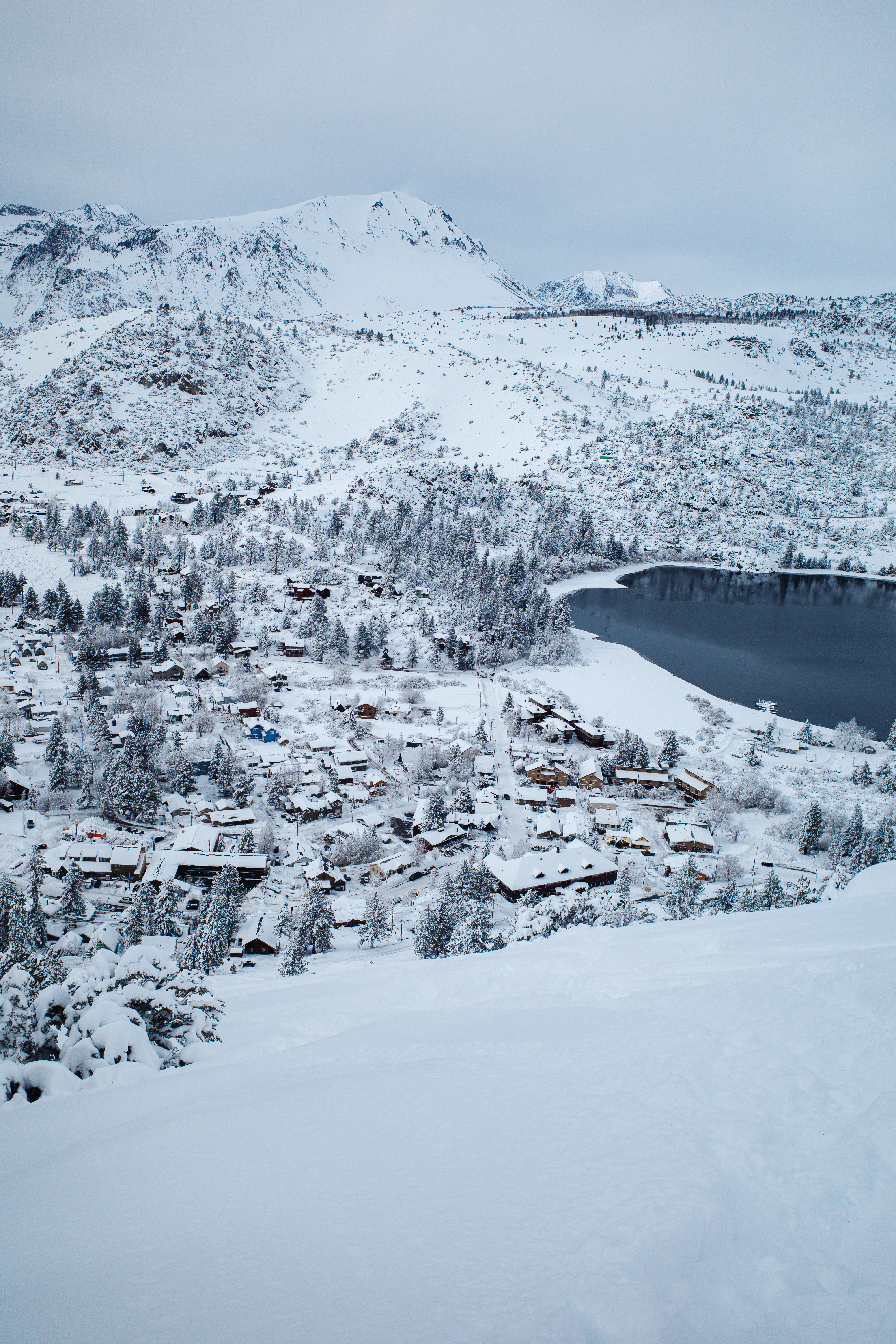
A couple days later I wake up and the sky is black. Easily mistaken for night if it wasn’t for a sliver of blue sky peaking out from under the enveloping cloud of smoke. Santa Ana winds cascaded down the foothills yesterday. Mountain wave. High voltage transmission line failure. A bad recipe, and a fire broke out. As the sun set, I watched from my house as the fire tore through the brush. It looked like when you touch a battery to a brillo pad. Reaction-diffusion on landscape scale. A layer of ash now covered everything outside. I went north to June Lake, where several months earlier I had packed my house into boxes and moved back down to Los Angeles after two years living in the alpine. Home there was buried in almost a thousand inches of snow and ice during a historic winter season. Now home is being covered in ash during a historic fire.
Being in the Sierra over the next few days I felt restless. Being physically distant from the fire didn’t change the proximity in the heart and mind. It became important to experience the fire and it’s effects directly, so I returned home. The fire was suppressed, but home smelled like smoke. Still drifting and settling in the basins trapped by the atmospheric inversion layer.
With all this particulate came an actuate awareness of the air quality. A concern with the longterm effects, the masks stockpiled during COVID came out of retirement. “Don’t go outside unless absolutely required.” Every store sold out of air purifiers. The amazon back order was weeks.
A few days after the fire the collective awareness of Los Angeles briefly shifted. David Lynch had died. Something changed in the magic of Los Angeles. Smoke still drifted around in the air.
Emphysema was a contributing condition. Years of smoking cigarettes left him unable to walk across the room without oxygen. I sat with restless legs reading this on my couch. Beside me my air purifier cranking away. Sometimes what you love isn’t good for you. Sometimes that’s ok.
I laced up my shoes and ran out the front door. I live in Mount Washington, in a canyon defined by steep walls. After days of being sedentary moving fast uphill is purely euphoric. A total high. Inhale, exhale. Deep deep breathes.
The road I’m running tops out at Kite Hill. A few days before I walked here to get a clear line of sight on Eaton Canyon minutes after the fire took off. That image of the flames now projected by my mind onto the landscape in-front of me. A slippage between that moment and now. That lucky run during the days proceeding the fires comes flashing past. Those were the last moments in that terrain indefinitely, unknowingly.
Friends had lost their houses. Their musical instruments. Their paintings. Family photos. Hundreds of hours of work building homes.
All of it now suspended in the air as particulate. Deep breathes. All of it was coming part of me. Embedded in my lungs. For who knows how long. The fire becoming part of me.
The legs are a little heavier these days. The past year has been one of different priorities. After two years living in the alpine centered on movement, this year was decidedly a counterpoint. A couple months in New York, a lot of screen time. A period of risk and learning in new and unfamiliar ways.
Still getting out. Still moving. But the “fitness index score” is way down. It’s liberating in some ways. I knew when leaving June Lake a ceiling to my athletics was hit. A sense of growth in the direction I was headed in how I spent time in the alpine required risk I was unwilling to take. At least in that moment and context. Finding stasis is hard without the motivation of frequent big objectives, and with increased responsibility at the desk, the fitness was now taking a hit.
Occasionally the awareness of this bothers me, but you must have periods of recovery. It’s an inescapable counterpoint to the intensity. Of course this is all relative, but to take a few months of reduced volume is alright, I think.
It’s been a year since the fires has passed, and in that way time work. It feels like both an eternity and a blink. Friends most effected shared impressions. It was encouraging to see the connecting thread being the generosity and support they received, both in the immediate aftermath, and over the course of the year.
The next day I see an announcement from the Cheney Trail account. “Partial reopening.” The map shows what terrain is back in play. All of Millard. Bear Canyon. Sunset ridge and Mount Lowe Road. A true surprise. With no established time frame for re-opening, the ambiguity had extended outward indefinitely. With clarity comes relief, and I fall asleep with trail on the mind.
My hip belt is stuffed with nutrition and 1.5L of water. Inspiration point, a shade structure about 12mi and 3k vert away.
I park on Lloma Alta near the corner of Cheney trail in front of a foundation where a house once stood. First steps. My achilles are barking from the grade of the road thanks to reduced volume and sticking to mostly flat terrain during the past few months. While there are pockets of charred skeletal brush, the tress are mostly intact. An incredibly welcomed surprise.
Moving upwards along Sunset Ridge. Power lines pass overhead, extending ridge to ridge and spanning the expanse of canyons below. These are the same high voltage transmission lines that failed during the windstorm. The source of the fire. Their contorted forms, straight lines and right angles, visually contrast the rolling folds and flow of the landscape. I move through the towers like gates, and a few switchbacks later they fall behind and below me.
Sunrise Ridge intersects Mount Lowe Road here. The fractured pavement turns to dirt, and the grade mellows out. My engine is warmed up now, and the miles come easily. It really opens up, on the feet and on the mind. Big views and small details I’ve greatly missed over the past year.
Soon the concrete foundation of the Alpine Tavern passes by. The movement has a real quality to it. A real connection. Reaching the saddle where the turn-off to inspiration point is. I’m not ready to wrap this up. Instead of making the turn to the right, I swing around to the left, contouring along Mount Lowe Road.
I’m doing the full climb from the base to the top of San Gabriel Peak again by total impulse. These things just sort themselves out sometimes. Something calls you. The trail drops a hint. What can you do?
I hit a cloud of un unmistakable stench. The smell of a recent fire. Poodle dog bush has taken hold. Only in a small pocket here. I’m surprised it’s been so reclusive in this zone. When fire sweeps through the transverse poodle dog comes barking. It looks freakish and leaves a hell of a rash. I once ran into a kid on trail who said he just came across weed growing nearby and smoked some. A gnarly case of mistaken identity. I wonder how that went?
Past Mount Lowe, then Mount Markham. The heat begins kicking in. The climb from the end of Mount Low Road to the top of San Gabriel Peak. The trail tucking into chutes of speckled black and white plutonic stone.
Points of location in landscape can transport you to points in time. Being here takes you there. It’s like a de je vu. But different. A certain type of access unlocked. The body’s presence at a certain place. It’s a space/time thing you can sometimes sneak a glance at. It’s always a real occurrence when it happens.
This place, this pocket of the Transverse, underwent a period of stress and recovery through the fire. A period of being out of form, out of play. I can’t help but feel the timing of this coincides with my own shift in my movement practice. Out of form, out of play.
But seeing the landscape, the chaparral bouncing back, the way winter’s rain has draped the foothills in green… it’s nudging me to respond in kind. To get back at it.
This may seem like just the beginning, but there’s a long history. The latest cycle of an ongoing idea. Using time as interface to adjust the drip-rate of things we want to remember.
Specifically, things with links.
It could be an Instagram profile, side-stepping their algorithmic feed that often hides what you follow, and showing ads more frequently than what you truly want to see.
Or it could be a personal homepage. An artist, or writer, or someone generous enough to publish archival knowledge. These aren’t frequently updated, but are beautiful and expressive representations of someone’s practice. The type of thing that may sit in a bookmarks folder for years and never get any attention, even though a brief glance may bring some joy.
Some apps like Twitter provide a chronological feed. These work if you don’t follow to many profiles, and inherently reward profiles that post the most frequently, leading to a lot of noise from the same suspects, and quieter voices being drowned out. Early testers of Cycle love following social profiles for these reasons.
Some things you may check too often, like the news, and simply adding your usual sources set to once every day or two helps to reduce fomo, as you know it’s only accessible in your daily digest once until visited, then hidden for the duration of the cycle, and will re-appear when that time passes based on how you’ve prioritized time relative your attention.
Some of us may have a massive archive of favorites, research, or otherwise. Things get lost in the expanse. Add a few of them, like some Are.na Channels—your own, or those of others—and set it to a few months. What a nice little treat one morning!
If you want to join the fun, feel free to request an invitation.
First Iteration
The first iteration of the idea was called Hardly Everything. In-fact, after not being touched in five years, it’s still humming along, with a modest number of dedicated users.
Part of the stability is due to there being no services. This is going to get a little technical. Data is managed by the user using Local Storage—a browser API that enables your data to live with you.
Or more specifically, your browser.
This decision was made in response to centralized platforms owning your data. Your data, in a sense, is you. This also simplified the engineering, as no databases or backend services were required.
However, this introduced friction. A recent conversation with someone who continues to use Hardly Everything on a daily basis mentioned his weekly habit of manually backing up all of the data to a text file! A poetic gesture, maybe, but not a common solution.
This had the additional disadvantage of data only being accessible in the browser used to create it. You couldn’t access your data from desktop on your phone, or vice versa.
One critical feature—a reminder—was not possible, as there was no way for a backend service to query user data and send a friendly notification or email on days when fresh links were resurfaced. A notification is critical—the idea fundamentally does not compete for your attention, and instead hands it back to you.
Despite all the friction, people still found it handy, and it continue to recommend it.
Second Iteration
Some years later, the idea cycled back around, ripe for revisiting. The core focus was to address mobile. Hardly Everything worked fine in a browser, but did not particularly excel on the phone.
This was due to issues of data portability as mentioned before, along with the interface. Creating a native app would ensure the interface felt great to use, with fluid gestures and the affordances of (then new) SwiftUI.
Building natively also enabled sending a push notification on days with fresh links.
Data ownership remained a priority, as did enabling synchronizing across devices. This was built on Apple’s CoreData API. It worked well for native apps, but the javascript browser API and documentation was a mess, and does not see much (any?) use.
This was all great—if you owned an Apple device. Specifically, an iPhone. Creating a desktop app out of the iPhone app wouldn’t require a total rewrite, but would have been substantial work.
Another set of compromises. And another name. This time, it was called Kawara, after the artist On Kawara who is regarded for the “Today” series of date paintings; canvases simply containing the date.
Learnings
After these two iterations of the idea a few areas of improvement became clear with time.
The first being awkward names. That was an easy fix. Cycle is self describing. Bookmarks that cycle back around.
The second was a series of technical decisions made with the technology front of mind and convenience of implementation, both at the expense of user experience.
Prioritizing data ownership was (and still is) a great thing, and a tool for doing so is planned. But when it comes to sequencing, the first priority is creating a frictionless user experience for saving and accessing links across all devices. Simple as that.
Cycle Beta
With these observations in mind, the third (lucky number) iteration on the idea is Cycle. Basically, it fixes all that shit mentioned above!
It just works, everywhere. Your browser, on desktop or phone, and as an app on every device by simply tapping “add to homescreen” or “add to dock”, depending upon where you’re at. It works really, really well. More on this in future Discover entries.
Login and connection is drop dead simple. Your data is in a database, yes, but it’s accessible everywhere, and export and a basic API are planned.
HardlyEverything will live on in perpetuity, so long as browsers continue to render it correctly. Kawara has not been accessible for some time, as Apple’s App Store requires continuous builds and approval requests with incremental versions of iOS.
Time as an Interface
There’s a lot of wisdom to find in nature. And nature is full of cycles. Night turns to day, with a period of rest between the two, where your mind and body recover. Imagine never sleeping!
Summer turns to winter, the old falls away and the new emerges. A micro expression of of solar cycles, the Earth around the Sun, the Sun orbiting the galactic core. It’s wild stuff.
Time is the only truly scarce thing. We’re all familiar with attention economics. So it seems there’s a lot to explore interacting with time, and timescales, and loops and rhythm.
Tools that involve time are, dare we say… timeless. There’s too much to write about here. Plans for future Discover entries will expand on the expanse.
Future
The focus is to keep the focus, but there are some clear improvements to make. For now take a look over here. And of course if you have any ideas or feedback, please feel free to reach out.
This was originally published to the Cycle log to coincide with the limited beta release. You can join the waitlist by navigating to Cycle.
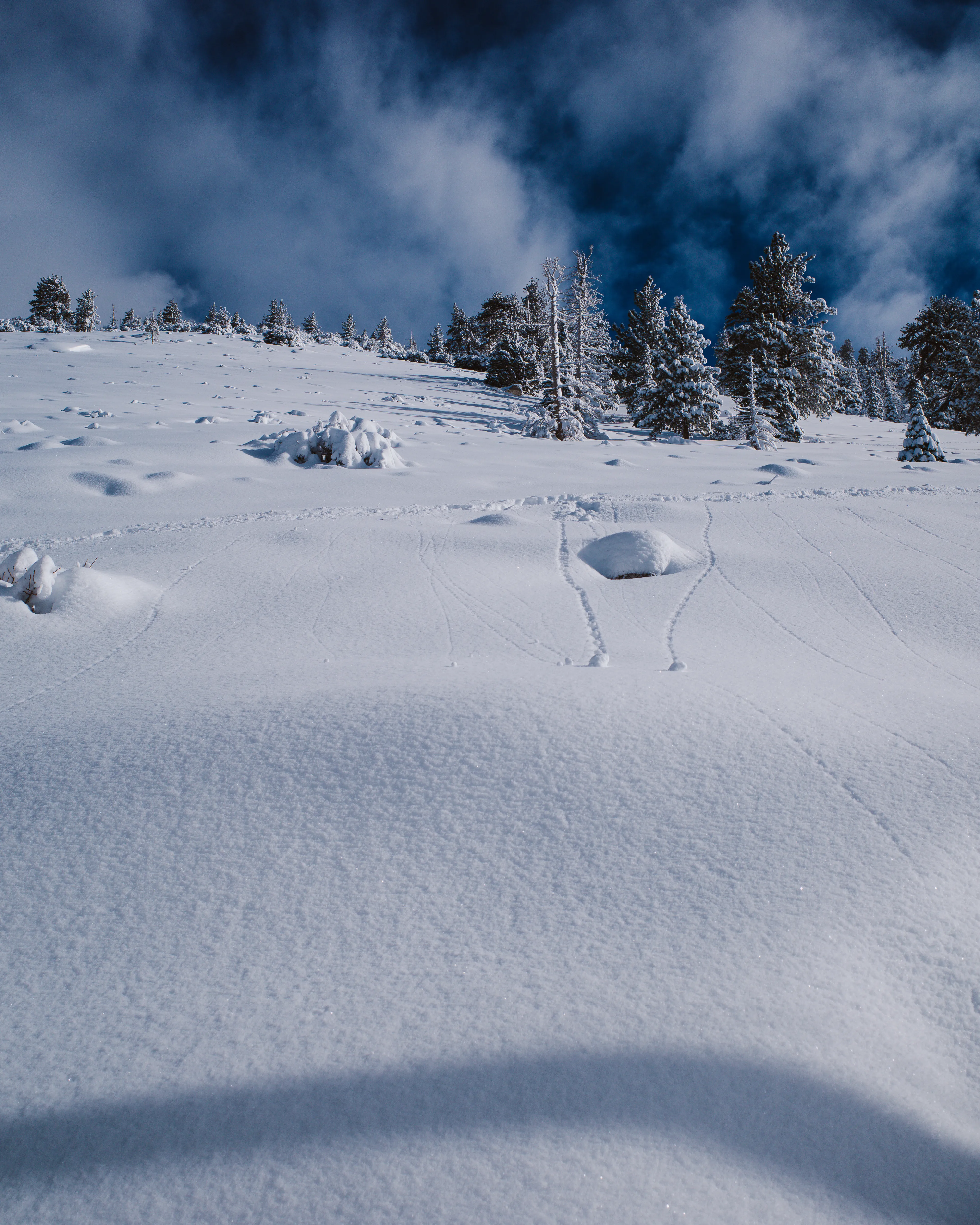
I intended to write this after the snow had melted. Until the winter felt truly over. But sitting here now on my couch, writing this in late October, I can see snow almost a year old out my window on surrounding peaks.
I’d been living over the summer in June Lake, an alpine town of four-hundred in the Eastern Sierra, and knew the winters could get intense. About three-hundred inches is the average—it sounded astronomical. Talking to neighbors after moving in calmed the nerves.
“Yeah, it’s hard for maybe a week total each year, after big storms move through, but generally easy.”
The house cantilevers off a forty-five degree slope. A door at street level leads to a dark storage area beneath the primary floor. Cords of wood are stacked floor to ceiling, enough to heat the place through the winter.
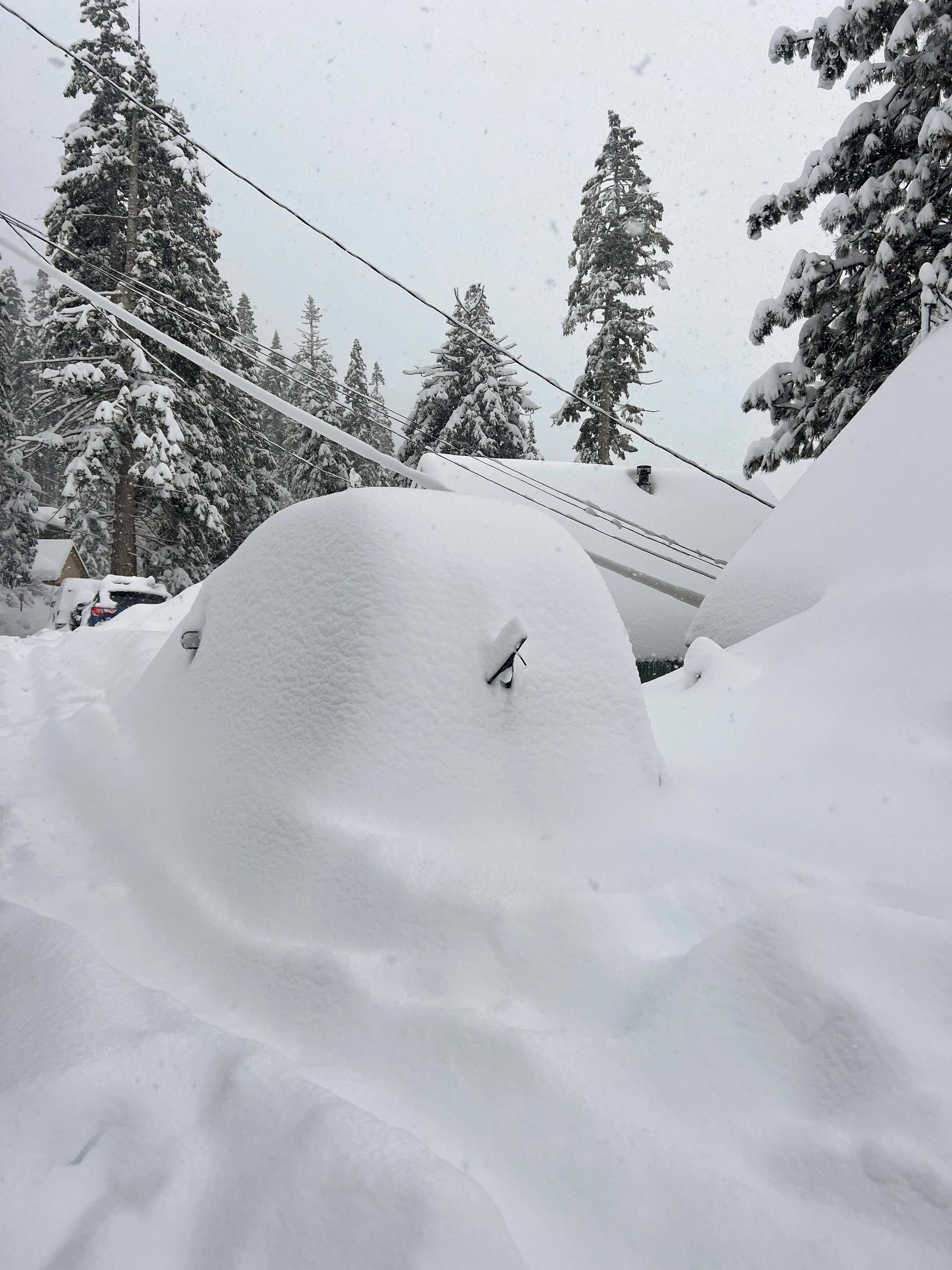
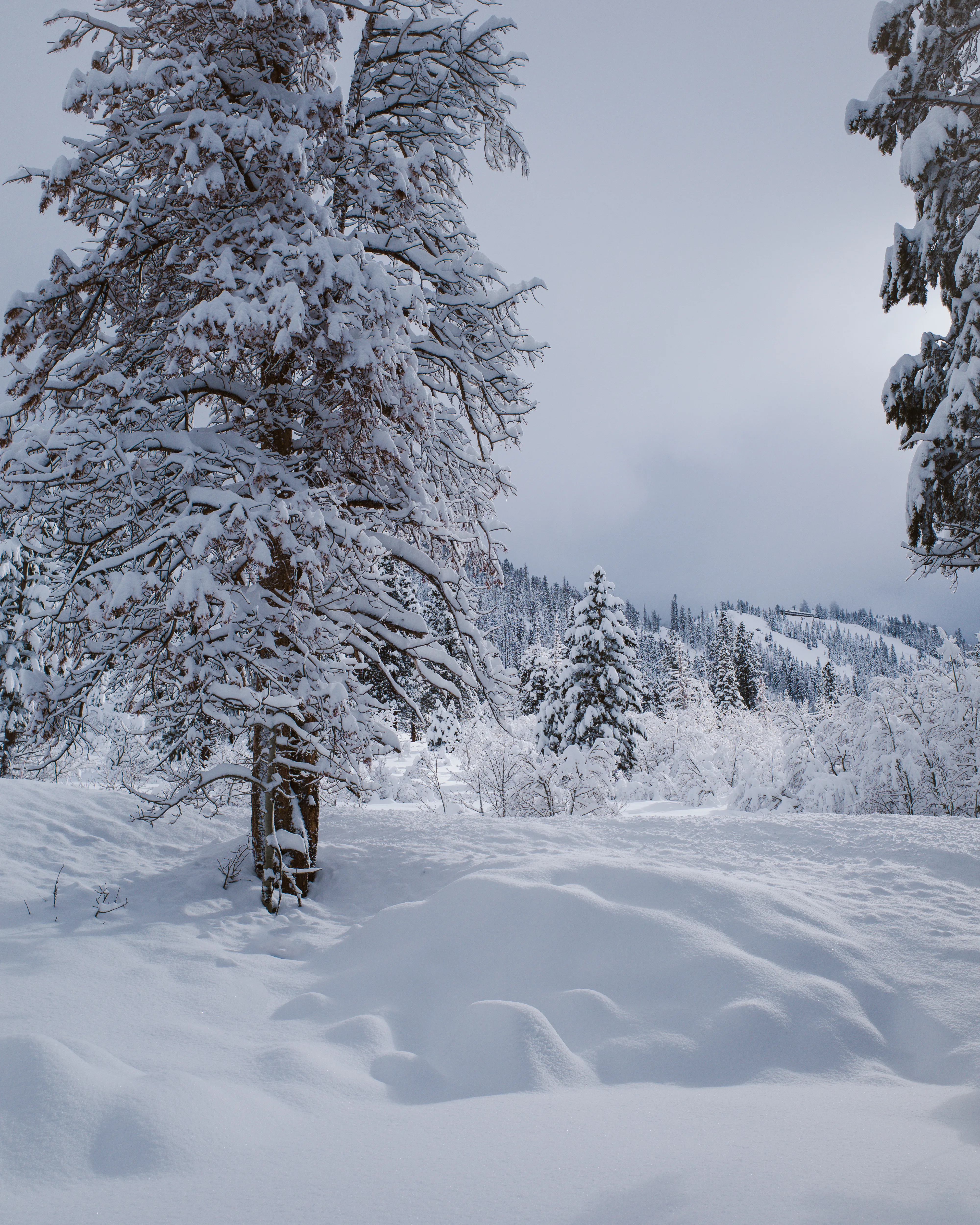
The first snow system of substance drops several inches the evening of November 2nd. Every few days a few more inches accumulate. The ski resort twenty minutes south, Mammoth, opens a week early on the 7th.
Having never skied before, now seems the time to learn. Backcountry ski touring is goal—a way of staying active when snow blankets the trails, and means of gaining access to fresh snow each day.
This winter is unique. Warm, wet tropical air moves in off the coast and hits the Sierra crest. Atmospheric rivers. Rain is rare in the winter. Temperatures are cold, but these pockets of air are relatively hot. Sometimes it rains when the leading edge passes through, creating an upside-down, unstable snow pack.
When this happens I get a call in the morning from my new friend, Chris, who works for Mono County. “Hey bud, things are looking pretty unstable and loaded. We’re issuing a mandatory evacuation.”
My street, line with around ten houses, is one of only three streets in Mono County to receive mandatory evacuations. Last week a few houses were taken out down in Aspendell in similar conditions.
Not wanting to be the ultimate kook and die of an avalanche asleep in bed, evacuating seems reasonable. A neighbor down the street mentions sleeping with their avalanche transceiver strapped to their chest, backcountry snow shovel next to their bed.
“If you don’t hear from me tomorrow, start digging.”
When evacuations are ordered I call up a few friends who work at local hotels. My favorite is located across the main drag of the 158. From the couch on the second floor rooms I can see my house, and the bald sloped snowy face behind it. Not wanting to be in the house if it goes, I sure would want to watch from relative safety from across the street. What a show.
In total, I evacuate five times over the winter—the longest period for almost a full week.
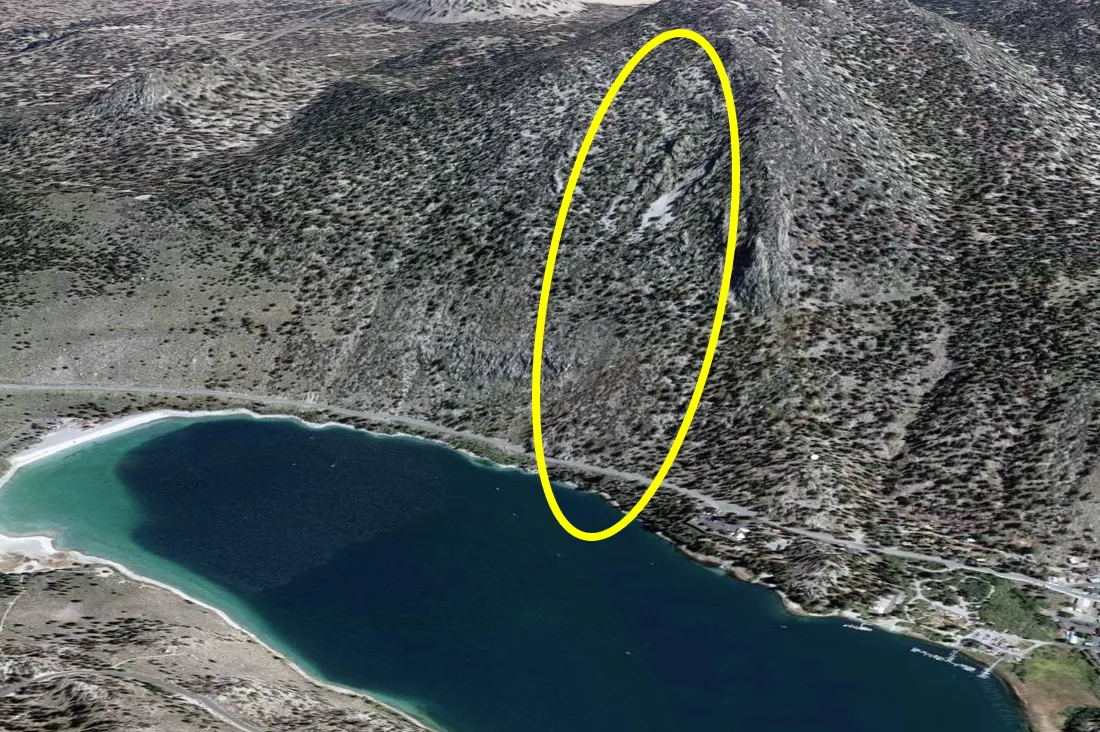
The 158 leads from the 395 and through the horseshoe shaped glacial moraine called the June Lake Loop. Driving westbound into town, the road passes Mount Downs. It’s not particularly astounding compared to the jagged fourteen-thousand foot peaks ahead. But there is one avalanche prone steep gulley.
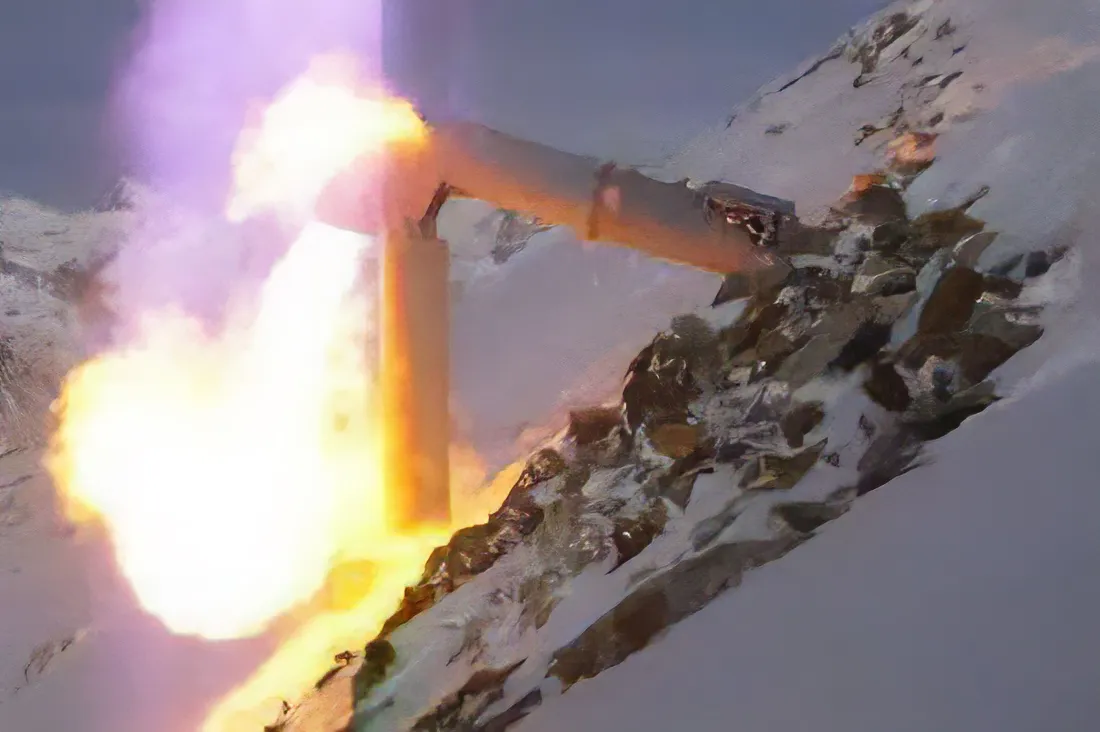
Thankfully, the California Department of Transportation has placed a series of Gazex systems within the gulley. Metal tubes jut out of the mountainside, fill with natural gas, and are then ignited. The blast produces an acoustic shockwave, triggering unconsolidated snow to slide and stabilizing the chute.
Sitting on my couch one night, snow falling outside the windows, the entire loop lit up like the afternoon sun was out. Massive booms shook the house a few minutes later. Impressive.
This process prevents a naturally occurring slide from potentially sweeping a car, carrying a powder hungry family, down a cliff and onto the ice-covered surface of June Lake—thank heavens.
Once a week over a three week period an atmospheric river system would bring rain and heavy, wet snow. With another system only a few days out, and the hassle of clearing the road after each storm, CalTrans simply left the 158 unplowed, blocked at the east and west gates.
When this happened in the past the town became entirely cut-off. There is no hospital. Emergency vehicles were stranded either inside or outside, along with everyone else.
A road was proposed, and then constructed in the late 1990s, leading around the north shore of June Lake from the entrance to the ski resort and bypassing the Gazex closures.
This makes life easier, but doesn’t solve all the problems.
While the North Shore route around the avalanche chute off Mount Down helps, it transportation challenges remain. Large systems also tend to shut down the primary north-south artery of the eastern Sierra—El Camino Sierra, also known as the 395. On these days the North Shore leads to a dead end, and the June Lake Loop is again entirely cut-off.
These were some of my favorite days of the winter.
Snow is unstable after a storm. It doesn’t like rapid loading. That could be a person skiing, natural rockfall, or simply rapidly deposited snow. It needs time to settle, discouraging skiing immediately after a big dump.
Waking up on mornings when the highway is closed is the best. Your eyes open to the sun peaking up over the ridgeline, bombs echoing off cliffs at the ski resort—only a quarter-mile from doorstep to lift for me.
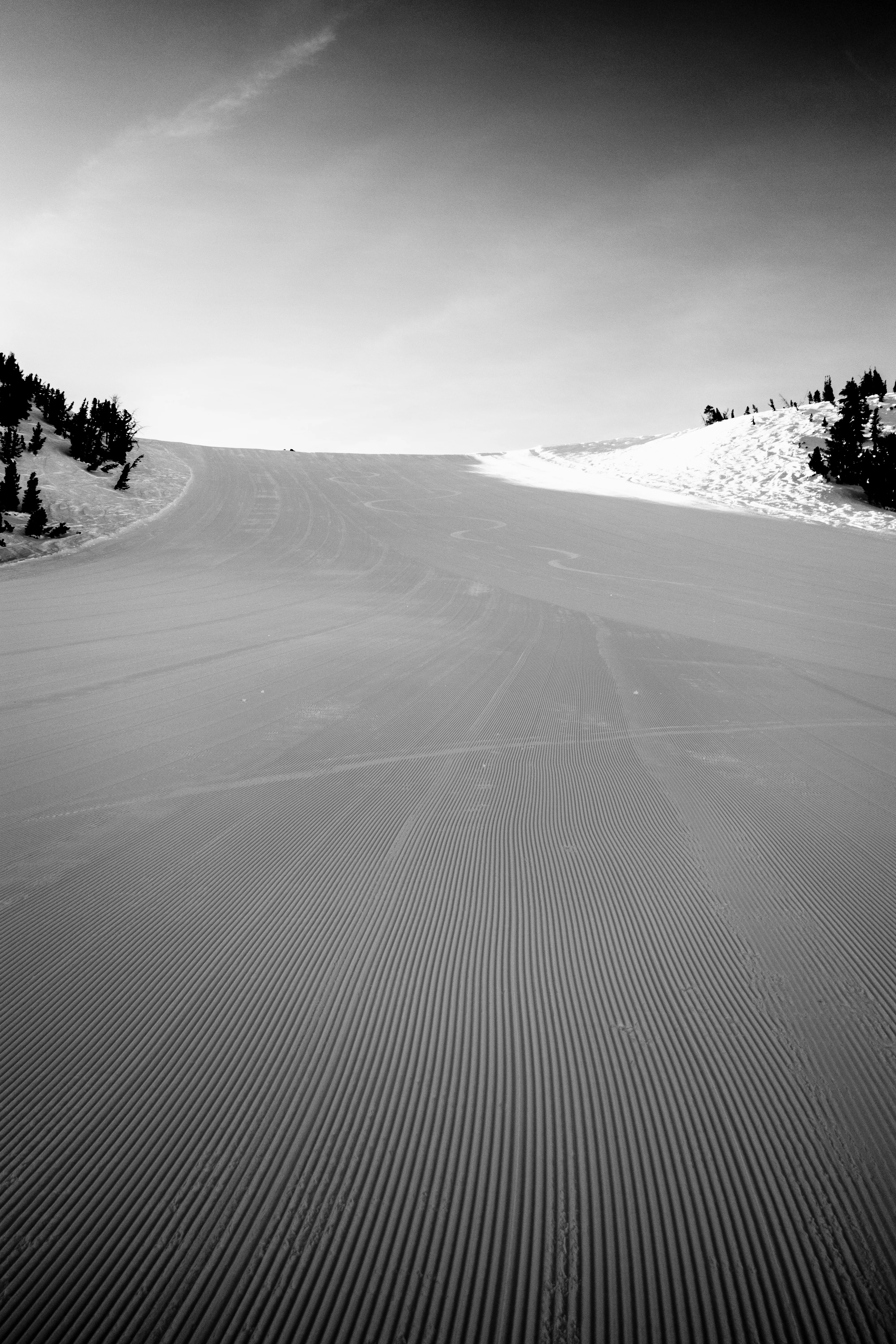
June mountain is unique. Only a small ticket office sits adjacent the parking lot. A single chair—wooden, with room for only two—takes you from the parking lot to the main chalet, where the rest of the mountain is accessed. Something more common in Europe, but unheard of in the states.
The ride takes about 13 minutes—anything but high-speed—giving you plenty of time to take in the scene, and make small talk when sharing the open seat.
On the biggest days, only this first chair at June Mountain spins. But this is fine by me. The terrain is all steep stuff, double black, and endless fun.
These days are spent lapping the first chair with maybe 10 other June locals, and a handful of tourists who make it out of the hotel room. 4:00pm rolls around and there’s still plenty of undisturbed lines to be had the next morning. It’s magic.
After each snow storm, and handful of snow plows begin clearing roads. Some are pickups fitted with plow attachments for clearing parking lots at hotels. The county brought in a few smaller wheel loaders.
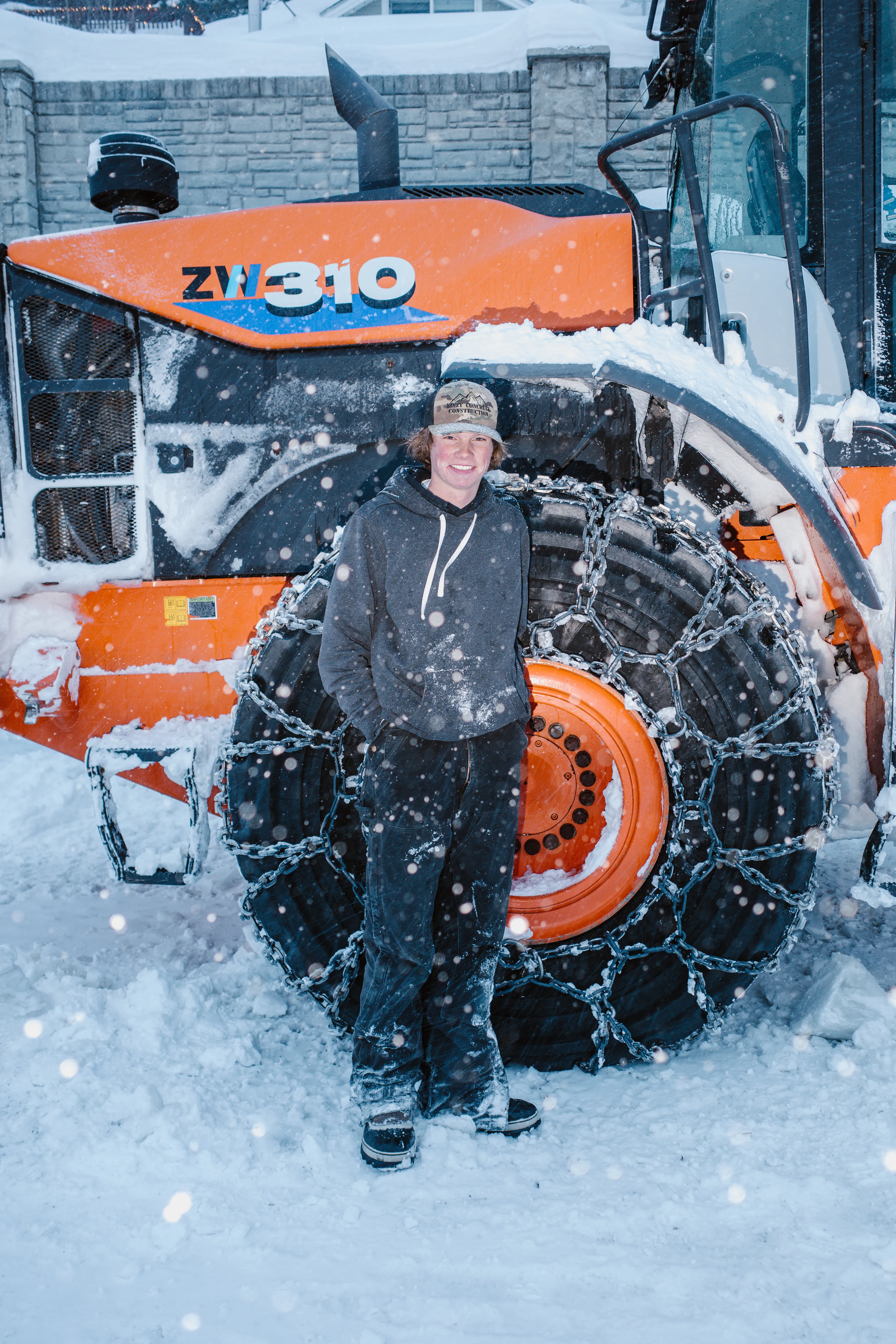
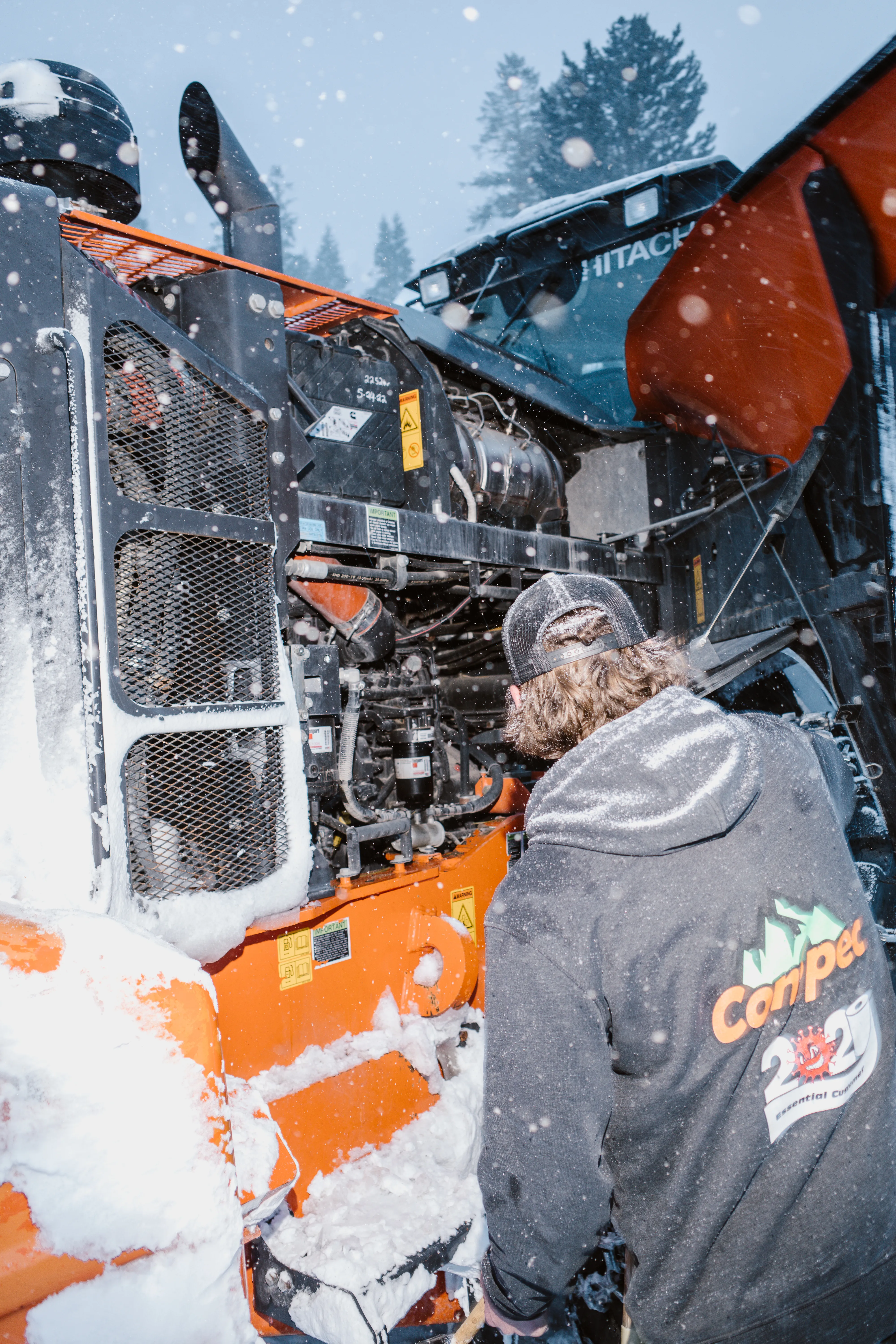
But the biggest, baddest loader is a bright orange Hitachi ZW-310, driven by a kid who goes by Murt. He absolutely rips up and down main street, both forward and in reverse, in white-out blizzards, neck craned backward to reduce the chance of crushing any cars, or at least get a good look at them if he does.
I ran outside when I saw him shutting down the loader for the day. A Mercedes S Class, parked in front of the post office, had the entire side ripped off. It’d been sitting tarped up for about a week. “Did you see that car that got torn up on main?” I asked. “Oh, yeah.” “It was a Mercedes S Class!” “Wait, that was a Mercedes?”
He looks like he just got his driving permit. Fresh face, rosy cheeks. The dinosaur of a machine makes him look even smaller.
Some kids have a dog, but Murt has a Hitachi ZW-310.
The road the house sits on hadn’t been plowed in over a week. The slope in the backyard was too unstable to plow, the county was afraid it’d set off a slide.
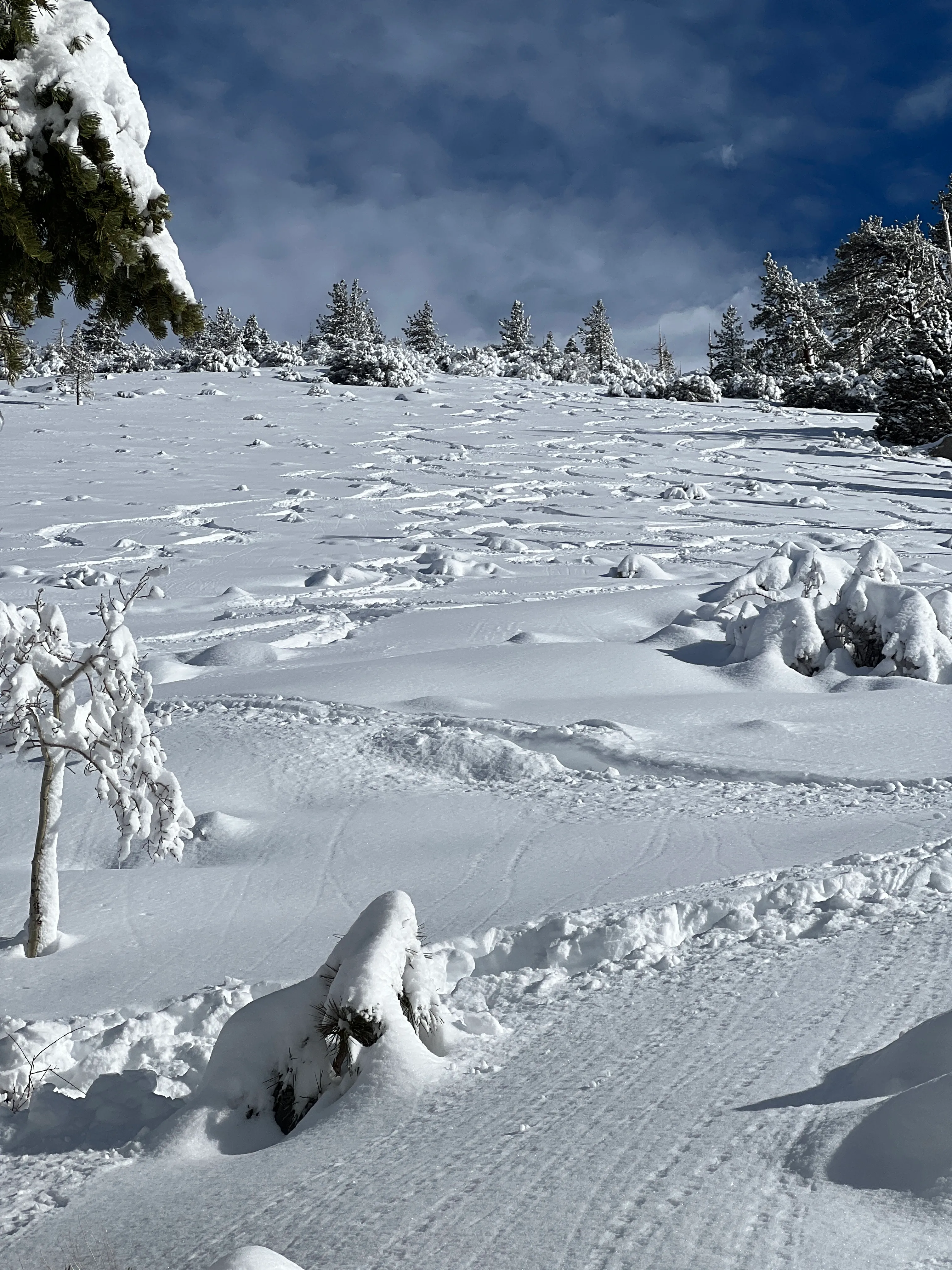
Walking to the coffee shop at the end of the street, head down to ensure stable steps in the fresh snow, walking became more difficult. I was walking uphill. Looking up, it became clear the hill had slid overnight. Not a huge slide, but enough to leave a runout across the road.
Looking around, the slide managed to take out a neighbor’s gate, and push all the trashcans quite a ways down the hill. A berm piled up almost past the second floor of the their house.
Later that evening some friends came over.
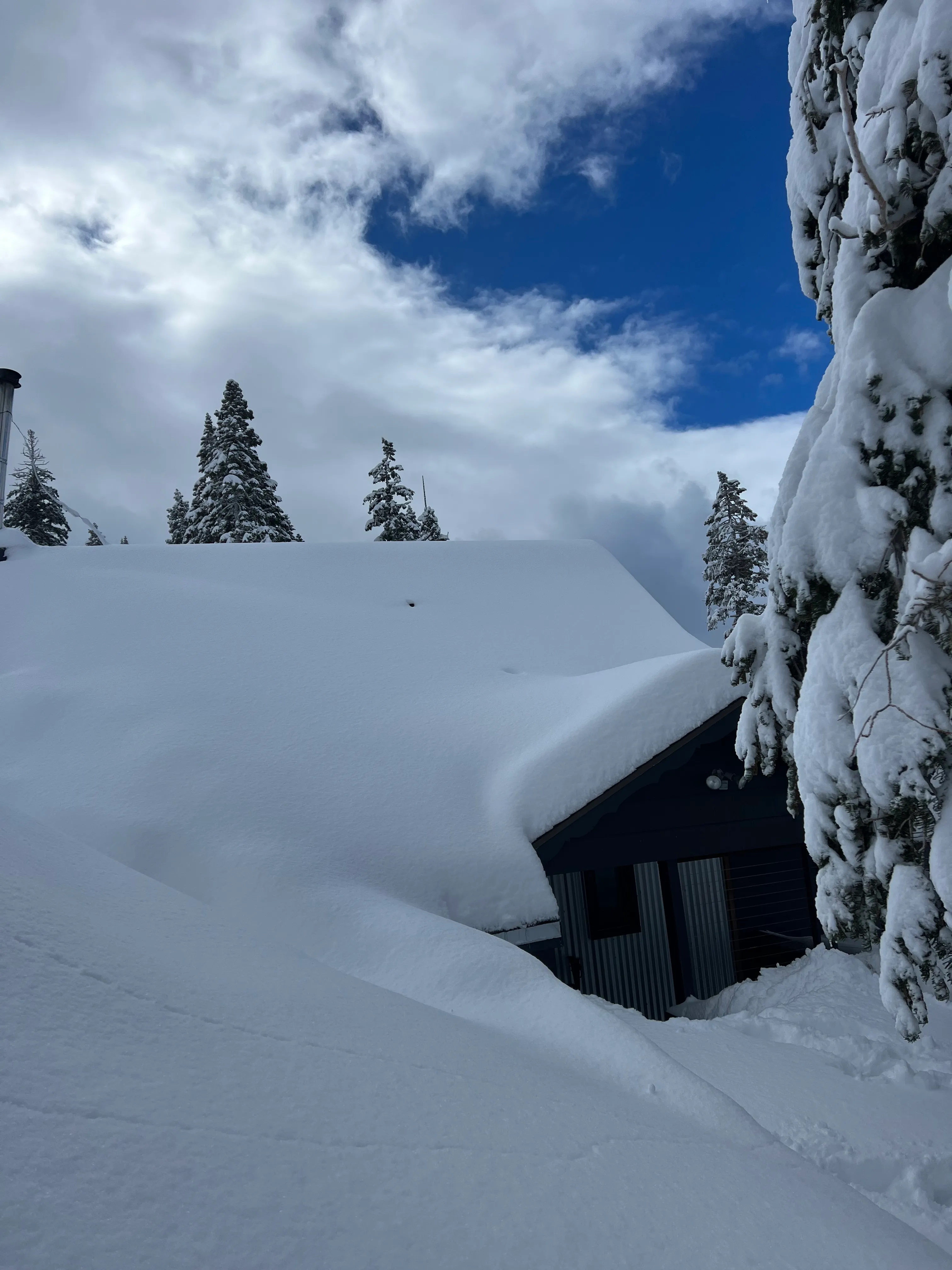
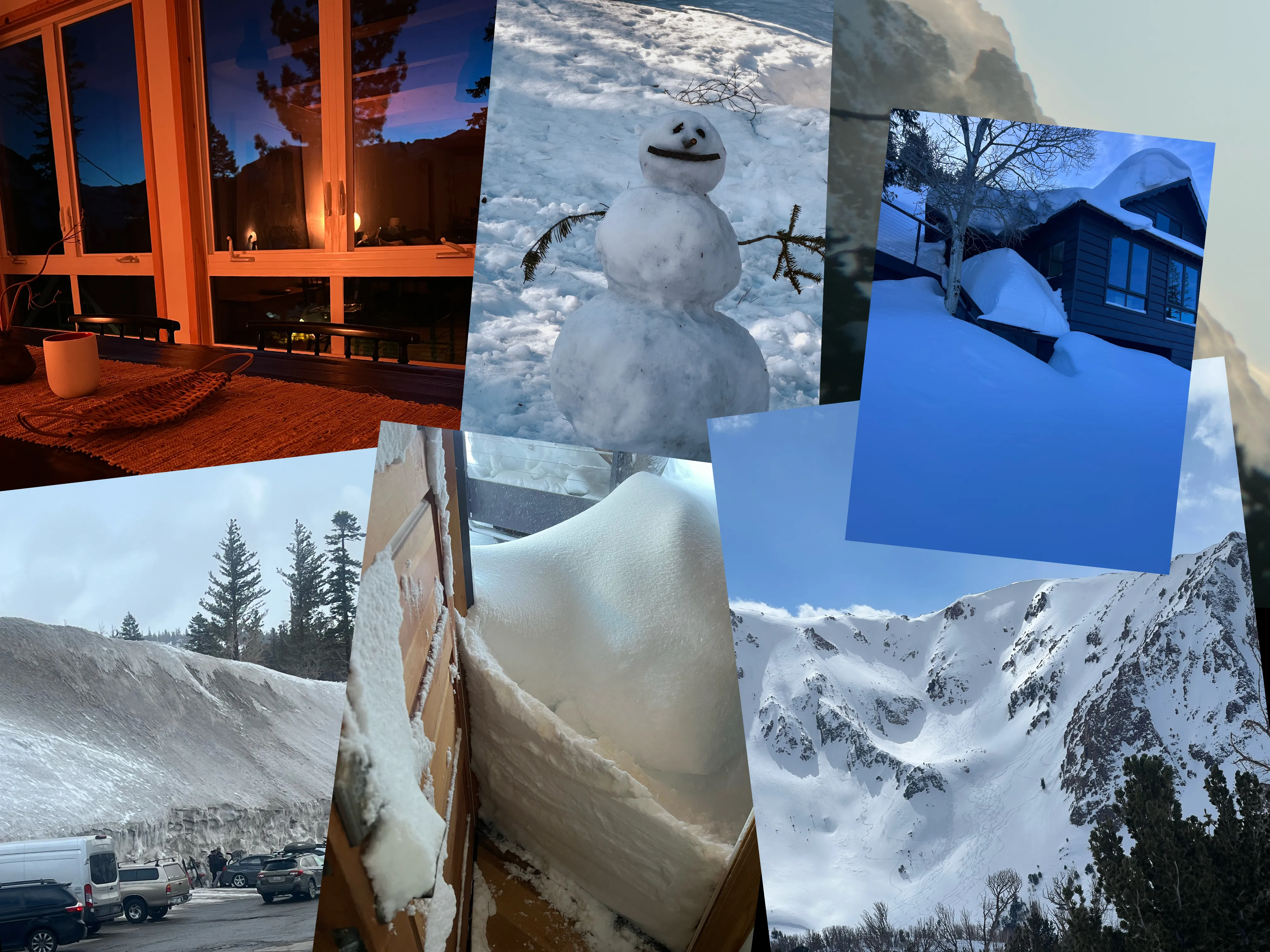
“Right, park at the end of the street, because my road isn’t plowed. Climb over the berm, it’s pretty tall, maybe 16ft. Walk about 100 yards and then you’ll climb up and over the avalanche runout. A little ways further and you’ll have to duck through a snow tunnel and up the stairs to my door.”
There’s an abundance of resources available on any topic. It’s easy to stumble into paralysis. When I was planning for the Pacific Crest Trail, the question of what to bring with me felt heavy in a literal sense. Each gram counts when you’re carrying it on your back for a few thousand miles.
Like any beginner, all I knew was I didn’t know.
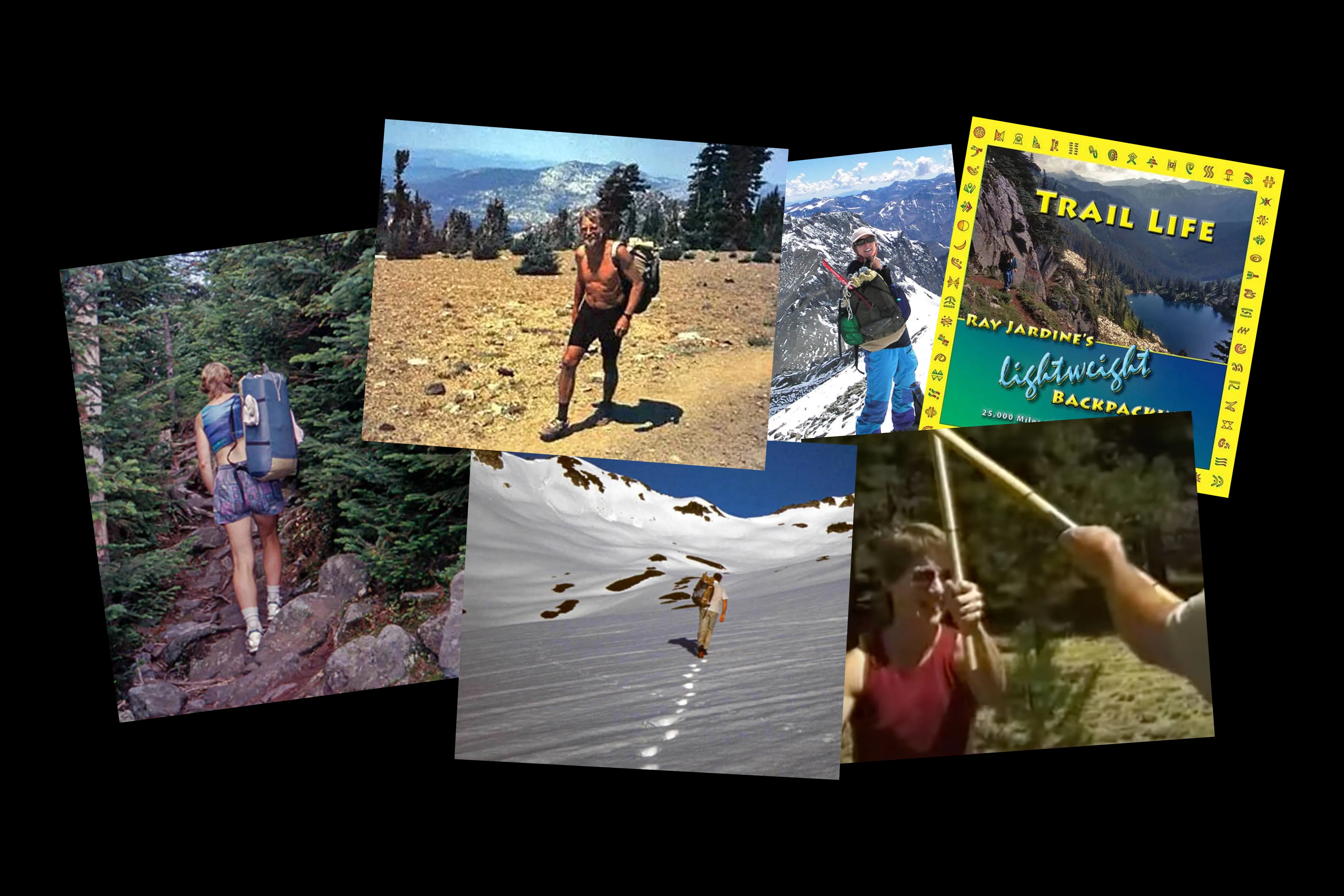
One afternoon I scrolled across Ray and Jenny Jardine. Together they are true OGs of ultralight backpacking equipment. Packs were once heavy canvas bags with metal frames and chunky hip belts. The Jardines began creating their own packs that answered to their personal requirements.
Essentially trash bags with straps.
Single volume, silnylon, no hipbelts, or any other fuss. Ray often wore his pack slung over a single shoulder.
I could go on about the Jardines. There is a page on Ray’s site with highlights including:
Was the first person (with Jenny) to thru-hike more than three long-distance trails of more than 2,000 miles in length (1993)
Founded the American Long-Distance Hiking Association-West (ALDHA-West) (1994)
Coined the Term “Triple Crown” related to long distance hiking (1994)
Originated the “Triple Crown” Award (1994)
Presented the First Plaques to the Triple Crown Recipients (1994)
Ray and Jenny received the world’s first Triple Crown Award
To recap… He was the first to do a thing, then created a foundation for the thing, created an award for the thing, and presented the award to the first person to do the thing: himself. Truly a visionary.
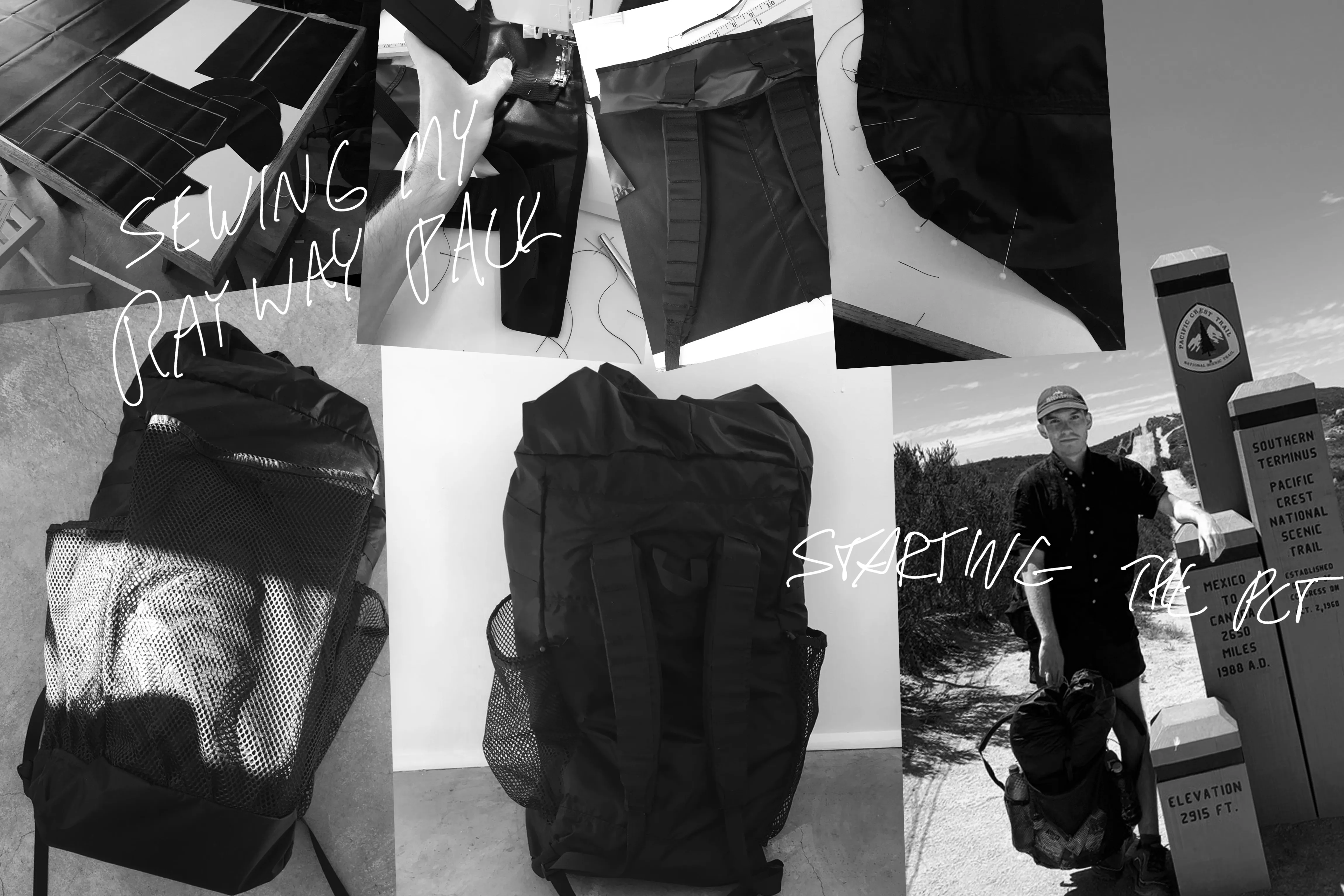
What excited me when running across Ray were the backpack kits. You can order the material, patterns, and instructions from Ray to create a Ray Way ™ Pack. I was convinced to give it a shot after reading an endearing essay, “Why Sew?”
Ray Jardine observed: “People will spend hours studying commercial gear in magazines and online. What do they get? Heads full of hype, closets full of superfluous gear, and depleted savings. But if they spent a fraction of that time making their own gear, they would spare themselves the hype and monetary loss, and would produce gear that is serviceable, satisfying and rewarding.”
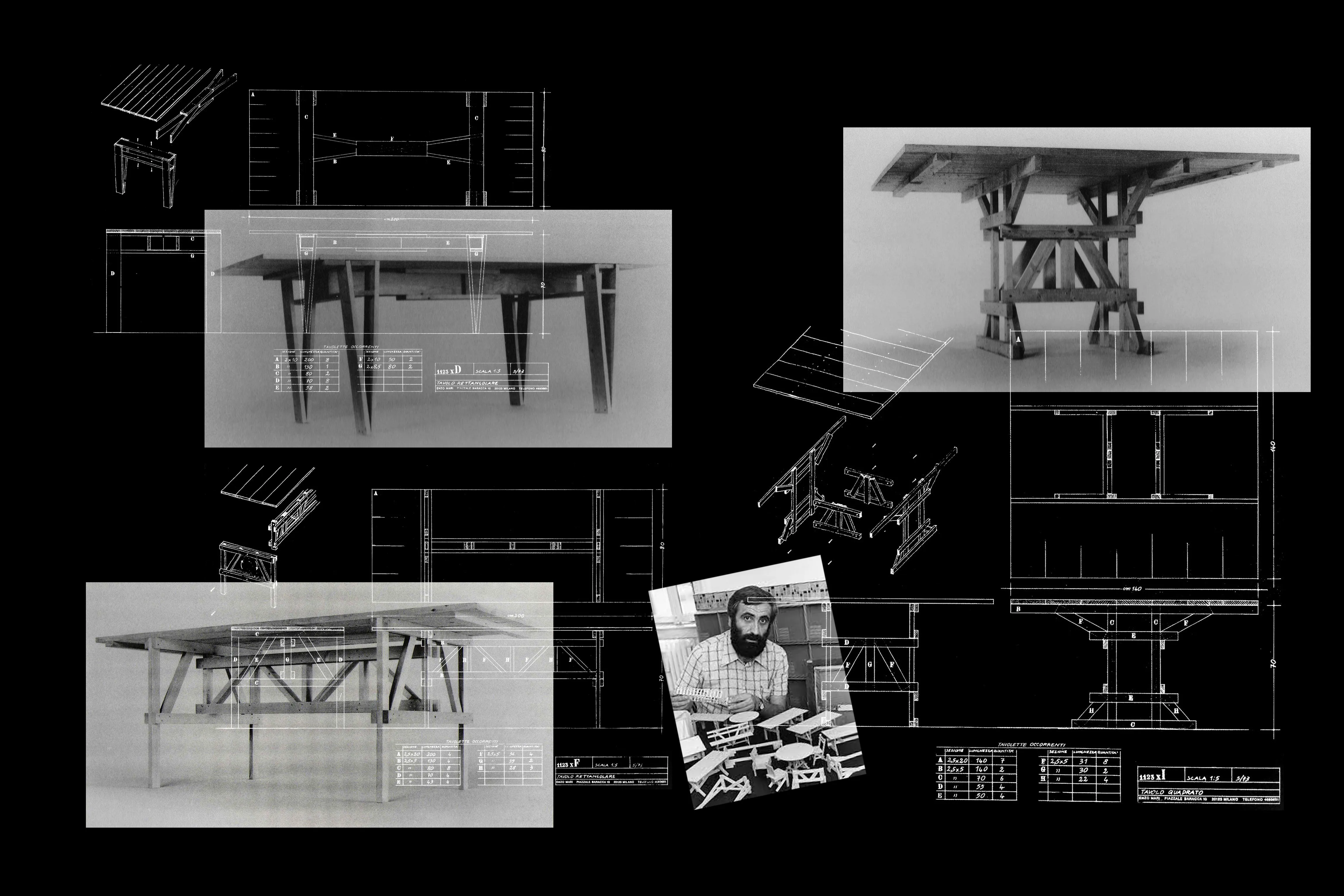
This reminded me of Enzo Mari’s Autoprogettazione, a project created to encourage understanding of what makes furniture good furniture. You’d mail order a booklet, find a piece of furniture, and build it using cheap and common lengths of wood, a hammer, and nails. There are no instructions; only self-describing illustrations.
The pieces are not only functional, but beautiful in their focused simplicity and modest material use. For several years I furnished each of my apartments with pieces built from Autoprogettazione. Each time I moved, to avoid the hassle of moving furniture, I’d list everything for free on Craigslist. “Free Midcentury Italian Table.” It’d be gone in seconds. And I’d start from scratch and iterate at the next spot.
After a few years I became pretty good at making simple furniture. Building pieces from memory, and adapting them to my personal domestic requirements.
And so I ordered for the Ray Way kit. It arrived within a few days, and I got to sewing. As promised, it was easier than anticipated. I learned what makes a good pack good, felt liberated to modify it, and capable of fixing it in the future. There was no pressure to baby it on trail, having flaws right out of the gate.
I carried it with me the first 700 miles of the trail, until entering the alpine Sierra Nevada. This stretch requires a bear can, ice axe, and some extra clothing. I also brought along a stove for morning motivation to warm up get moving, something I didn’t fuss with the rest of the trip.
It was easier to make a decision on what pack to grab for this heavier carry—now I knew what I was looking at.
Hands on experience is priceless. Critical understanding through practice. The knowledge is carried with you, and applied when making future decisions. Recognizing when and why something is good.
It’s not possible to build every tool in your box, but there are similarities between tools that make an experience relevant beyond an immediate application. Packs, bags, shelters—even clothing. Using silnylon once makes you more confident to repair other gear. But having a set of instructions, and working on something you crafted helps relieve the pressure of farming your first more demanding repair job.
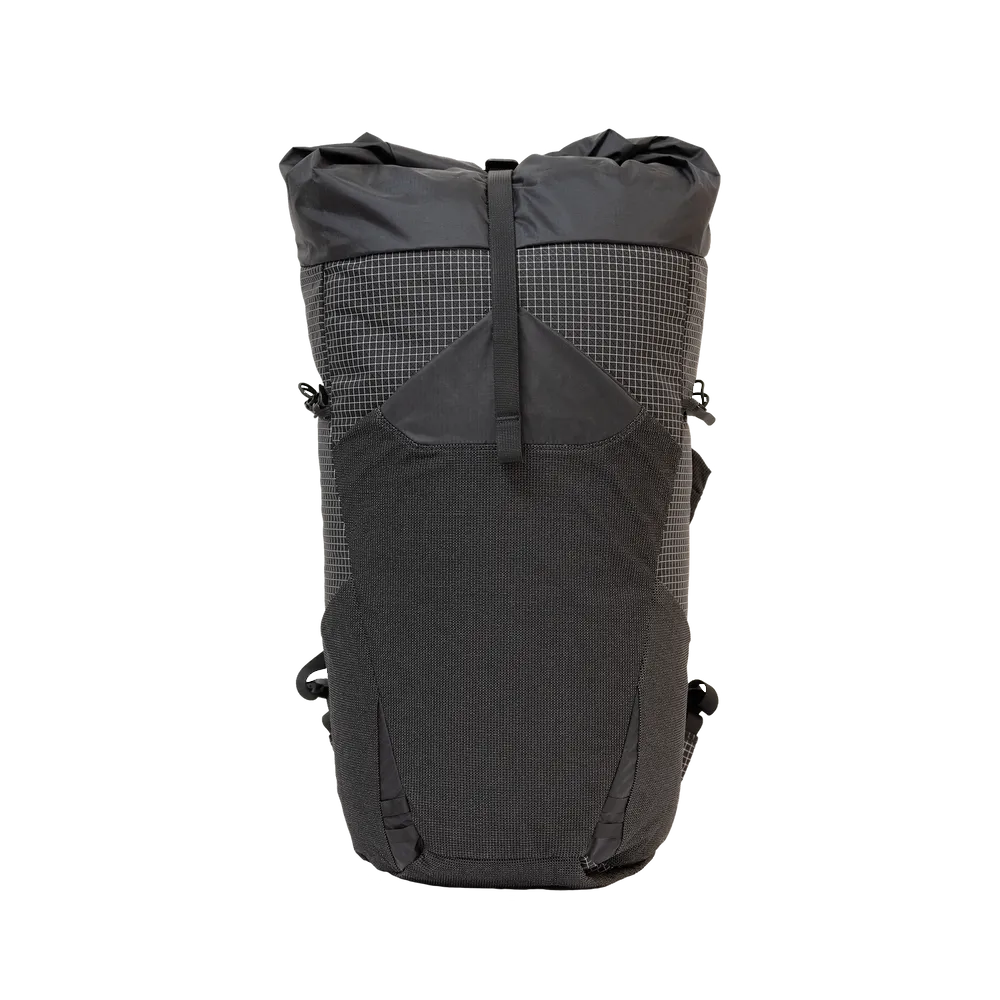
One of my favorite packs is the Pa’lante Joey. It uses nylon ripstop to create a single volume and has vest-style straps. While I could’ve made something similar myself, I recognize the craft that went into the Joey, and what Pa’lante is trying to do.
There’s a satisfaction in supporting people going out on a limb and doing good work. In purchasing a pack from a cottage company like Pa’lante. Helping to sustain a small business making good gear accessible more to people. They’re generally more nimble than larger manufactures, and experimenting on the edge.
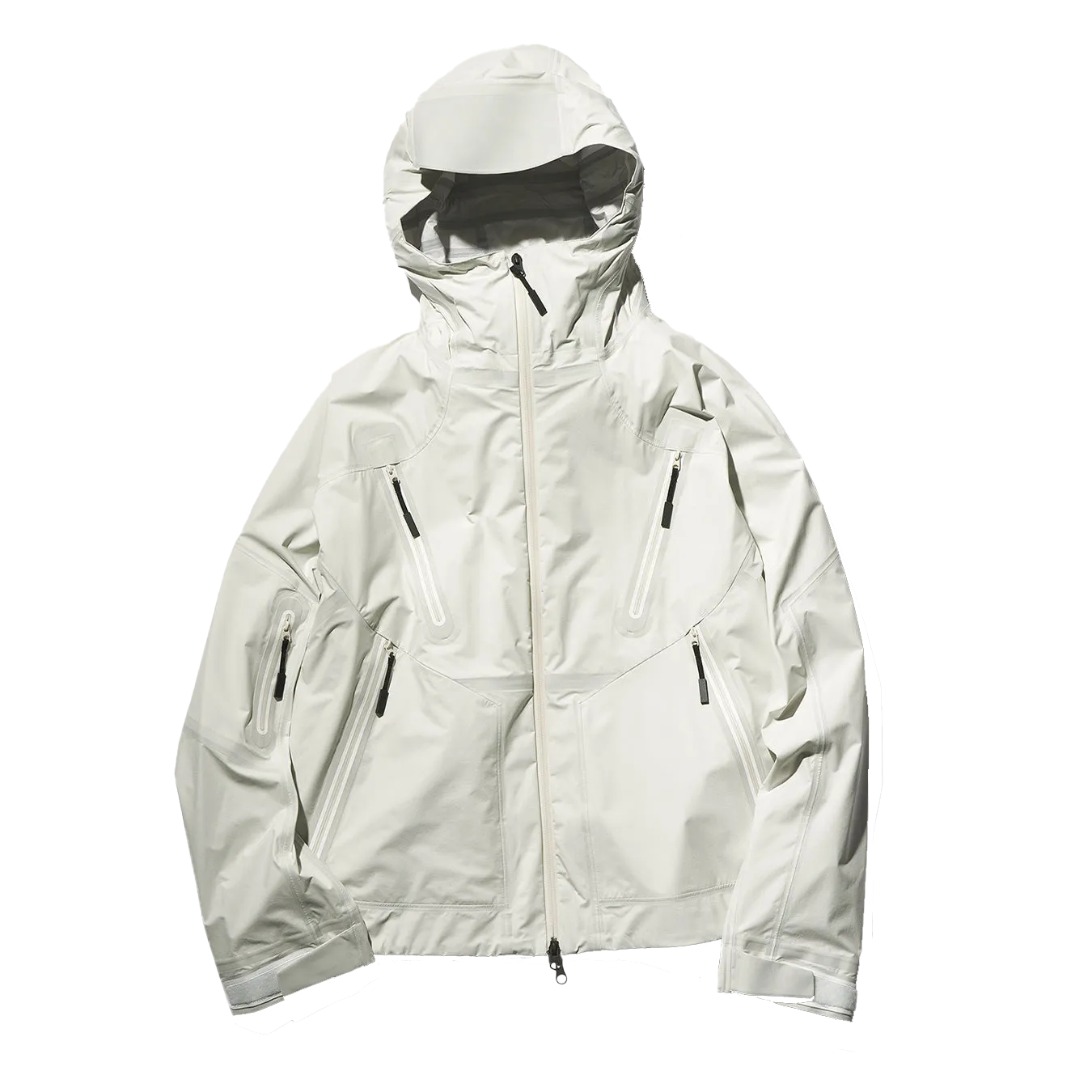
Or grabbing a bit of kit from a larger manufacturer who funds experimental projects, like Goldwin and their Goldwin 0 series of campaigns by OK-RM.
According to Goldwin 0: “A garment is made from materials and energy. An intergenerational garment is made from all the materials and energy it has saved; by rendering their production unnecessary. Functionality and performance are not incompatible with ethics and responsibility.”
The clothes come at a premium, but ultimately a purchase goes to funding experimentation and new material use. The hope is, as process is refined, these techniques make their way into more common offerings.
My Goldwin jacket got a cut from the edge of a ski when shouldering them to the car. My familiarity with repairing technical fabric from fixing my Ray Way pack freed me up to make a simple patch repair with confidence.
Goldwin isn’t required to do the research, or fund interesting projects like the OK-RM campaign. The gesture goes a long way towards motivating me to support the effort by making a purchase.
So in thinking about gear, all of this leads to a loose manifesto:
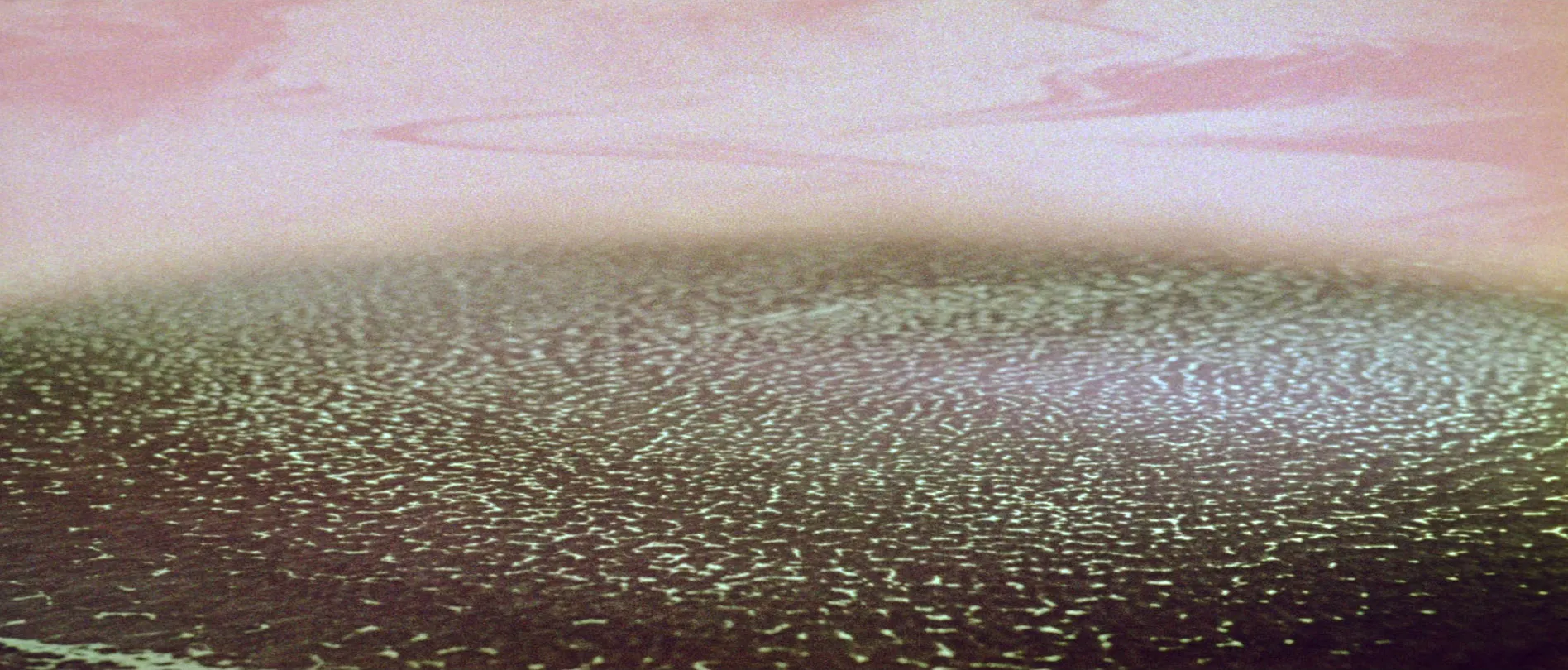
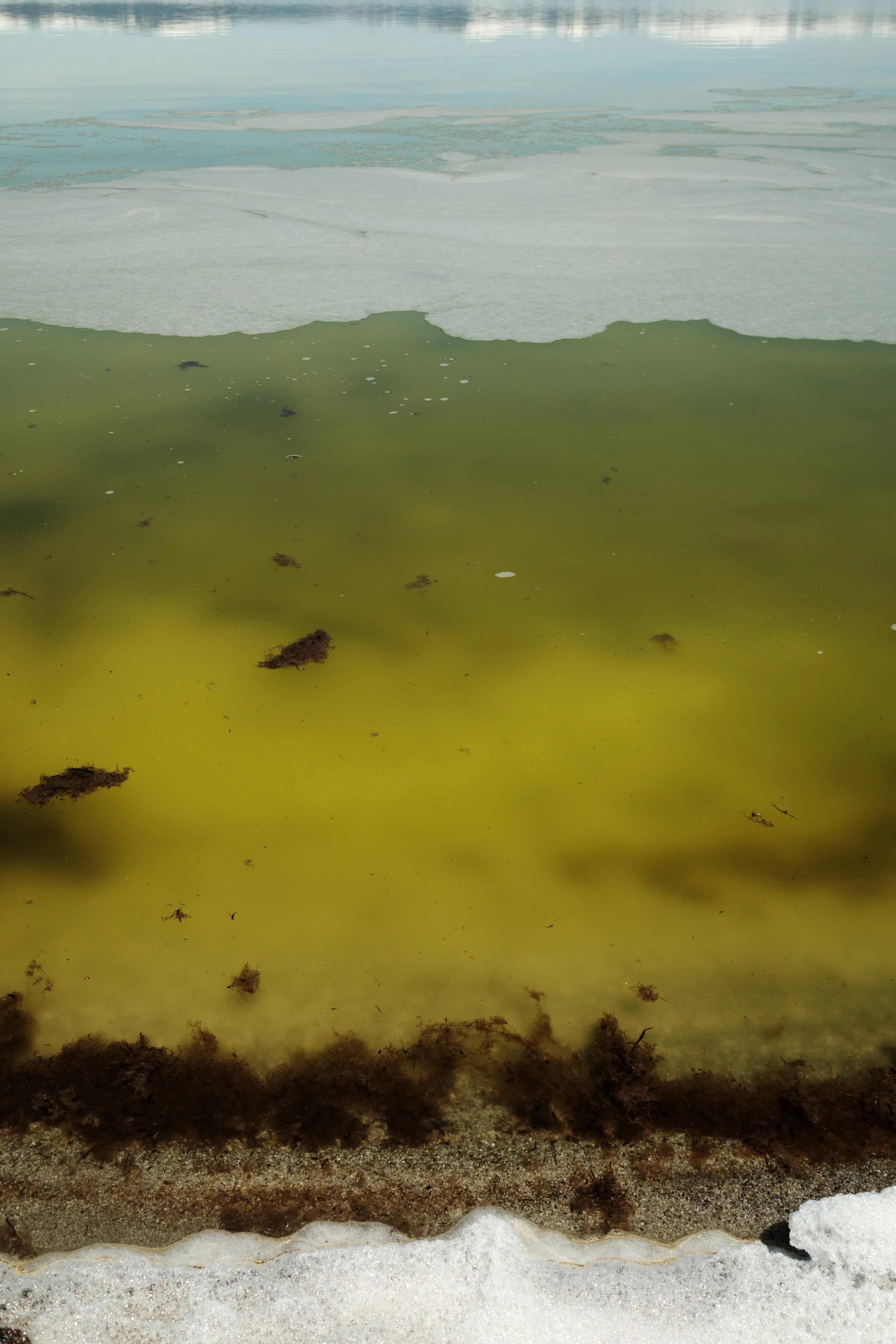
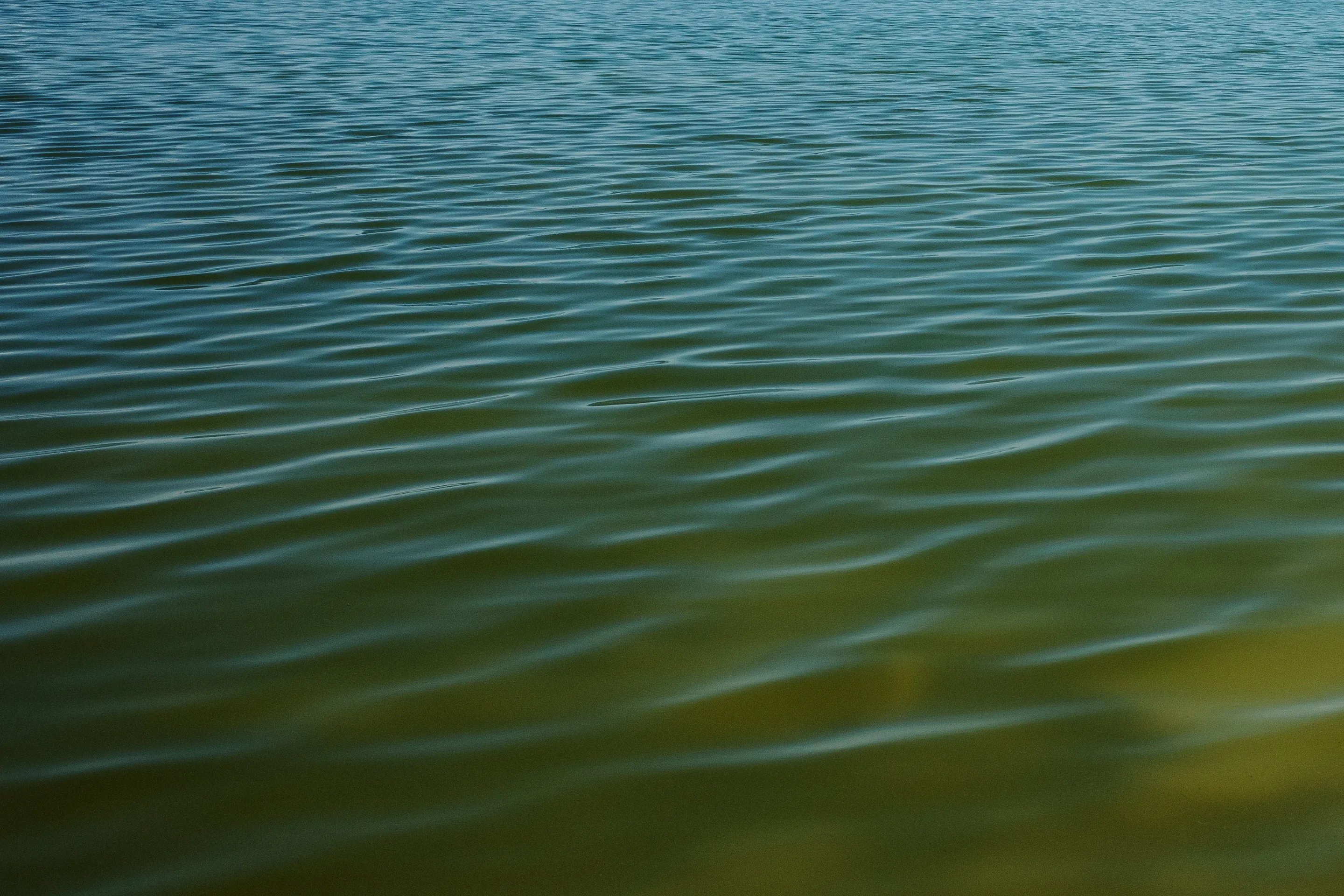
The water of Mono Lake is unlike other bodies of water. It’s hypersaline and alkaline, thick and viscous. On days with calm wind, the amplitude of each wave stretches like elastic. Elongated and skewed towards horizon. Like the oceanic planet in Tarkovsky’s Solaris.
The Mono Basin might be the closest you can get to standing on an alien planet without the hassle of actually traveling to one.
Last week my good friend Ethan hosted a pizza topping potluck. I brought oyster mushrooms, ricotta and basil. We tossed ideas around while tossing toppings on the pies.
“…could be fun to run Mono Lake, you know?”
“Sand… a lot of sand… ”
“40 something miles, right?”
We glanced around…
“Sign me up!”
As the date approaches there’s a hint of hesitation on my part. The Bishop Ultra is a week after our planned date to run Mono Lake. I’ve signed up for the 50k. My performance in the ultra would be affected.
Running mono and running the race are goals of a different type, and surfaces questions of motivation.
“What is my focus?”
I decide to run the first half (20 miles) of Mono Lake, and leave the question of “do I complete this, or prioritize the ultra?” up to the moment.
8:16am · Mile 0
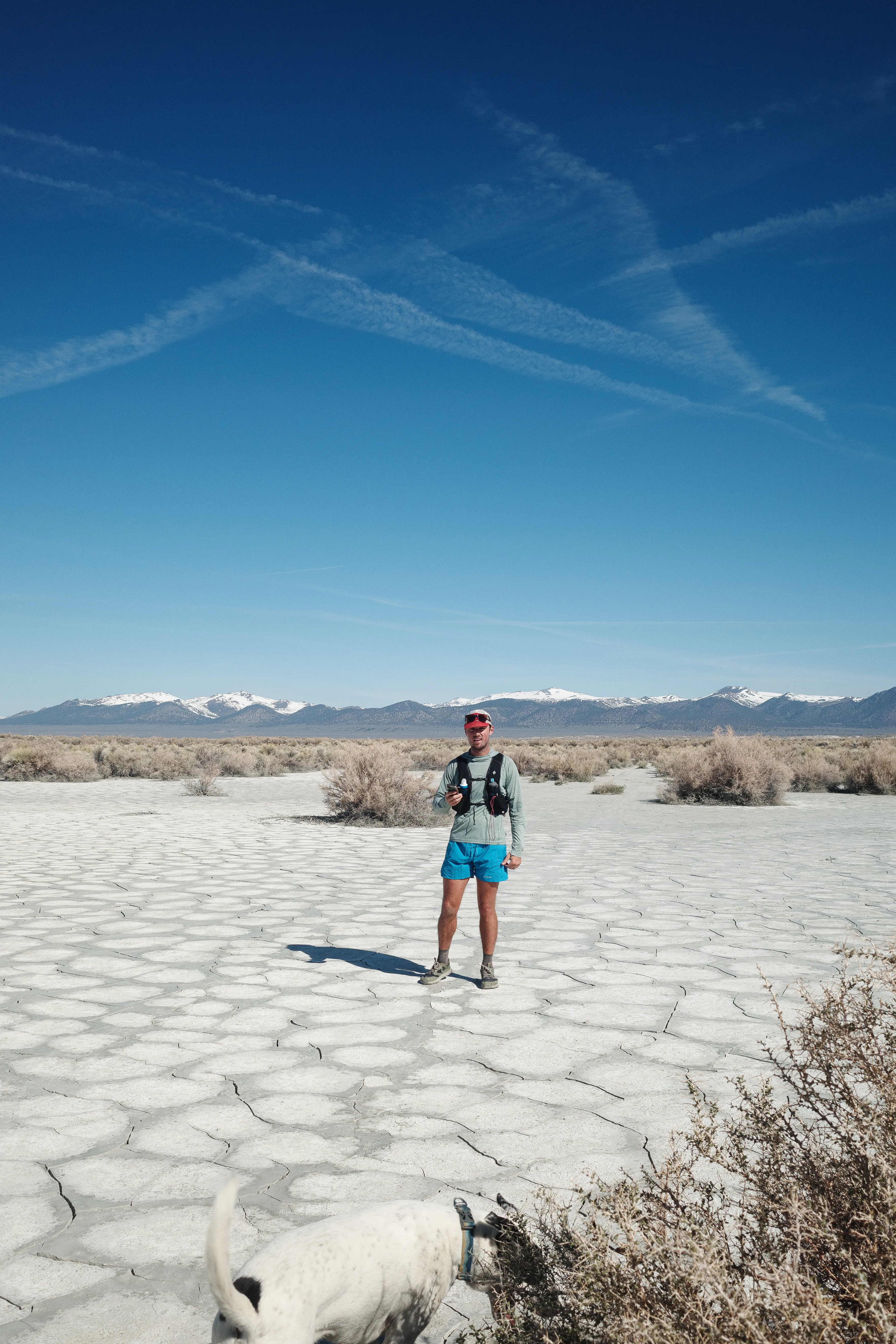
Here we are, standing at the north shore on a crisp early May morning.
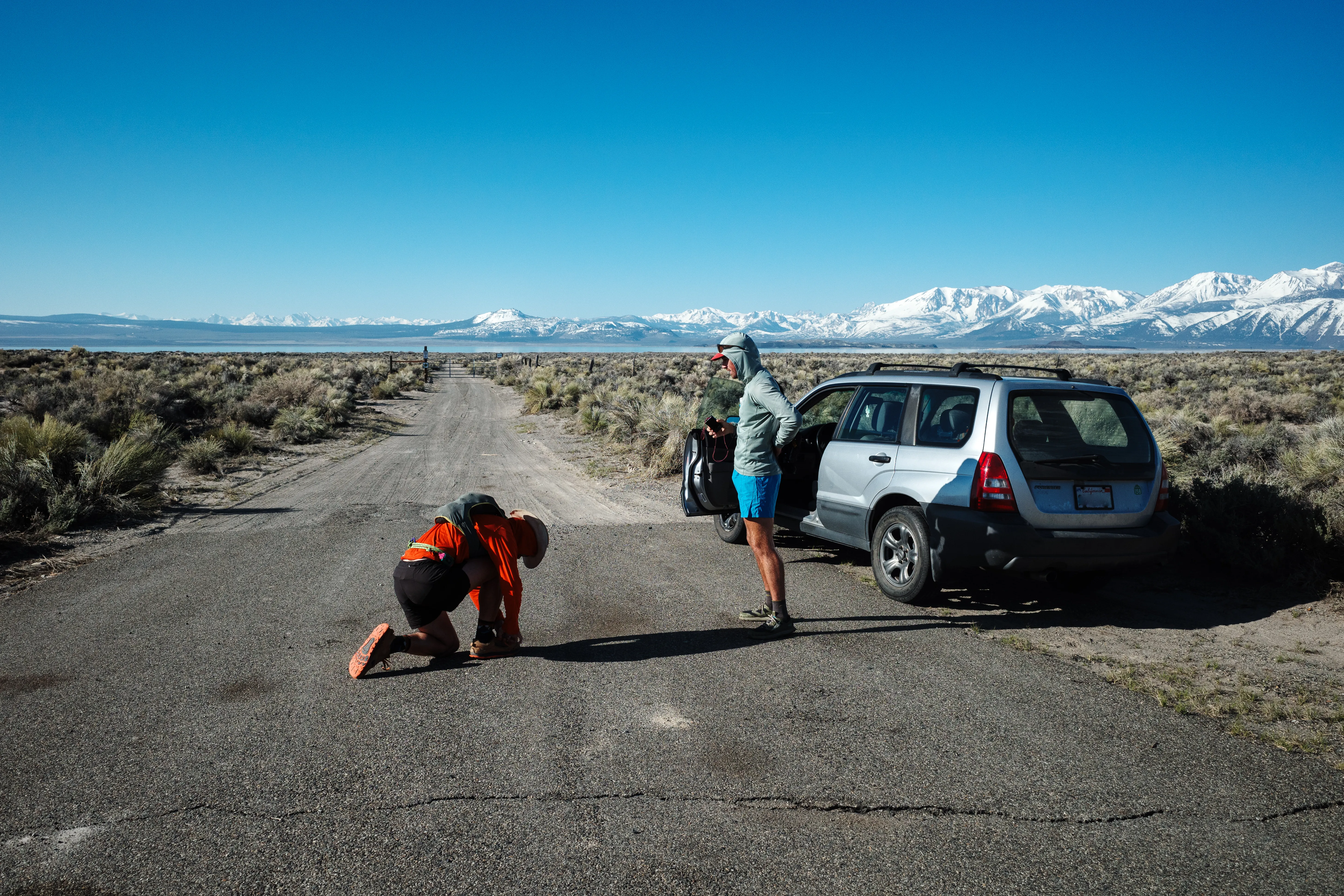
Lucas’ dog, Spot, is running laps around the three of us as we do that awkward pre-run dance. Stuffing running vests with snacks, and swinging our legs around like we’re fighting off some invisible Force of the Lake.
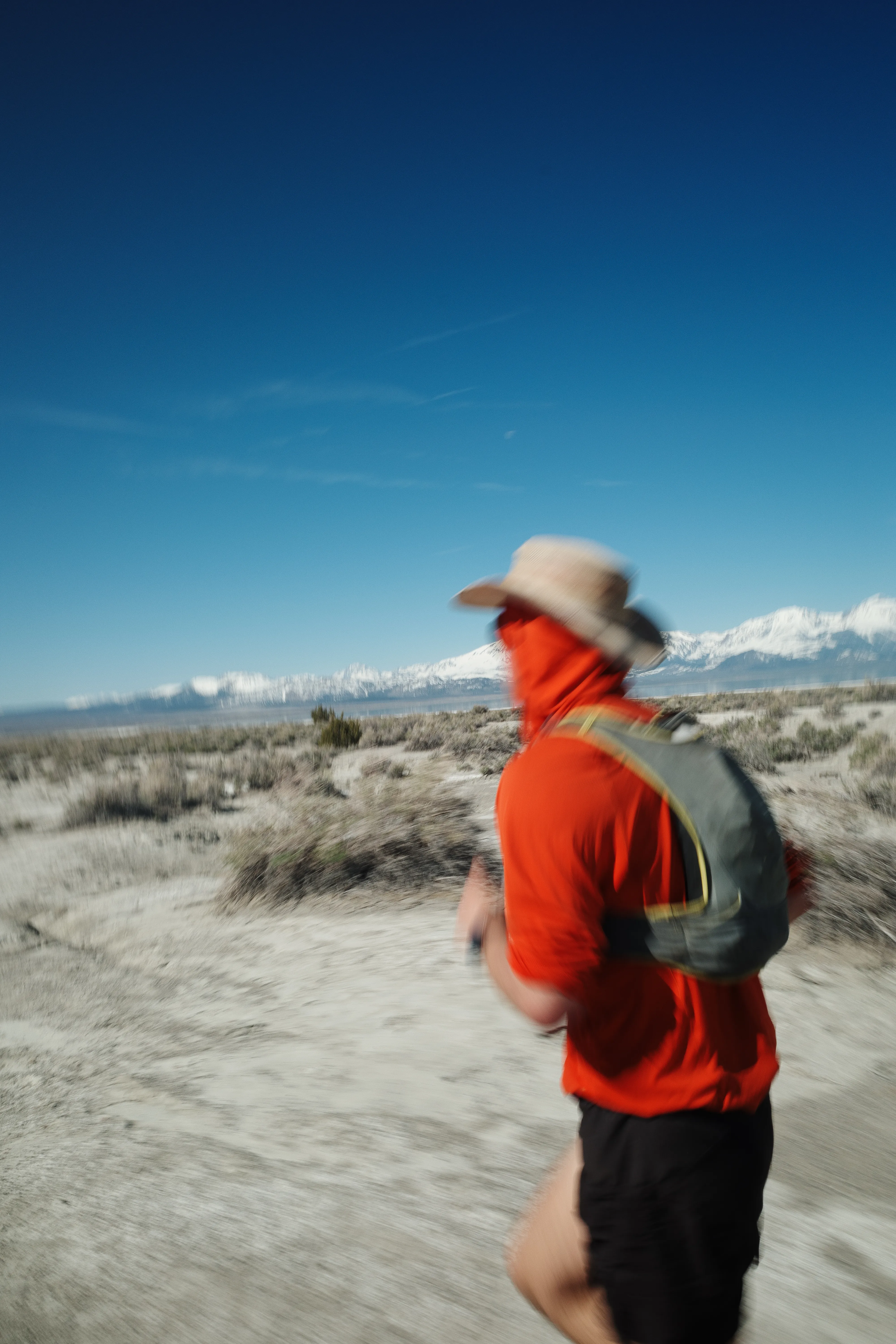
Lucas placed the final piece of his kit on his dome, an oversized cowboy hat.
And just like that, we get moving.
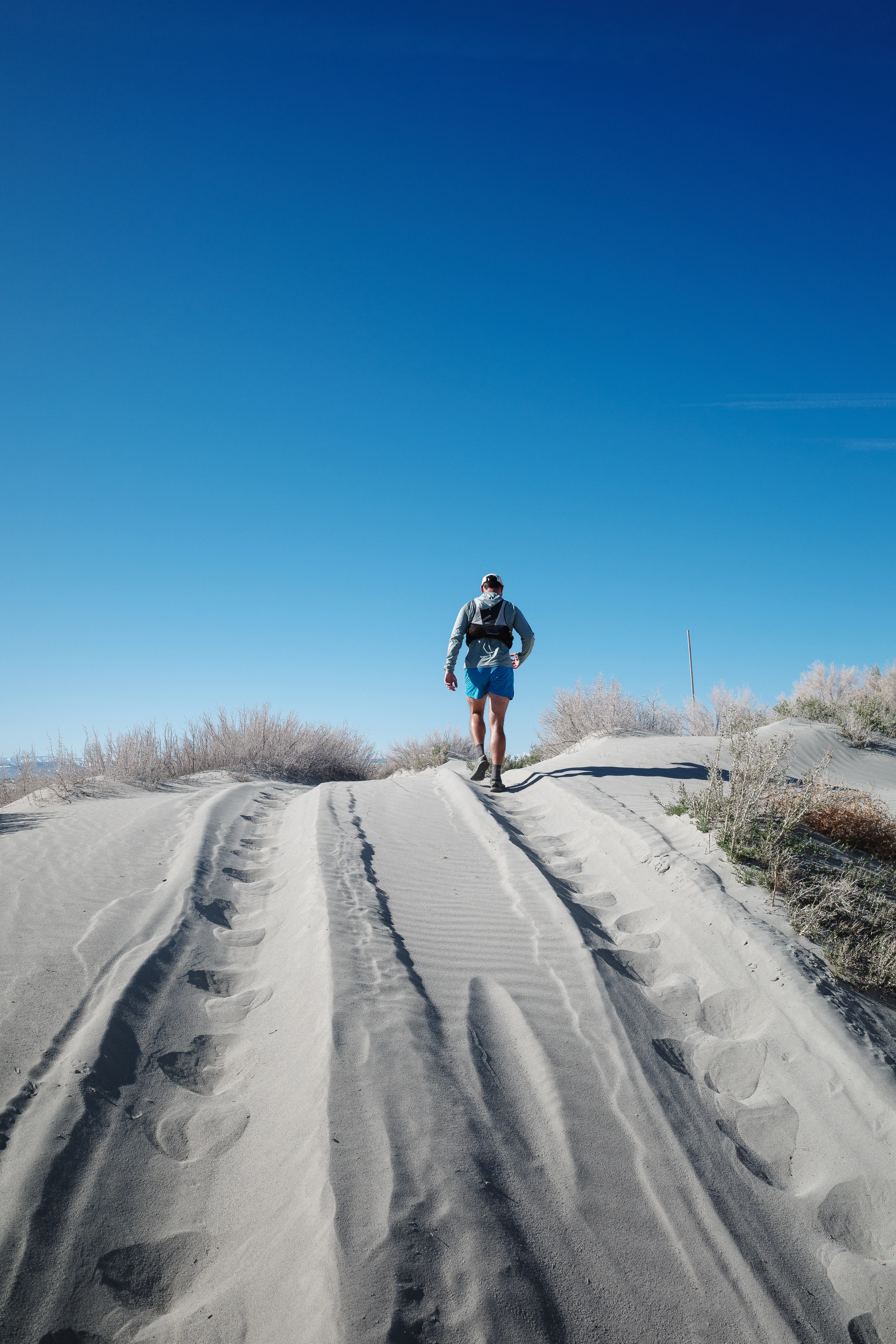
About that sand mentioned a few weeks back. It’s no joke, and all consuming within the first few minutes of running.
This isn’t sand you run at the beach, compacted by waves lapping. These are loose dunes, not doing any of us any favors.
Stakes in the sand mark where the road should be. The dunes drift season to season, wandering with breeze. Occasional gale force easterly winds, spilling over alpine passes, blow shoreline alkaline dust clear into Nevada.
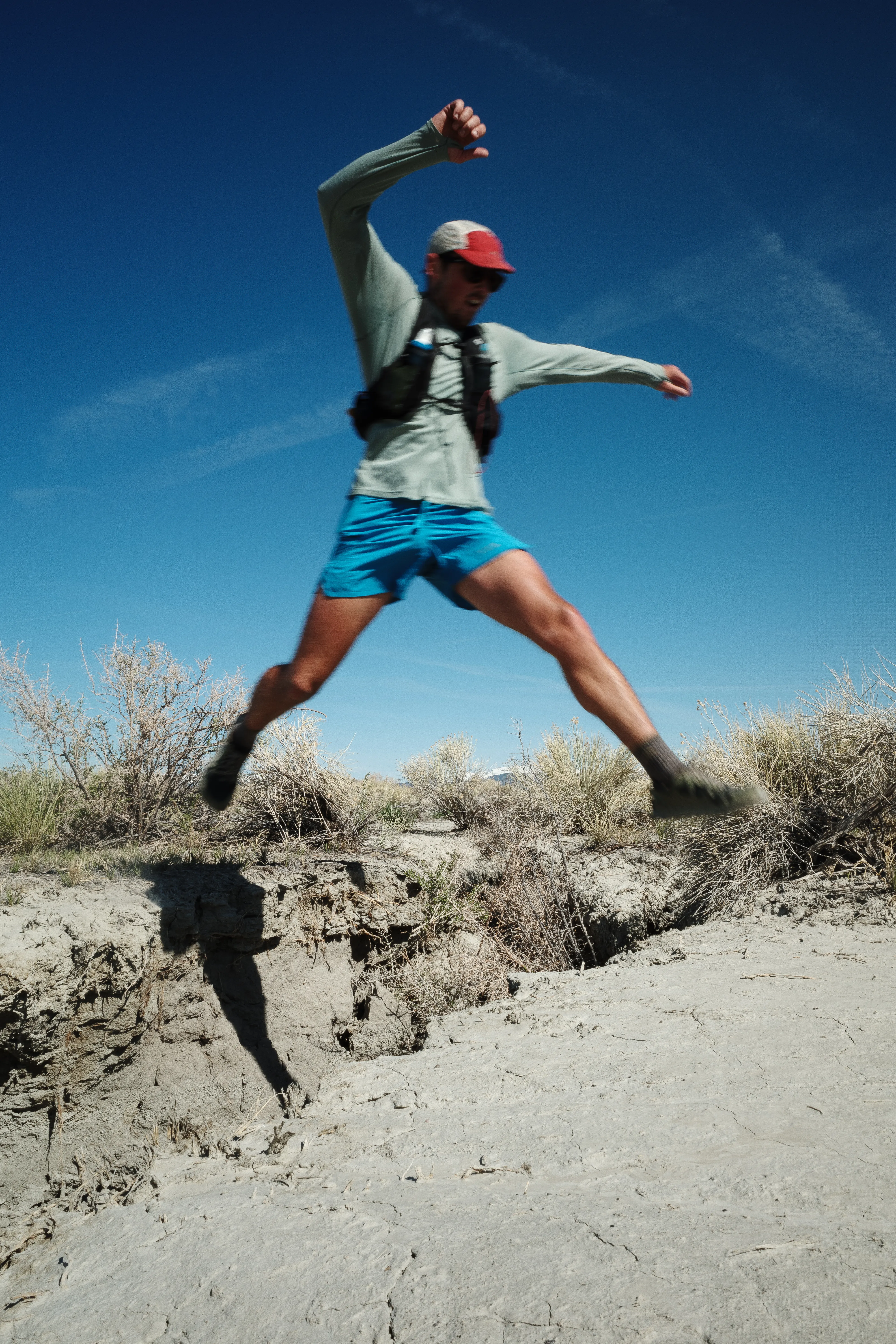
The loose grains turn to bone-dry hexagonal clay plates. They collapse when stepped on, and emit a satisfying hollow timbred ting sound.
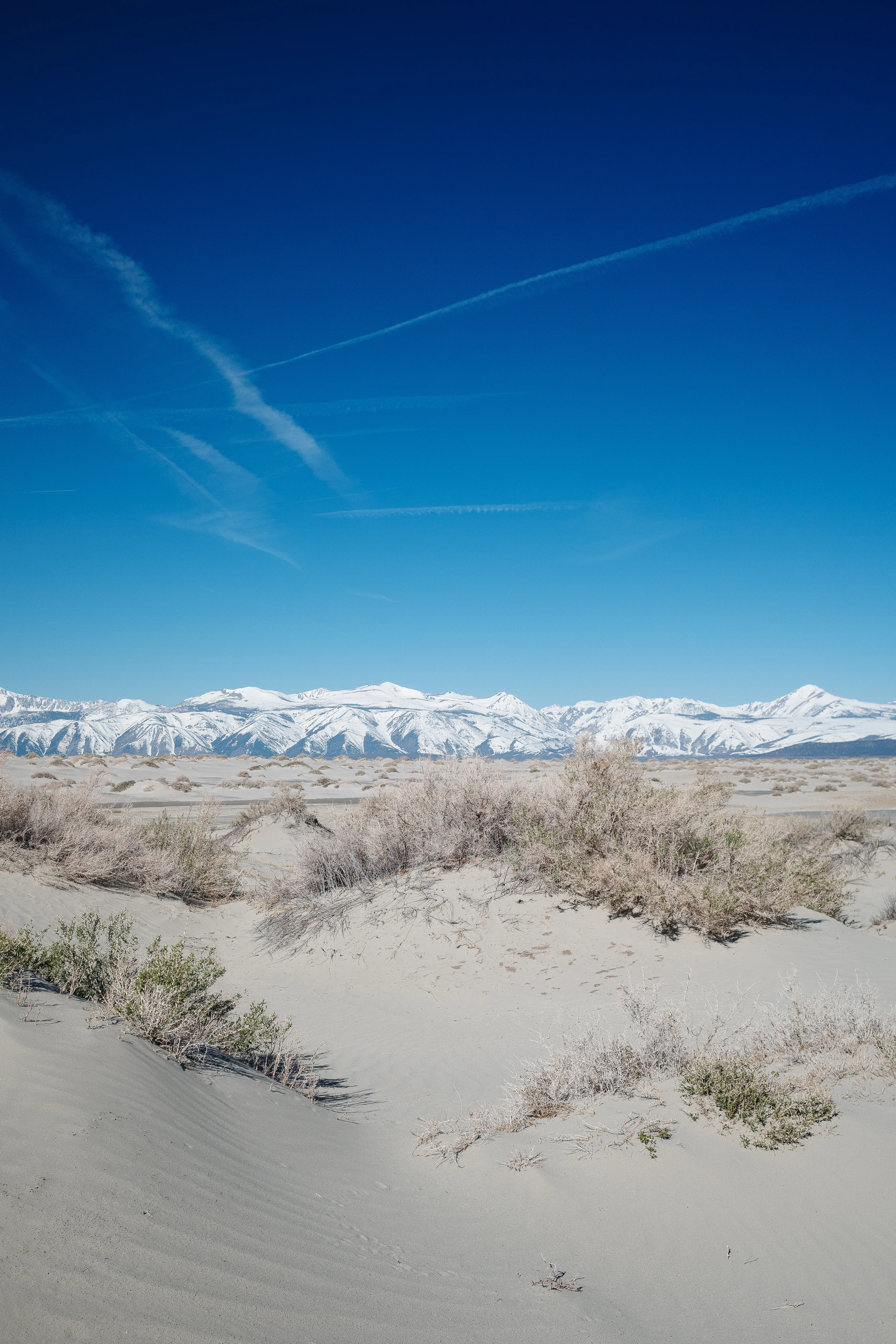
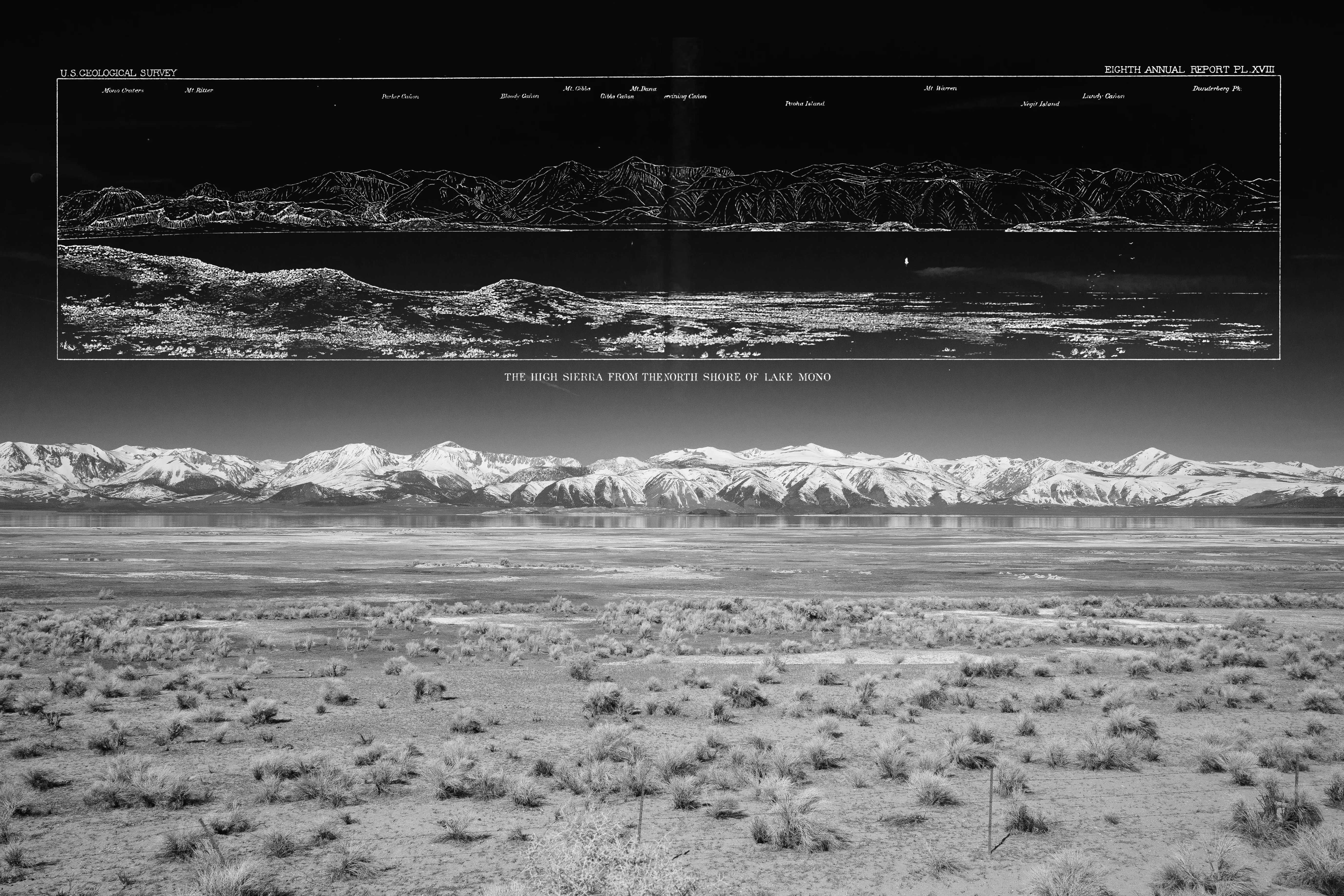
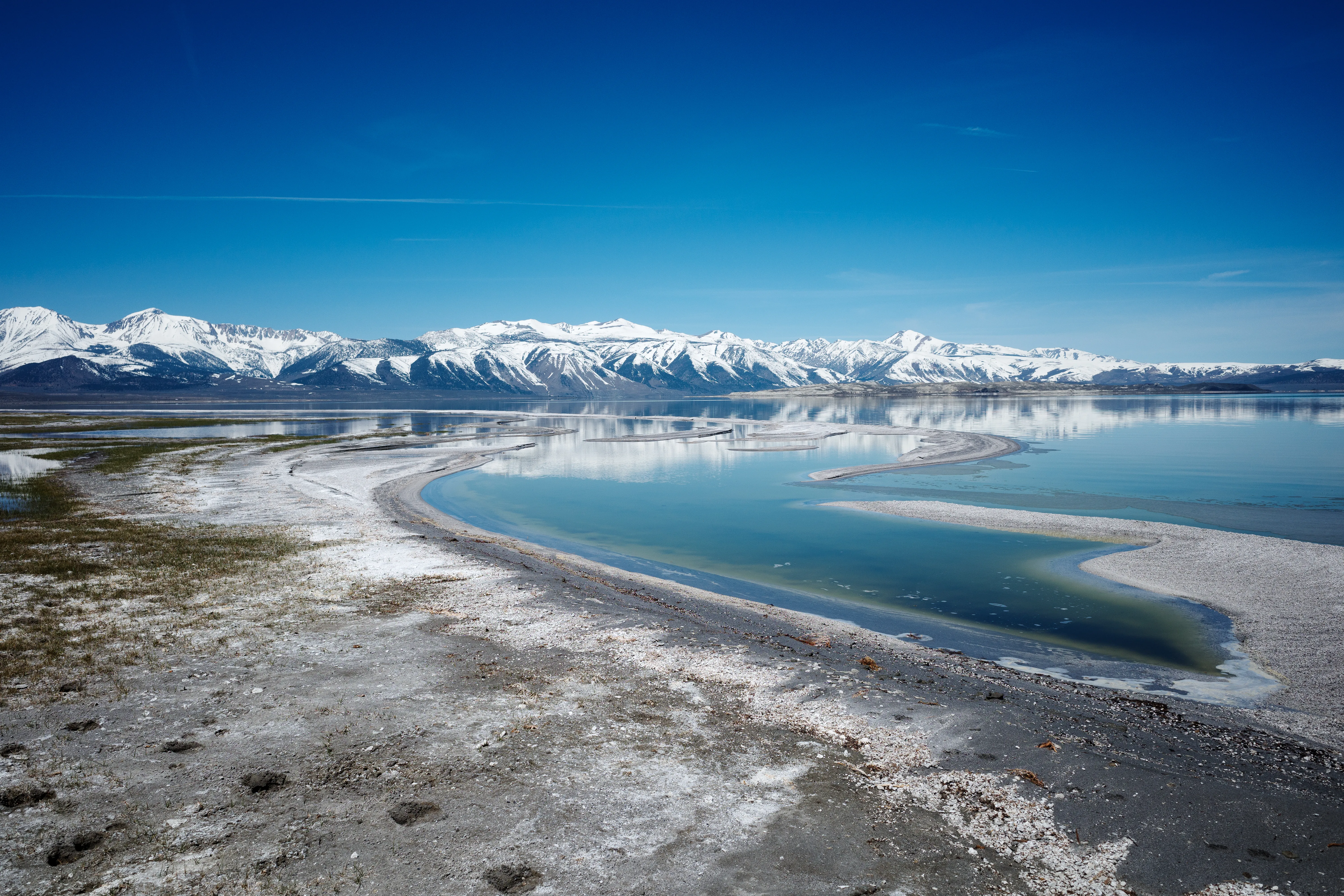
The full width of the Sierra between Bloody and Lundy canyons reflects in the Lake. Only within the past week did winter thaw out at our elevation. A unique perspective not many see from the north-eastern shore. Particularly on foot.
As the sun climbs higher in the sky the water’s tone becomes a deeper blue.
Lucas’ dog, Spot, takes off running after a herd of wild horses in the distance. There was nothing we could do to catch him.
About four-hundred wild horses live on the eastside of the lake. This winter was rough on them, with the record amount of snow making access to food difficult. There were rumors of a mountain lion stalking the herd. All of this has driven the horses closer to the lake, and has become a big interagency political project for wildlife and land management resources.
We’re still waiting for Spot, but after maybe ten minutes, he comes running back to us. Kicking up a cloud of dust and looking a little more tired.
A sense of progress isn’t obvious. We’ve been running for some time along this line of sand you could say resembles a road. The scale is becoming clearer through perception shaped by movement—not just what we see in-front of us.
We choose to drop down to the actual shoreline to break things up, contouring and gradually heading more westerly.
The turf becomes swampy, muddy, and surprisingly lush. Immense amounts of water from the record winter snowmelt remains at the surface. Wet feet progressively saturate with each step.
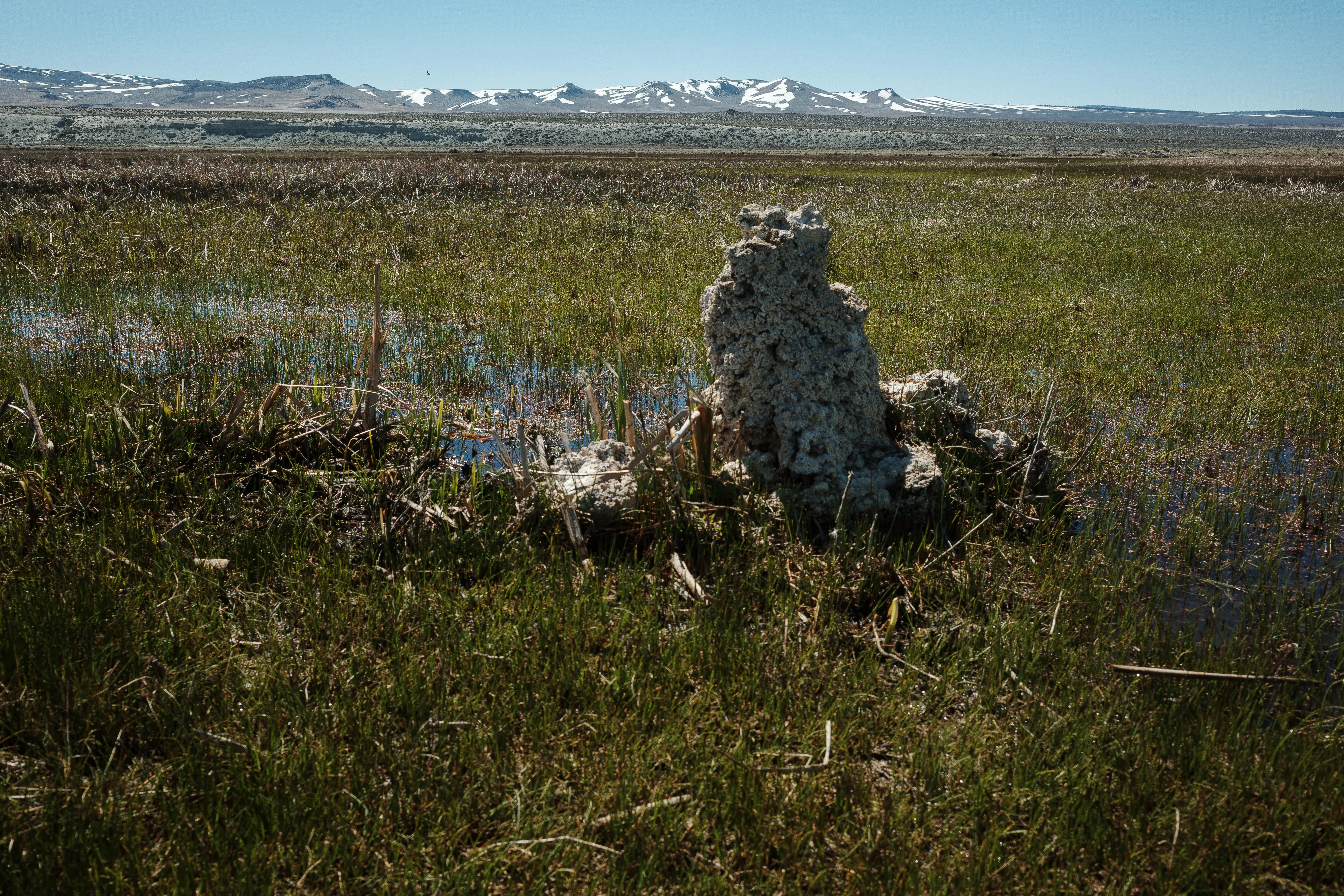
White columns of calcium carbonate, tufa tower, dot the expansive green ahead of us. They form when warm spring water percolates upwards from the lake bottom, and are only visible due to the receding volume of water in the endorheic basin lake.
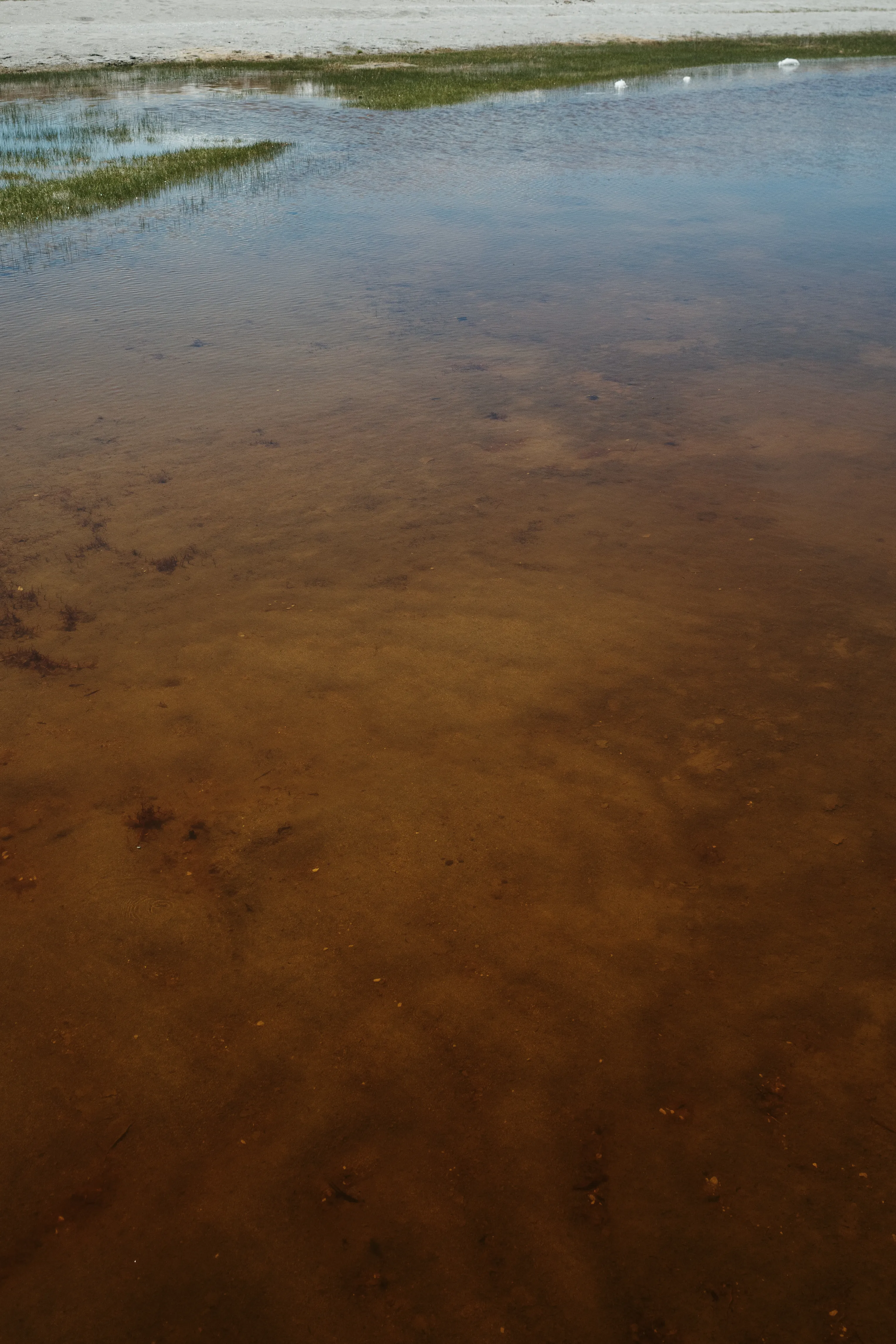
The water is thick and slimy to the touch. Alkaline. The hues shift between burnt orange, azure blue, and emerald green. Narrow sandbars parellel the shoreline, the sand providing stable support one moment and swallowing your entire foot the very next.
It’s unclear if they lead to dead-ends, but we follow them anyway.
Ethan stops in his tracks, pointing towards what looks like a mummified mountain lion… or is it a polar bear? Reason tells you it’s not, but it sure looks like one. After a few minutes of debate we agree it’s an unlucky black bear who didn’t make it through winter.
Looking ahead, there’s speculation about what point on the horizon is the south tufa parking area. We’re getting close, but I find that never makes the distance go faster. Better to keep cruising and delay thoughts of snacks and stretching.
12:23pm · Mile 20
We step off the sand and onto asphalt, arriving at the van just past noon. Snacks sprawled out and foam mats on the ground. The first half went by surprisingly fast.
Lucas and Spot are planning to meet us again in another ten miles with more water and snacks. Ethan and I set back off down a dirt road paralleling the shoreline.
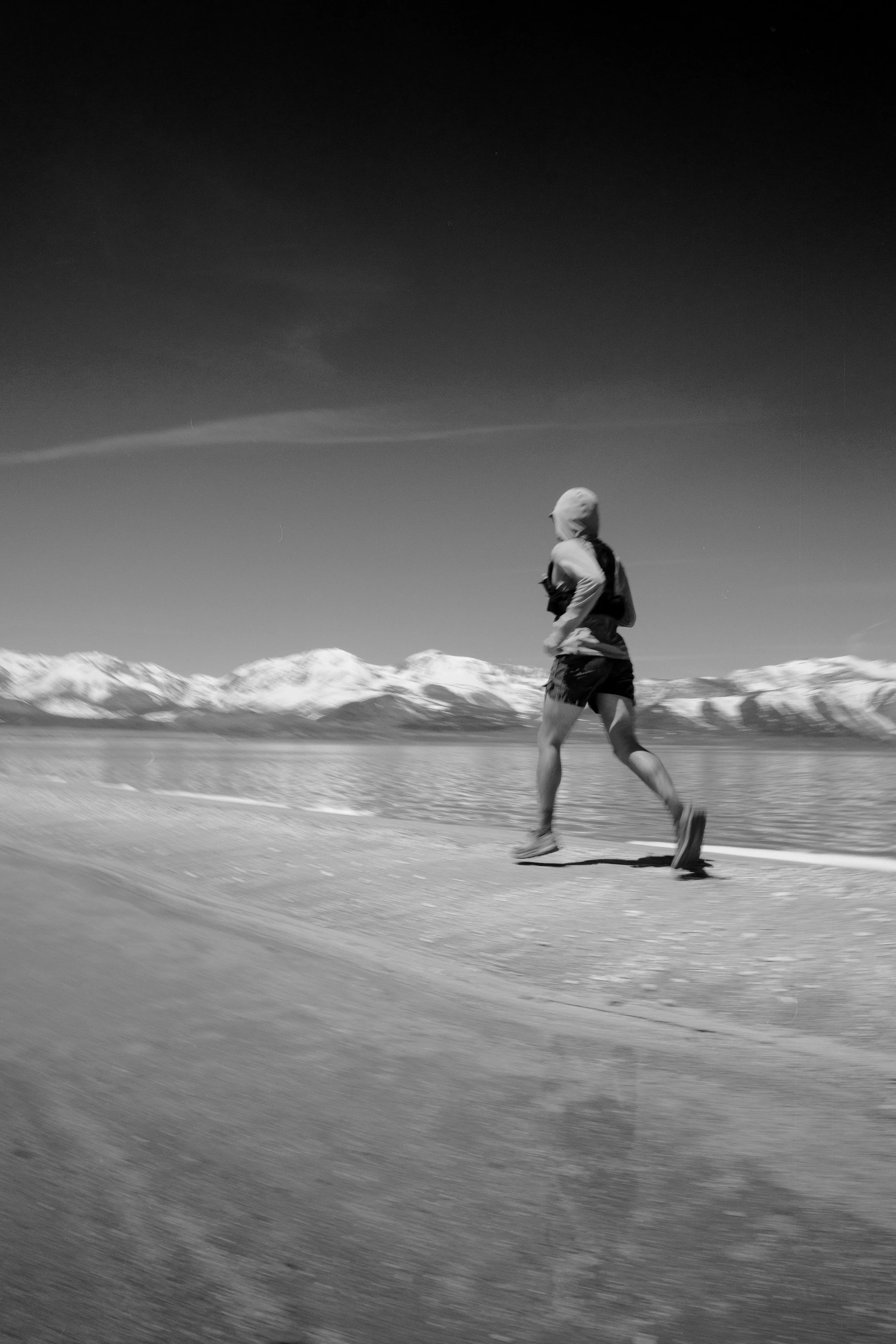
After a mile or so we begin settling into a focused cadence. Step after step becomes a drone of muscle movement. Steps syncopating with the heartbeat.
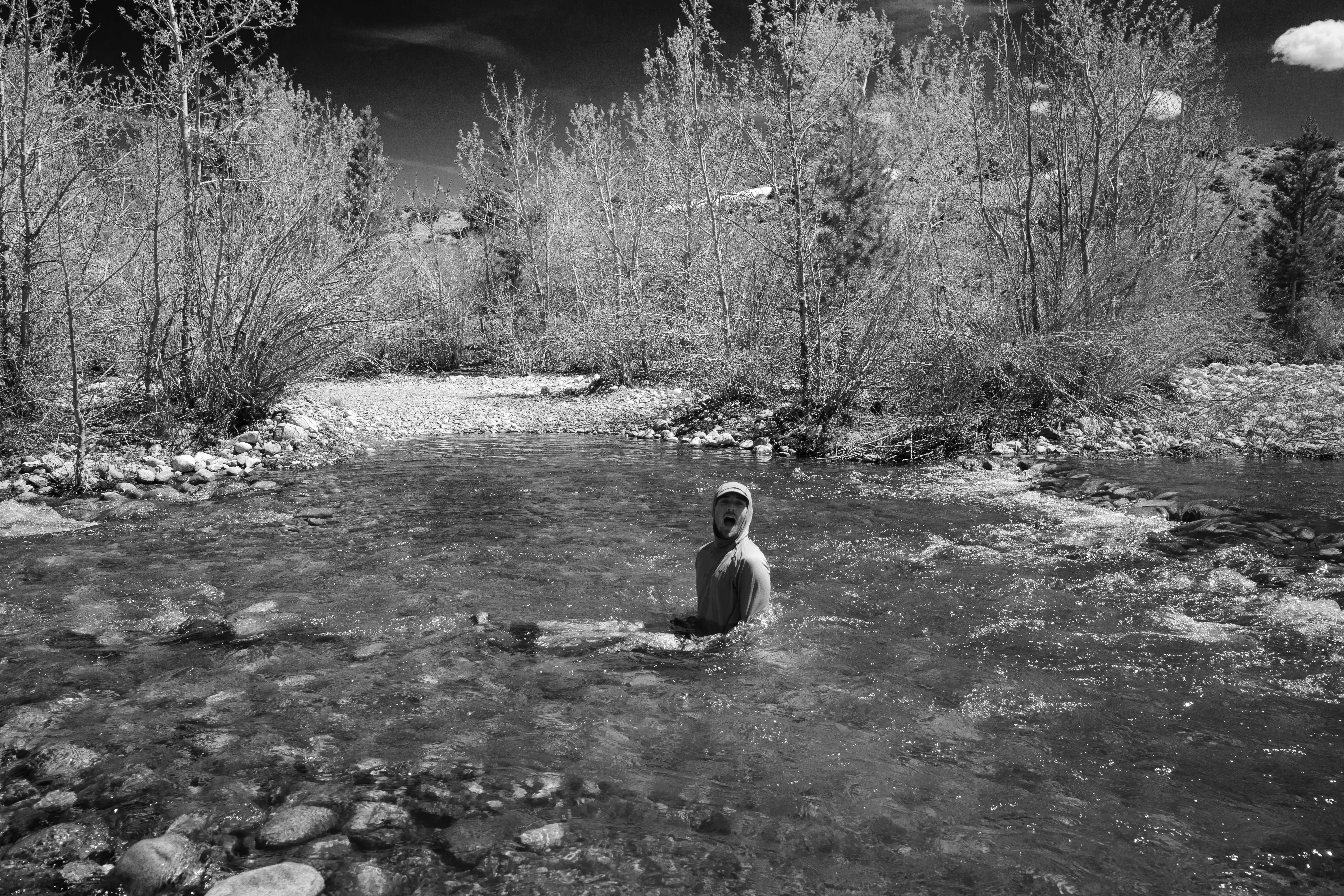
It’s beginning to get hot in the midday sun. A mirage appears; a stream of cold fresh snow melt crossing perpendicular to our path. Ethan hops in and dunks his head—an alpine baptism of sorts.
The water is incredibly refreshing, and we freeze for a few minutes before completing the last few miles of the leg. Within a mile we’re bone dry again.
The Mono Lake Visitor Center comes into view, and a beat later Spot is running our direction, leading us to the van.
3:15pm · Mile 30
We plant ourselves at a Picnic table and Lucas serves up fresh grilled cheese. Incredible. I stretch out and camel up. It’s nice to take little breaks, but each stop requires overcoming more inertia to get moving again.
This next stretch requires running a few miles of the 395. Semi-trucks barrel past us, and vans packed with families scream by. Necks turn to rubber while looking at us, in a “what the hell are they doing?” kind of way.
This is the mental crux of the day, but the views to the east over Paoha Island make up for it.
We pass the Mono Lake Inn and hook a right onto cemetery road. At this point we’re feeling increasingly sun fatigued. Pulling up to a fence, we lay down to stretch our legs.
It’s a good thing we did.
A few miles sit between us and reaching the 167—back to the start. The sand in the distance is a darker hue, and it becomes clear why;
Mud. Miles of mud.
Thick, gloppy, knee deep. The snow in the hills to the north is rapidly melting and cascading into the basin. I try to avoid it for a few hundred feet, but accept the inevitability that this is going to be messy and slow.
In a way, it’s a nice reprieve from the running. There’s no chance of efficient movement in this mud. A good excuse. Each step requires as much—if not more—energy than the pace we’ve been at, although the impact sure is reduced.
The cadence slows down the sense of time, and it drags on until finally Pole Line Road is underfoot.
It’s the final stretch, and excitement is high. After a few miles the hard pavement begins taking its toll on my feet. I slow to a walk.
So close!
With only a mile left I rally, while Ethan seemingly breaks into a sprint up ahead. Just like that, we’ve arrived back at our start, the loop now complete.
We take a moment to appreciate it, then hop in the car and head straight to Mono Cone where I order two large milkshakes. Oreo. I feel more haggard after annihilating them than I did at the end of the run!
This one was incredibly special. It’s a great line, and I relive moments of it each time Mono is in view. Either by car driving the 395 North, on an afternoon run around the south shore, skiing over at June Mountain, or when panning around the area scanning topo maps while thinking of what to do next.
The Mono Basin is an incredibly special place. If planning to be in the area, set aside a day for Mono. If not, plan a trip. Stop by the visitor center. And stop by the Mono Lake Committee. They have the best bookstore on the east side, and the history of advocacy for the lake is remarkable.
“Alright, 2:45 a.m. See you there.” The weather has been warm, creating an isothermal snowpack by late afternoon. Instead of exhibiting a temperature gradient forming cohesion, the snow becomes a sludgy soup. Unpleasant for skiing, and increasing the risk of wet loose avalanches. Spring skiing is all about chasing good timing.
The Eastern Sierra has an abundance of classic winter alpine traverses. One particular route stands out, as it connects my hometown of June Lake to the nearest town featuring a well-stocked grocery store—Mammoth. Ask any Southern Californian about Mammoth, and they will likely describe it as a premier winter sports destination. Being gratefully spoiled in June Lake with prime lift access to arguably the finest slack-country in America, my thoughts often gravitate toward avocados and kale.
Driving south on the 395 toward the town, the horizon begins to radiate a warm glow. A brilliant orange orb gradually ascends, and though only half-illuminated during its third quarter, it casts striking shadows from the Jeffrey Pine trees.
Our designated drop-off location is Mammoth Main Lodge. In a matter of hours, it will be inundated with visitors from the south; however, for the time being, it is solely occupied by us. We swiftly attach the skins to the skis, double-check all the essential gear, and skillfully dodge a snowcat grooming the flat terrain. Only then do we embark on our journey into the darkness at 4 a.m., precisely as planned.
The route traces Minaret Vista Road, leading to a well-visited summertime overlook of the Ansel Adams Wilderness. Our group settles into a steady rhythm, with one foot consistently gliding past the other, reminiscent of socks on a kitchen floor, as toes pivot around ultralight pin bindings. Deep breath. Slide. Turning off the headlamp, we watch the moon rise above the summit of Mammoth Peak.
Scarcely any time elapses before we pass the gate leading to Devils Postpile, a striking geological curiosity characterized by columnar-jointed basalt formations. These mostly hexagonal pillars were shaped approximately 100,000 years ago, when lava cooled and fractured—a relatively recent occurrence on a grander scale. Rather than descending to Postpile, the route takes a right turn and begins its ascent along the San Joaquin Ridge.
Reside in the Eastern Sierra for an extended period, and the vista of Mount Ritter and Banner Peak becomes a constant, yet it continues to evoke a sense of awe. The unusual abundance of snow this late in the season causes the moonlight to disperse in every direction, magnifying the spectacle. Our group momentarily pauses to absorb the view and settle in to the ridge.
The ridge is infamous for its windy conditions, and due to the Venturi effect, which compresses the air and lowers temperatures, a cold night can become bitterly frigid. This frequently results in the ridge transforming into a sleek ice rink—sufficient reason to carry ski crampons. Fortunately for us, the wind remains tranquil for the time being, as the incline gradually becomes steeper with crampons securely stored.
Approximately two miles into the journey, we find ourselves fully immersed in the experience. However, our focus is momentarily disrupted by something reflecting the moonlight in our peripheral vision, only for it to vanish abruptly. We feel as though we are being watched, and then a pair of eyes materializes. A coyote dashes past us and lingers up ahead, seemingly curious about one aspect or another. It must be hungry, as this winter has been particularly challenging.
As the ridge grows increasingly exposed, the wind intensifies. The cold sets in, prompting us to grab the mitts. Glancing upward, we notice a faint dot gradually brightening as it steadily moves across the sky, its azimuth passing directly overhead before continuing toward the horizon. “Look, a satellite!” In just a few moments, another one appears, followed by yet another, and then another. An entire procession of Starlink satellites travel at a consistent speed in a perfectly straight line. Observing human intervention on such a planetary scale in this setting creates a truly hyper-real experience.
To the east, above the White Mountains, a faint glow starts to spread across the horizon. This sight is undoubtedly welcome. The silhouette of the coyote appears, maintaining pace with us, most likely eager for a morsel from a Snickers bar.
Up ahead, the ridge dips no more than a few hundred feet to a corniced saddle. Removing skins would be an inconvenience, as there are no turns to be had here. Instead, our group begins side-skinning downhill. After a couple minutes, Nick pivots and straight-lines it down the remaining half! I have never seen anyone move downhill fast on skins! The flat dawn light conceals the wind-sculpted sastrugi at the base of the saddle, causing Nick to go flying, toes locked and all. With broken glasses, blood, and a grin on his face, we are all slightly stunned and laughing.
Speed record? Likely!
The day’s first direct sunlight illuminates Ritter and Banner in the distance, then the ridge ahead as it continues its ascent. The temperature rises a few degrees, prompting the group to pause and take in the view, warmth, a few sips of water, and a snack. Nick seizes the opportunity to insert the remnants of his glasses into his goggles to keep everything intact. Meanwhile, Agnew Pass, situated to the east, gradually fills with sunlight.
When attempting to describe these moments, I find myself reaching for phrases like “unreal” or “another planet.” It’s ironic, considering they are often the most real and entirely unique to our home planet.
This ridge was once slated to become part of a mega-resort, connecting the Mammoth and June ski areas with a series of nearly 20 lifts. These plans were discussed for decades, until Congress designated the area as the Owens River Headwaters Wilderness under the Omnibus Public Land Management Act of 2009—a decision I’m grateful of. It’s a reminder of the interconnectedness of things. This drainage system, feeding the same Owens water supply that has long provided Los Angeles with water.
As we reach the top of the climb, our first view of “Two Teats” comes into focus. It’s easy to guess the general area referred to here. Yeah—we intend to navigate right between them. When looking back at the distance covered, it’s evident we’ve made good progress. We’re now more than halfway there.
Over the past week, there has been significant solar activity, as springtime tries breaking through. Bald patches of ground appear on the climb ahead, and surprisingly, for a moment, an actual dirt trail becomes visible—the first of the season. But for now, it’s very much still winter. As the incline steepens and the snow hardens, the ski crampons come on, just incase.
It ends up being mild, and before long the planks come off and the group starts booting up gravel. This provides a pleasant change of pace after months of sliding around.
Upon reaching the saddle between The Teats, our first view of San Joaquin Peak comes into sight. The sunlight, now noticeably stronger, gently invites us to take a break in this sheltered alcove, and we are eager to oblige.
With feet propped up, the group discusses various exit strategies. Numerous routes lie ahead, and given the cold temperatures and stable snow, we decide to pursue a more ambitious option.
As you drive into June Lake along the 158, your gaze is immediately drawn to Carson Peak and settles directly on its north face, featuring a perfectly carved bowl—the very bowl we decide to ski. Having been a primary objective since moving to June, I am incredibly eager to drop in.
As we descend from The Teats, looking back reveals an impressive headwall. There are countless potential routes, and everyone agrees to return at a future date for further exploration. The final ascent to the summit begins, with some members of the group choosing to hike, while I decide to practice my kick-turns.
In no time, the summit is reached. This is my third visit within the past few weeks, and the view never loses its charm. We take it all in. With no real rush, we slowly remove our skins, transitioning between relaxation and preparation for a brief downhill traverse to Carson.
As the group traverses a bowl beneath San Joaquin, we ascend and cross a cornice to follow its lip toward a plateau leading to Carson. During the summer, I jogged along this same route towards Spooky Meadow after a big climb to the summit via Fern drainage. I remember thinking “whoa nelly” and imagining how incredible it would be to glide through here on skis. What took me 30 minutes to jog now takes only minutes to slide across. Winter travel has its perks.
Sufficient uphill terrain between our current location and the drop for Carson’s north bowl warrants skinning up. A large white hare darts across the alpine tundra—an incredible sight! This ascent feels more like a leisurely cruise, with the mind drifting on the gentle breeze.
Upon reaching the top of the bowl, a perfectly symmetrical view of the June Lake Loop emerges, with Carson dividing the two halves. “Wow… Wow…” From this vantage point, it’s impossible to see beyond the rollover and fully observe a route down the bowl. The snow is surprisingly firm, probably due to the strong wind from the previous evening and the subsequent low temperatures. Consequently, the group boots around, examining the area.
We agree to drop towards the right side of the bowl. After chatting with a friend who skied the line last week, we know that the exit is through some trees on the right. The bottom of the bowl cliffs out, and the firm snow means that falling is risky. Our plan is to link up with Devil’s Slide—a feature so filled in during this record snow year that it’s like a halfpipe with a 2000 foot descent.
After waiting for the better part of half an hour, it becomes apparent that the snow is not softening beyond its present condition. Nevertheless, it is edge-able, and we decide to drop.
Despite the firm conditions, skiing down the bowl is too good to pass up. Being here, skiing a line I’ve stared at so many times, fills me with immense joy and pride, even though it may not be the biggest or most exceptional by any metrics. “Here I am!”
After reaching the bottom of the bowl and above the cliff exposure, we begin our traverse through the trees towards Fern Lake. We make a few corrections along the way since the group is initially higher than necessary, but before long we pick our way through the trees and rocks to arrive at the top of Devil’s Slide.
Skiing down the slide has become almost routine for me, as this is my third time here in the past few weeks. Still, the descent never gets old. The heat of the past few days has deposited debris from several loose wet slides throughout the descent that have now firmed up and made for somewhat technical skiing. Nevertheless, we ski with all smiles the entire way down.
Reaching the runout, the group ducks into a notch in the trees and zips the flats towards my car, having staged it there several hours earlier. A series of creeks run through this zone, and the snow bridges that existed only days earlier have now collapsed. We carefully pick our way up and over a berm for a brief walk back to the car.
It was a personally monumental day, and completing the long standing objective was satisfying. I have a sierra-sized amount of gratitude to Nick and Kim for letting me link up for the tour.
In the eastern Sierra, the places are second only to the people.
This entry was written in 2020, at the start of the pandemic, and reposted here for archival purposes. Anyway, I’m not here to make a point. Just meandering after going down a TikTok hole.
This is a quick ramble about Parametric TikTok — a pattern shaped by the recommendation algorithm where creators make viral formats and bombard them w/ variation, not unlike processes seen w/ GANs and style transfer.
My favorite instance of this is Little Durag, who created a viral dance and proceeded to feed it input sourced from comments. There are plenty of other instances, including imjoeyreed. Durag stands out for how the comments are literally weighted.
“Dance at 10% with 100% emotion.” “0% dance, 0% emotion, 100% far away.” “100% dance and 100% sadness.” “10% emotion, 100% dance.” “100% right arm, 10% left arm.”
What’s interesting is the feedback loop between how parametric the creation of these videos are and the TikTok algorithm—itself a weighted system.
The killer feature on TikTok is the algorithm. The sauce determining what appears in For You, the primary surface. It’s noticeably better than anything similar, like Instagram Discover. Apps are mediums of their own. What is appropriate for one platform may feel out of place on another. The context shapes the content.
Parametric TikTok is truly native to the platform.
Parametric TikTok is a symptom of its parent platform, similar to early Mr Beast on Youtube. Let’s call it Analytic Youtube. My absolute favorite is the 2017 durational work (lol) “Saying Logan Paul 100,000 Times” in which he says Logan Paul 100,000 times over 17 hours.
Youtube is a platform aggressively shaped by numbers. Big numbers. No surprise this performed well. Today the work has 16,492,195 views. Hear me out; this shit is profound. He takes the aggregate behavior of 100,000 Youtubers and performs it in one go. Call it “The User is Present” or whatever.
We live in an increasingly parametric world. One easily consumed and shaped by models. It’s funny to think about how these TikTokers are normalizing “parametric design” in a sense.
For instance, within architecture, a site condition is established and permutations in form are generated. The design processes becomes curatorial. Many practices today are centered around these principles of parametricism in response to advances in fabrication; the tools and materials at hand.
We can say this is nothing new or novel. It’s just more evenly distributed now. In other words, fuck your process, I’m just making TikToks.
In the near future I expect to see way more ML video processing beyond face filters. The emergent behavior of TikTokers feels like a warm up for this super automated future. A convergence between inevitable functionality and what creators are making today.
Snap has shipped filters which map your face on to animations that make you dance… this is not what I’m trying to point out here. It has more to do w/ creative process and how the platforms shape the work created and shared within them.
I wonder how much of Parametric TikTok’s novelty is thanks to interpretation. If we had trained a model on Little Durag’s dance and curated the best 10 out of 100,000 permutations would it hit the same? Even assuming they were indistinguishable from the originals?
By the time it’s possible I assume the novelty will have worn off. Similar to how anyone who has grown up with the artificiality of facetune can see right through it. I am curious to see the unexpected ways these future applications of ML on platforms will continue to shape what users create and share.
Mexico to Canada on foot. Roughly 2,650 miles, five months walking north: out of the desert, up over the high Sierra, down through Oregon and on into the Cascades. Wake, walk, eat, sleep, repeat. The trail narrows the whole day down to a single task, then a single step, and you keep taking it until there’s no more north left to walk.
Peer-to-Peer Web was a series of relaxed afternoons of talks and workshops centered on decentralized publishing, creative practice, and digital archival.
Three instances were held between Los Angeles, New York, and Berlin.
Peer to Peer Web / Los Angeles
Poster (11 × 17 in) printed on a Risograph by Folder Studio
Callil Capuozzo
Contributors, sponsors, friends
Jon-Kyle Mohr, Louis Center, Callil Capuozzo, Tara Vancil, Jon Gacnik, Paul Frazee, Grace Kredell, Sam Hart, Hugh Isaacs, Laurel Schwulst, Lai Yi Ohlsen, Alejandro Matamala, Seth Thompson, Kei Kreutler, Jay Springett, Yoshua Wuyts, Cory Levinson, Georgia Hansford, Arthur Röing Baer, Calum Bowden, Mathias Buus Madsen, Cade Diehm, Harry Lachenmayer, Joe Hand, Olly Bromham, Lily Clark, Danielle Robinson, Exonemo, NYC Mesh, Bail Bloc, Los Angeles Contemporary Archive, School for Poetic Computation, Trust, Folder Studio, Are.na, unMonastery, Mazi Project, FOAM, Resonate, Liberate Science, Code for Science and Society.
This conversation with Seth Thompson and Willis Kingery was originally published in Paprika!, the broadsheet of the Yale School of Architecture and Art, in November 2018. Reposted here for archival purposes.
Jon-Kyle Mohr is a designer, programmer, and musician from Los Angeles. His work is methodical, technically rigorous, and at turns provocative or philosophical. In the past year, he has developed a tool to archive Soundcloud music on the distributed web, a bookmarking site, a blogging platform, and an interactive map of thoughts, images, and geospatial data generated from a walk through the Los Angeles Arroyo. Each project embodies an approach to radical transparency that includes open-sourcing code, hosting sites peer-to-peer, and broadcasting live question-and-answer sessions to share context and background.
Seth Thompson: We’ve been talking about the idea of producing a rendering by individually selecting the color of each pixel one by one in Microsoft Paint. This is a provocative idea as a piece of performance art … or at least process art. Why is this idea so compelling and what are the implications for all of the ways we otherwise produce digital images? Why is Microsoft Paint always a piece of software that gets referenced in relation to this kind of idea?
Jon-Kyle Mohr: I think about this from a place of consumption and creation. I grew up looking at images on screens, and have spent much of my adult life doing the same. At a certain point the image breaks down for me and I see it as abstract individual pixels. I find it difficult to design something, or take a photograph (forms of image making) without feeling those individual pixels on a screen. Same with audio. It’s difficult to record and process audio without seeing the audio as an image: a waveform. This affects my process in a certain way. This has more to do with biology and how the eye processes the environment, and less about a distinction between analog and digital methods or something of another epoch that existed maybe fifty years or five minutes ago. Microsoft Paint is jurassic in position relative to the sequence of consumer electronics and the graphical user interface. It’s a rock.
ST: I think, if I can make a generalization, that when you say you see abstract individual pixels, you’re also talking about a certain facility with signal processing? Like the ability to see a low pass filter on an audio waveform and envision what it will sound like, or the ability to see a photograph and recognize a certain desaturation in the highlights that you can intuit how to recreate with a set of curves or tone mapping. Or is there something else at play?
JKM: It’s less granular than that. Just raw perception. I know I’m looking at a grid of pixels and most of the time my brain couldn’t care less as it just sees an image, but every once in a while an awareness floats to the surface, usually when making something. It’s hard to bridge the gap between the nothingness of initiating a project and knowing its ultimate place on the screen. Why not skip the process and draw in the individual pixels, or just draw the waveform? This is of course a ridiculous idea, but a personal hangup nonetheless, and it overlaps with a semantic tripping point between “process” and “processing.”
ST: [Responding] as someone who makes websites, what is the substrate for a website? The site is not (usually) expressed in terms of pixels. Is there another unit of “raw perception” that comes into play? Is the HTML tag an equivalent? Or to put it differently, if you had to “draw” a website without any process (no wireframes or moodboards) and were forced to just output it to the screen what would that look like?
JKM: That’s sort of what I do. I don’t consider myself a designer, but I do design a lot of things, including websites. When I do, I’m always in the browser working with the native material at hand. In this case, the Document Object Model. There are never wireframes, or project-specific moodboards. So in that sense, my process is very direct from brain activity to final form. This is not particularly efficient; there are a lot of redundant motions, but it feels like imposing methodology on individual gesture is artificial. Working like this is closer to hand building, whereas wireframes/moodboards are more like creating a mold and casting the form.
ST: You’ve built a number of tools for others (I’m thinking about Cargo, Enoki, and some of the internal authoring tools you’ve built for institutions). Do you think about designing interfaces that encourage the same directness of intent from impulse to execution? To go back to Microsoft Paint, is there anything to be mined from its primitive simplicity? Or to put it differently, to what extent do you believe that your process (or we could even say nonprocess) is a personal artifact vs. a pedagogical tool.
Enoki.
JKM: In order to create a useful tool conducive to a range of possible forms it is necessary for the design process to center around defining brokenness. Consider the visual flow of a deep neural network and try to design a “user experience” around that. Untraceable chaos. My work on Cargo was never directed by any imposing methodology. It was extremely lucid. This is because I was not creating something for a specific user but creating a flexible authoring environment for a multitude of possible applications that we could never know from the onset. This is a symptom of working in the future. Creating interface for a specific client is a more focused challenge based on the experience that client brings to the table, or the context of that particular institution. I personally find that far more of a challenge than following my nose.
ST: When people talk about image consumption they are quick to jump on the idea of the “feed” as a kind of universal interface (sometimes Pinterest is mentioned, but the reference is usually used as a stand-in for every online image stream). It strikes me that Pinterest, Instagram, Tumblr, and of course Are.na are very different kinds of image repositories. How does the interface itself, the technology underlying the interface, and the community around the interface affect the experience of browsing images on any given site?
JKM: It is interesting that all of the platforms you mention share the feed in common, yet have distinctly different patterns of use and communities. There is of course no clear answer, as these are organic and emergent qualities that seem clear in retrospect but are often unknown in the moment. I guess it’s always possible to point to style. Pinterest looks lame, and that makes me uncomfortable, so I’m not going to use it. Are.na looks “lame” in a very specific way (default sans-serif typography, desaturated UI, etc.) that aligns with my sensibilities, so I will use it, and that will connect me with certain other people, and now there is a community. These things don’t just happen (a lot of work goes into it) but I question how much one can know in the moment exactly what something is. At least I don’t.
Willis Kingery: Your point makes me ask a basic question: what would healthy image consumption online even look like? The platforms you mentioned occupy incommensurate worlds in terms of content and organization, but the mode of consumption they offer is largely the same. People lament the “feed” and feel that supposedly better alternatives exist, yet every platform offers essentially the same model for looking at images.
JKM: Right now we wake up in the morning and take a hit of fresh content. Something healthier is less like getting a fix and more like something ambient. “Oh, that’s nice. Goodbye now!” The screen is a difficult interface to work with.
WK: In the life of the image-based platforms mentioned above, each seems to start as a somewhat peripheral community, but as its user base grows, they inevitably reach a kind of saturation point, where eventually the repository goes from being a rich site of discovery to a more mainstream mood-boarding tool. Can image-based platforms scale without propagating a certain sameness of content? In relation to fringe platforms I’m thinking of some comments you made to my classmate, Steven Rodriguez, about the ongoing suburbanization of the internet as a reaction to the centralization of the Valley’s platforms, how people have been seeking online “property” outside of the center of activity, and I wonder if you still see this as a trend?
Has that movement possibly opened pockets of possibility within the “urban core” of the image economy/ecology?
JKM: And just look at how well suburbia played out! Imagine the commute to your Facebook feed every morning. Yeah, I think this is also where metaphor breaks down and it’s important to abandon the analog as its core meaning fades away. The decentralization thing is really simple: you are your data, you do not own your data, you should own your data, you should not have to be constantly aware of this. To your point about community scalability, it is important to be skeptical of the growth chart. Capitalism loves a good growth chart. It’s hard to do things within capitalism without them. Looking towards urbanisation to understand this is useful but should not be taken literally.
ST: In the past year, you’ve broadcast a number of “hangs,” or livestream updates, to a community of programmers, designers, and distributed web enthusiasts who are interested in your work. In one of them, you constructed an Enzo Mari Autoprogettazione table in your backyard. What is the significance of sharing the artifacts of your working process with such an audience? Does Enzo Mari’s notion of sincerity in individual creation have relevance in an era when code, ideas, images, and even websites can be so easily copied, modified, altered, and combined?
An Enzo Mari Autoprogettazione table, built in the backyard during a livestreamed hang.
JKM: Yeah, these are awkward for me but the feedback is good, so I keep doing them. I see Autoprogettazione as less about the sincerity of an individual and more about a critique of production. Enzo is not saying, “everyone should build their own furniture to truly know it.” He’s saying, “Look, build this table. Now when you look at tables you know when one is shit and why.” Not only this, he uses plain language to communicate the ideas. A similar critique on the production of the internet would be challenging considering the difference in materiality. I have difficulty imagining what this would be if not reductionistic.
ST: It’s been said that prediction is a low form of journalism, but do you have any guesses or aspirational ideas about what images we will be viewing in the future and how we will be making or viewing them?
JKM: Prediction is the ability to know the future, but exists squarely within the past. The work being done with GANs are producing entirely new forms, but the output is a hallucination of those that exist. The future of image making will probably be variations on Deepfakes, content substitution ad infinitum. The audience and the author will continue to become one and the same.
WK: In relation to future modes of viewing and the earlier conversation about pixels and having an atomized view of every image, I wonder how we’ll navigate these shifting image worlds offered by digital platforms. Is there a direct visual parallel to this condition in some of your Are.na channels, [‘Array’, ‘Aesthetics’] and Deep Field, for example? We’ll certainly be engulfed by an ever-expanding constellation of images, but perhaps its ubiquity and banality should be embraced as a generative force. It’s overwhelming, but is there value in becoming adept at searching for anomalies in an infinite field?
JKM: For me, a lot of this comes down to who owns the data? If it all continues to centralize and we’re just using Instagram, there is very little room for speculation about possible form because it will all be dictated by them. They own the land as it were. In this era of data ubiquity you mention there is room for the truly personal “artificial intelligence” or a formalized mode of augmented cognition. We already all do this “offload your brain to the cloud” kind of thing but it’s not articulated as such. Perhaps this will manifest less as decentralization vis-a-vis localization … a continuation of today’s antiglobalist sentiment as it makes its way online. As I type I begin to care less and less about this and more about finding a good snack to eat.
Originally written for Are.na’s editorial, published August 13, 2018. Reposted here for archival purposes.
On the ground at the second Internet Archive summit for preserving the open web.
For those of us who grew up connected to the Internet, to say the neighborhood looks a little different now is an understatement. There has been unabated progress. Explosive development. Things are a little broken. The possibility of a future techno-pastoralism continues along the cliché of an epic edenic narrative… but perhaps not?
Photo via the Internet Archive
The Internet Archive is a church, both figuratively and literally. Founded by a ragtag group of custodians to the preservation of an earlier web, it’s a retrofitted place of worship whose facade is perhaps most recognizable as the white-columned favicon of Archive.org. It’s located on sacred ground in San Francisco, halfway between The Golden Gate Bridge and its namesake park. Here you won’t find any future billionaires rich off an IPO outfitted in Acronym and rolling up in Teslas. Instead, the archive is run by volunteers preoccupied with a history of people using technology to connect to each other, regardless of individual ideology or belief.
It was in the Internet Archive space that the first Decentralized Web Summit took place in 2016. In an effort to preserve the open web and evolve the discourse, the summit assembled participants inside of the sanctuary to ruminate on the theme of Locking the Web Open.
Two years have passed and much has happened. Many came down with crypto-fever. Grassroots communities interested in data-as-environmentalism sprang forth via Google Docs. America voted. Zuck (sic) went to Capitol Hill.
This year the summit moved from the church to a bank, a facade of columns in common. The substantial increase in participants and programming necessitated the additional space. The theme was similarly located elsewhere: Global Visions / Working Code.
Day One, July 31st
We left from Los Angeles as the sun was rising. After a week of 100°F+ days I found myself wondering when the “Excessive Heat Warning” will no longer be included as an exception in the daily forecast.
Interstate 5 (“The 5”) connects Los Angeles to San Francisco by cutting through one of the most productive agricultural regions of the world, which provides a significant amount of the country’s nutrition. Handmade signs line the interstate along the edges of fields, commentary on the truly scarce resource in the region.
“Food Grows Where Water Flows!!!”
The opening party was held at The Archive, and upon arrival, that particular type of anxiety produced by seeing a sea of faces a little too much like your own began to set in. The reaction is twofold; it’s unsettling to realize both how generic you are, and how homogeneous the people involved in the discourse continue to be.
With this in mind, it was perplexing to many why the kick-off party featured an interview with Mike Judge, creator of the popular HBO show Silicon Valley. Granted, the current season features the cast attempting to “drain the cloud” and overthrow the archetypical platform (Hooli) by creating a peer-to-peer protocol. Bringing the participants down a notch through self deprecation was welcome. However, shortly before reflecting on his inability to strategically manage wealth, Judge went ahead and squeezed in a quip about female underwear models and female programmers, prompting everyone’s eyes to roll in perfect unison. Judge appeared visibly uncomfortable, and so were we.
Afterwards a friend summarized her reaction perfectly, saying something along the lines of, “I sure hope they didn’t pay him to attend after having asked for a list of (and then not inviting) several POC who were unable to afford the $1400 ticket.”
My bubble of friends dispersed and we all headed off to our respective AirBnBs by taking Ubers and Lyfts after Yelping a place to eat.
Day Two, August 1st
The day began in the courtyard with an introduction from the organizers and a playful exercise in networking by Taeyoon Choi before his Distributed Web of Care workshop. At any given moment several workshops, panels, or talks were happening concurrently. Although the intent was to meander more, I quickly realized which rooms contained the programs I found fascinating, and frequented those. (The hardcore cryptography workshops and panels on governance were simply outside my generalist range of understanding.)
Photo via the Internet Archive
First up was a workshop on Beaker Browser, an experimental browser that supports the peer-to-peer Dat protocol. It was my first exposure to p2p publishing several months ago, and is the environment I find most enjoyable to work in.
Just down the hall were Laurel Schwulst and Kyle Mock with their p2p2p2p workshop, which guided participants through publishing a personal website on the peer-to-peer web with Beaker Browser. Participants completed a short survey about “virtual houses” to generate content that would populate their new personal sites. It included questions such as what happens in your space, and who is there? Laurel and Kyle then provided a simple template site to fork, and we customized our cyber-abodes. In an age of personal brands, there’s a clear richness to understanding personal online presence through the lens of domestic space and how we inhabit it.
Afterwards I wandered down to the basement of the bank. Tucked into one of the vaults was Distributed Gardens, a site-specific installation designed to exhibit the technical and creative output of the summit. It also functioned as a critical breath of fresh air, as the room was mostly occupied by fellow misfits.
My day rounded off by catching a surreal interview of Ted Nelson by Are.na co-founder Charles Broskoski, which began with Ted theatrically checking his mic by reciting a full several minutes of Hamlet from memory. Charles asked about Ted’s Xanadu project, the perpetually-in-progress origin of hypertext and precursor to Hypertext Markup Language (HTML). One question that stood out was that of being burdened by a good idea. There is a certain weight in feeling the responsibility to execute. To solve problems.
Next was a lively conversation between hypertext researcher Cathy Marshall and the musician and journalist Claire L. Evans, during which they reminisced about early hypertext culture and non-linear poetry; the social stigma attributed to contracting for the CIA; and other memories of Cathy’s time at Xerox PARC. At the end Cathy quipped on what her mother’s reaction would be to her speaking in front of an audience with unbrushed hair. “But it’s important to be authentic.”
Ted Nelson and Charles Broskoski
My day ended back down in the garden basement with many others from the creative track, a portion of programming that grounded decentralization in creative thinking. Co-organized by Mindy Seu and Sam Hart, it involved many familiar faces from the Are.na community. The number of talks, panels, and workshops at first appeared overwhelming, but ensured everyone had some way of fitting in, something I was thankful for.
Day Three, August 2nd
The previous evening’s festivities had me running a bit behind, and I arrived back at the bank around 10:30 am. After some coffee and reconvening with others in the basement garden, I headed upstairs to attend the “Internet as a City” workshop.
Organized by a group of students and teachers from MIT’s Media Lab and Architecture departments, the workshop viewed network connectivity through the lens of the built environment. From the workshop webpage:
If the Internet were a city, what would be its roads, buildings, and parks? How do people, businesses, and governing bodies produce insights into the qualitative characteristics of distribution beyond the tired triptych of centralized, decentralized, and distributed?
Network as environment. This has been on my mind a lot, as it has many others. Is it possible to set aside digital areas as open space, similar to public parks surrounding urbanism?
The "Internet as a City" workshop
The workshop involved three exercises, the last of which required the use of a few hundred cardboard boxes of varying shapes, colors, and sizes, all having been laser-cut at MIT and flat-packed in luggage to the summit.
Everyone reassembled into new groups of five and was delegated a collection of cardboard blocks and colored paper. Each participant in the group had to pick from a stack of cards that would assign them a responsibility: the state, the private interest, the user, the architect, the anarchist, etc. Each member would take a turn in constructing the city by placing a few blocks and explaining the rationale.
Collaboration and friction between members emerged, and quickly spread to other “cities” throughout the room. Some built close to the masking-tape river, others built public parks, and there were even a few toll-roads.
We took a break and evaluated our progress by sharing our processes. One group put most of their effort into building the tallest structure in the room, a narrow cardboard skyscraper reaching several feet. It’s role was that of panopticon, sucking up data and piping it back to partner cities.
The mood was jovial (it was play) but ultimately the cities took a very centralized form. Perhaps these monolithic tech platforms we are so critical of are not so much out to get us, but rather are the manifestation of these same decisions being scaled up. It’s all fun and games, relatively speaking.
“Your task is to now decentralize the cities.”
"internet as a City" participants
Some cities began talking to each other in attempts to broker agreements amongst themselves. Others went straight to the panopticon tower to set up remote locations in an effort to reduce the height of the tallest structure. One began investing in missiles.
The workshop acted as a sort of therapy. Rather than construct a utopian city built upon a foundation of decentralization, most participants seemed to LARP what they perceive around them in their daily lives, exaggerating the wrongs to a comedic degree. “Let’s gentrify the areas around the train station to raise rents!”
After the last of the sessions many of us in the basement garden went out for burritos. Later we migrated to a mansion near Nob Hill for an after party. Perched high above the city, we sat around and drank, surrounded by a panoramic view of downtown. A book on the shelf next to the grand piano detailed the nuances of navigating life as a founder. How to keep your money. How to grow your money. How to learn who to trust. It felt like a continuation of the somewhat dystopian outcome of the workshop earlier that afternoon: You are the tech billionaire outfitted in Acronym who drives a Tesla.
Day Four, August 3rd
We left late in the morning for the drive back to Los Angeles, this time opting for the slower route down Highway 1 (“The 1”). It had just reopened after a section was taken out by a landslide more than a year ago.
The drive along the coast takes several more hours than driving up The 5. There would be plenty of time to reflect on the past few days.
Nearing the city’s edge, we hit dense fog along the coast, and it would stay with us in patches the rest of the trip. My path through the summit felt similar. We talked about how there was a heavy amount of solutionism hanging over the summit. “In the future we will look back on someone, somewhere, who while at the summit wrote on a napkin the solution to save the world.” This attitude feels somewhat dated considering the state of the industry. To say these issues are to be solved by technology is naive at best. At moments during the summit, it was difficult to see through the clouds of hype, but it was encouraging to encounter those who continue quietly doing the work to understand these complicated issues comprehensively.
There is always palpable energy coming off a gathering of people this size who share a common goal. It creates a sense of infinite possibility, which I believe to be accurate. But what happens the next day, week, month, or year? What do we do with that inertia?
Members of the Are.na team and I have had conversations for some time about ways in which to progressively introduce parts of the peer-to-peer web to the platform. Even when your intentions are to make the Internet a better place, many questions still arise when considering the possibility and how it relates to actually making something. Does the common person care about data ownership? Is the time better spent elsewhere solving less esoteric problems? Is the timing right? Is the culture there? This is to say nothing about the pragmatics of making a company financially sustainable, invisible geopolitical forces at play, etc…
Ultimately the realities of these questions are slowly revealed only through active engagement. At a moment overwhelmed by speculation, a thoughtful gesture goes a long way. That is to say, progressively gaining understanding through experience.
We continued our drive south towards Los Angeles, the fog thickening during sunset. When considering the seemingly infinite variables affecting the peer-to-peer/decentralized/distributed movement within the environment at large, the summit appears to me as an atmospheric condition. A high pressure system pushing through an upper level low.
Jon-Kyle Mohr is an independently curious navigator of the open web.
I was the founding design engineer at Cargo Collective, now known simply as Cargo.
Cargo is a personal publishing tool for creative practice. As the first full-time hire, I contributed to everything — conceptualization, interface design, front-end programming — and wore many other hats, as you might imagine.
I joined at age 19 and moved to Los Angeles. Memories of getting kicked out of bars when trying to grab a post-work drink come to mind. We worked out of a room in a craftsman house in Angelino Heights, and later a studio along the Los Angeles river in Frogtown.
For a number of years, joining Cargo required an invitation or an application: a single open-ended textarea prompting a description of your practice. Some people wrote a sentence, others wrote paragraphs. Each one I personally reviewed, and most I responded to. I would generate an invitation, copy a template in the macOS Mail app, paste the link in, and occasionally write something personal about the work. I sent tens of thousands of invites by hand over several years.
These years were personally foundational in many ways, greatly informing how I see the world, and where I find motivation and meaning within it.
This interview was conducted by Geoff Manaugh and Nicola Twilley, originally published to Venue in 2012 and republished by The Atlantic in September 2013. Reposted here for archival purposes.
Geoff Manaugh and Folkert Gorter at Superfamous HQ.
At the risk of seeming recursive, Venue stopped by Superfamous, the Los Angeles-based design studio behind our own graphic identity and website, to discuss the architecture of the Internet and the process of exploring and expanding its potential with Dutch interaction designer Folkert Gorter and developer Jon-Kyle Mohr.
As the co-founder of online networks and creative communities, such as Space Collective, Cargo, and but does it float, Gorter’s perspective on the Internet is deeply influenced by the sixties-era counter-culture in which the early web’s artist-engineers were immersed. The design projects he regularly features on but does it float, in addition to his own quite stunning photographs, often feature other-worldly landscapes, surreal geological forms, computer-generated geometries, and more, as if part of a visual quest to uncover the programming and code beneath the forms of the world, the frustratingly inaccessible HTML behind planets, continents, oceans, and skies.
Mohr, meanwhile, comes to programming from a lifelong background in drumming and sound art; he pointed out, after our interview, that he had more or less grown up inside a recording studio. Like Gorter’s formal interest in extreme landscapes, Mohr’s musical tastes veer toward patterns, mathematics, and code, finding unexpected polyrhythms through experiments with wires, electricity, and back-of-envelope calculations.
Our conversation ranged from psychedelic science fiction to scroll bars and the future of skeumorphism, all the while asking what it means to inhabit virtual space.
Space Collective, “a cross-media information and entertainment channel for post-ideological, non-partisan, forward thinking terrestrials,” was co-founded by filmmaker Rene Daalder and designer Folkert Gorter.
Folkert Gorter, Jon-Kyle Mohr, and Nicola Twilley at Superfamous HQ.
Geoff Manaugh: Folkert, we were joking on the way here about something you said in an interview once on Los Angeles, I’m Yours. Back in 1994, apparently, you had the realization that you were going to dedicate your life to the Internet.
Folkert Gorter:[laughter] I can’t believe you read that!
Manaugh: Where did that realization come from? What made you want to work in online design?
Gorter: I was at the School of Art, Media and Technology in Utrecht, one of the first schools in Europe that took the virtual, digital revolution kind of seriously, although it wasn’t a revolution yet, but its emergence. They brought in a lot of conceptual thinkers to talk about, well, it was not really the Internet back then. It was more like CD-ROMs, multiple-ending films, parallel storylines, and so on.
It was interactive thinking: where information technology meets interface design meets art and education. The more conceptually inclined people who were professors at these schools were almost psychedelic, I think. They came straight out of the sixties and seventies counterculture in California.
New posts gallery, Space Collective.
As interactive design went online, these people who I really identified with, these artist-engineers, were the ones who were asking how they could put their stuff online. And they started making art specifically for what was possible: the basic things that you could do in the rudimentary browsers at the time, like Shockwave and animated GIFs and trying to figure out how you can scroll more than the height of a browser to show more content.
I think that group of people, who first came to the Internet as artist-engineers, completely set the tone for what the web is now. For example, browser standards are totally based on what was being pushed back then, in terms of multimedia content.
Diagram showing the relationship between identifier, resource, and representation, from Architecture of the World Wide Web, Volume 1.
Nicola Twilley: Are you implying that the Internet could be quite different today, if different kinds of people had been experimenting with it at the start?
Gorter: Right. That’s what I think. Take, for example, blogging. I think blogging probably became popular simply because it became possible to scroll vertically in web pages.
Before blogging, before vertical scrolling, there was a 640-by-480 screen, and everything that didn’t fit had to go below the fold. That was a disaster, because people couldn’t scroll, which meant you had to make all sorts of new interface artifacts (“previous” and “next” buttons, page folding, and God knows what else) until people finally said, “Screw it. We need scroll bars.”
That’s why I call them artist-engineers, because they were making a medium that was able to carry what they wanted to express.
Of course, scroll bars already existed. They were carried over from all the other OS technologies like Windows, which is why they also get really high system priority: the mouse and scroll never lag because they’re driven directly by the operating system. It wasn’t that the concept of scrolling was new, but it was definitely one of the innovations that was necessary at the beginning of the web in order to push the amount of content that you could show on sites.
Scroll bar design, Chris Norström.
Gorter: The scroll bar is a great device: I have always been most excited about it as my main user interface device. Way back, I started experimenting, along with a whole bunch of other people, with making scrolling interfaces. I would put up a ton of content, but you couldn’t see all of it. It was as if the browser was the viewfinder of a camera, and, instead of moving the viewfinder, you could just scroll the page.
Manaugh: Based on some of the images and quotations that you put on but does it float and Space Collective, from people like Timothy Leary and Terence McKenna, as well some of the things you’ve said in the past about wanting to see how human culture could move online, there seems to be an overlap between your interest in information technology and an almost psychedelic interest in things like the “Singularity.” I’m curious as to how those two strands weave together for you, if one led to the other.
Screengrab, Jon-Kyle Mohr.
Screengrab, fluid simulation with Turing patterns, linked by Folkert Gorter.
Gorter: I’m really glad that you picked those things out. Those are the peaks of the landscape that I try to hang out in, pretty much. The web is a space of infinite potential, especially when I first met it, and it has not been charted. We can only go as far as our current interfaces and technologies let us go, in the same way that human language gives us a territory in which we can dwell, and it’s almost impossible to get outside of that.
I’m really excited about trying to make that space bigger: to create more land, as it were, the way the Dutch use ever more sophisticated technologies to pump out water and now we can live on the sea floor.
To bring that back to the psychedelia thing: for me, that feeling when you dive below or beyond or above language, when you’re in that zone, that is very much akin to being on the Internet. You can be somebody else. You don’t even have to be a human. You can speak using media.
Artwork by Anton van Dalen, posted to but does it float?
Gorter: Do you know the book Starmaker, by Olaf Stapledon? At one point, the narrator has evolved so far that he’s using the brains of different organisms as hosts. He’s sharing the minds of a flock of birds sitting on some mountainside, describing the amazing sensation of feeling an entire mountainside through a collective, distributed mind. He says (and I’m paraphrasing) that it was almost as though a blind race, through technology, could have invented organs of sight.
Manaugh: He was using the birds as a browser.
Gorter: Right. The Internet is a sensorium in the same way. Thinking about it as a biological, technological extension makes a lot of sense to me. What’s mainly interesting to me, at least right now, is that you don’t carry the limitations of the body with you in the virtual domain.
Twilley: So the limitations of this virtual world come from our interfaces: both the hardware and the software. Can you give some examples of things you’d like to do but can’t because of these kinds of technological limitations?
Jon-Kyle Mohr: Some of the stuff that we’re starting to explore right now is only possible because today’s browsers are capable of enabling it. Before, there were technological obstacles like latency. Latency is the bane of my existence. If you do something, you want to feel as though you’re affecting it, and not that there is a 15-millisecond lag: that there is latency. That’s what’s so great about your phone: you flick it and it responds immediately. It feels like you are actually manipulating it.
To give another example: right now, everything uses the metaphor of a page. We’ve been playing around with Z-space, that is, breaking out of the metaphor of a page and moving into three dimensions, the X, Y, and Z axes, but still within a browser. People have been playing around with how to represent three dimensions forever, but figuring out how to do that within the interaction history of the browser is particularly interesting.
Screengrab, gallery, Space Collective.
Artwork by Anton van Dalen, posted to but does it float?
Gorter: Virtual reality has been the frontier forever, and people have thought about it as if you were walking into a big sphere or you were wearing goggles and all of that. But, to me, thinking about virtualizing ourselves is much more interesting if you think about expanding what is possible online.
True Names, by Vernor Vinge, is a really great book to read on this subject. He lays down a lot of amazing metaphors for inhabiting cyberspace.
I mention that because what we’re trying to do with a Z-space interface is reintroduce the whole notion of the peripheral. Part of it is to do with the Tumblr and Pinterest thing: all these people posting millions of images and the way that styles seem to emerge from that stream.
If we compare vertical scrolling in blogs to driving in your car in a landscape, what we want to do now is lift off and be able to see all these image feeds, for example, as geological strata. If you’re flying above the landscape at 30,000 feet, there’s stuff to see, stuff you can’t see from your car window. That’s how we want to enlarge or expand the interface.
Flickr gallery, Folkert Gorter.
Gorter: What we’re talking about now is really more of an actual environment, in which everything you see informs how you see the things around it. That’s one thing we want to accomplish with this interface, so that when you’re looking at one visual, you can also see it as part of a pattern: you can see all of its connections.
Back in the early days of the Internet, these artist-engineers I was talking about pushed for browsers to be able to handle what they wanted to do. We still have that power. Whatever the W3C sets as its standards is just based on what people want. With the whole web 2.0 fiasco, let’s be honest, it’s as if people stopped really pushing new things, because everyone was just happy together, using Facebook and Twitter and pushing their shiny social buttons.
But we need to keep pushing new stuff. It’s a really delicate process, because if you push too far, then it’s going to be clunky and no one’s going to be able to use it; but, if you don’t push far enough, there’s not going to be any change and it will never catch on.
Folkert Gorter and Jon-Kyle Mohr at Superfamous HQ.
Mohr: It’s an accessibility thing. You have to make sure that you’re still innovating, but that you’re not excluding everybody from that innovation.
Gorter: Because if you’re excluding everybody, then there’s no critical mass.
Mohr: Degradation in digital design is also really interesting: it’s almost like time-travel, in a way. If you try to look at the Wired website on a browser that was last updated four years ago, it’s going to look like hieroglyphics.
Jon-Kyle Mohr working on a sound installation.
Manaugh: Jon-Kyle, you’ve done a lot of sound-related work. How does that relate to your online design?
Mohr: There’s a lot of overlap. A lot of sound design is just designing space, and directing the ear’s attention to certain things: how you use one rhythm to offset something else, for example. Then, all the looping and cloning translates to pagination and scrolling really well. It’s all math.
Gorter: I remember you saying that you credit being able to program to being a drummer.
Mohr: Totally. They’re both additive and subtractive processes. They use the same metaphors. They loop and repeat in similar ways. It’s actually kind of funny, because, ever since I started to do a lot of the programming with Cargo, it’s influenced how I perceive music now, as being much more programmatic.
Twilley: I love this idea of useful metaphors. If the browser is to be more than just a “window” and the web is to be made of more than just “pages,” where else might you go to find new metaphors that could expand what we can do online?
Mohr: Those are great questions. Skeumorphism was such a hot topic last year, and it was that exact same question, asking about the extent to which you need to be literal with your references versus the extent to which you can be more free and abstract.
Apple's skeumorphic calendar design.
Gorter: I think the way we get around this is that we try to not make a specific interface. Instead, we always use the content as the interface. This is how we always design. In Cargo, there’s no design, there’s just content. You click on a thumbnail, but the thumbnail is just a smaller representation of the project.
Essentially the browser is the canvas, it is the design, whereas, with a lot of web design, you see people making designs inside the browser, like a box inside a box, and then shading here, adding a bar there.
But we don’t do that. We try to disappear.
Twilley: You’ve described Cargo as not social but rather collaborative. That difference between closed and open, complete and unfinished, is really interesting. There are actually not a lot of middle spaces on the Internet that manage to straddle that division, whereas Cargo is populated by user content but still feels aesthetically coherent.
Gorter: I think, again, that’s because the design is the way the interface works, rather than being some kind of overlay.
Even if you completely disassociate your personal site from the platform, the brand is the interface. We care so much about the feel and the behavior of the interface (when you click something, something happens to bridge the waiting time between the click and the response, and the typography is always properly in proportion) that it still feels like Cargo, at the end of the day, no matter what it looks like.
Screengrab, gallery, Space Collective.
Gorter: You’re in a structure, but the only things you see are content.
Twilley: Most of the time, when you enter a social network on the Internet, the structure is very visible. If you’re on Facebook, for example…
Gorter: Everything is a dull blue. [laughter]
Twilley: It seems to me that you could maybe split the Internet between broadcast and community. Those two different kinds of platforms have very different design aesthetics.
Screengrab, Cargo Collective gallery.
Gorter: I think that’s true. We are always trying to find out where we are, between those two poles.
We’re now working on something called trace-marking. It essentially started as favoriting images across the Cargo platform. It’s one of a few attempts we’ve made to go a bit more into the community direction. The thing about Cargo is that, although our community is definitely there, it’s built on people digging how we do stuff, then trusting us with their material.
We have implemented a few community things, though: you can follow people, and there’s internal commenting. We built that functionality for student networks that we’re now running with UCLA and Art Center College of Design, and a few other places.
This new trace-marking thing is a way to visually connect. If you see an image you really like, you can save it in your own space and you can create categories for how you want to save it, whether it’s for reference or simply to tell somebody that you love their image. It becomes a visual collection tool mixed with a book-marking functionality.
Tableau de l'Histoire Universelle depuis la Création jusqu'à ce jour, 1858, posted at Bibliodyssey, posted to but does it float?
Gorter: But this is really early days. We always let the process determine the outcome. Today, Jon-Kyle made the first steps: you drag an image, a little shelf opens up, you put it there… So now we have to figure out: what’s next?
Twilley: It seems as though images are the quickest thing to get detached from their source online.
Gorter: Exactly. That’s always bothered me! Tumblr does a great job of showing the thread of reblogs, but then no one gives a fuck about who made the original image. Creating that kind of trace for images is important.
Manaugh: Our final question, just to bring it full circle, is about the process of working on the Venue website, and whether that allowed you to explore any new territory. Perhaps it did, perhaps it didn’t.
Mohr: The integration with Google Maps for Venue was really fun. I had never used their API. We’re actually starting to work on an API for Cargo, and working with Google Maps’ API for Venue really influenced how I’m approaching that.
It was also really fun to play with spatiality. Google Maps is already interesting in terms of its Z-space functionality: the way that you can zoom in and out in satellite view, and we spent a long time playing around to find a comfortable zoom level for Venue, and so on.
Screengrab, Jon-Kyle Mohr.
Gorter: It was a great project for us, I think, because we’re always looking for excuses to extend Cargo’s functionality. The only reason we make new stuff for Cargo is in response to a specific request. We never say, “Hypothetically, people would love such-and-such new feature. Let’s make it!”
And, because we don’t design websites (we don’t make layouts, we just put content in), the Google Maps integration is not simply decoration. It’s actually integral to how the site works. What I really love about what we accomplished was that we put the Google Maps in there, but we imposed the Venue aesthetic over top of it.
We’ve done projects with Flash before where we work the same way. The problem with Flash is that it’s like an aquarium: all the content sits behind a thick layer of glass. You can’t touch it; you can only look at it. It’s imprisoned. What we’ve done is use Flash in a new kind of way, as a background environment, and then put a flat HTML layer over top of it so that you can interact with as if you were interacting with any website.
Now, if you guys do another iteration of Venue, we can imagine even more integration. Come back in 2014, and we’ll talk!